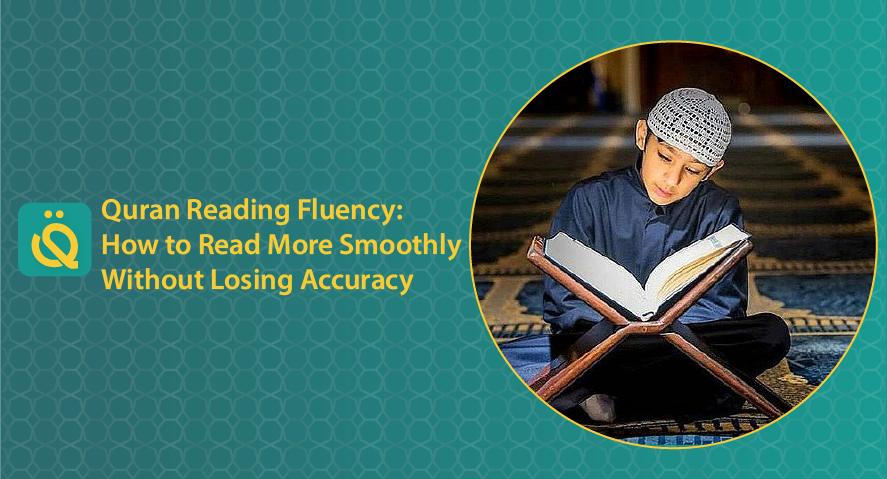
Quran reading fluency means being able to move through Quranic text with fewer unnecessary pauses while keeping letters, vowels, and words accurate.
It does not mean reading as fast as possible.
A learner may know Arabic letters and understand basic reading patterns but still pause after almost every word. Another learner may try to read faster and begin losing vowels, pronunciation, or Tajweed that was accurate at a slower pace.
Both situations show the same thing:
Fluency should grow without sacrificing accuracy.
The goal is to make Quran reading increasingly smooth, connected, and independent while protecting the quality of the recitation.
This guide focuses on that transition.
Quick Answer: What Is Quran Reading Fluency?
Quran reading fluency is the ability to read Quranic text with increasing accuracy, continuity, and independence.
A fluent reader does not need to rush.
Instead, the learner gradually becomes able to:
- Recognize familiar reading patterns faster
- Decode unfamiliar words with less hesitation
- Avoid unnecessary word-by-word pauses
- Keep basic pronunciation stable while reading
- Recover from a difficult word without losing the whole phrase
- Read longer passages with less teacher prompting
A useful way to think about Quran reading fluency is:
Accuracy first → smoother recognition → connected reading → greater independence
If you need the broader learning roadmap before working specifically on fluency, begin with How to Learn Quran Online.
If basic letter recognition, connected forms, Sukoon, or Shaddah are still unstable, strengthen the foundation first with the Noorani Qaida Online: Complete Beginner Guide.
If reading is already stable but pronunciation and recitation rules are the main difficulty, continue with Learn Quran Tajweed Online: A Complete Beginner Roadmap.
Quran Reading Fluency Is Not the Same as Reading Fast
Speed is easy to notice.
Fluency is more subtle.
A learner may finish a page quickly but:
- Drop vowel sounds
- Guess unfamiliar words
- Lose clear letter pronunciation
- Ignore natural stopping points
- Depend on memorized passages
- Make more mistakes as the pace increases
That is not strong Quran reading fluency.
Another learner may read more slowly but maintain accurate decoding, connect familiar phrases naturally, and correct a difficult word independently.
That learner may actually have the stronger foundation.
| Reading Pattern | What It Looks Like | What It Usually Means |
|---|---|---|
| Fast but inaccurate | Few pauses but frequent mistakes | Speed is ahead of control |
| Accurate but very broken | Correct words with constant stopping | Accuracy is developing but continuity is weak |
| Smooth only in familiar Surahs | Strong familiar recitation, weak unfamiliar reading | Memory may be supporting the reading |
| Accurate and increasingly connected | Fewer pauses without rising errors | Fluency is genuinely improving |
The question should therefore not be:
How fast can I read this page?
Ask:
How smoothly can I read it while keeping the text accurate?
What Does Strong Quran Reading Fluency Look Like?
A useful fluency framework has four parts.
1. Accuracy
The written text is being read correctly.
Fluency built on repeated guessing is unstable.
2. Continuity
The learner can move through short phrases without stopping after every word unnecessarily.
3. Independence
Less teacher prompting is needed.
The learner attempts the word before waiting for the answer.
4. Transfer
The same reading ability appears in an unfamiliar Quranic passage, not only in a page that has been repeated many times.
| Fluency Dimension | Question to Ask |
|---|---|
| Accuracy | Is the written text being read correctly? |
| Continuity | Can short phrases be read without unnecessary breaks? |
| Independence | Can the learner attempt difficult words without immediate prompting? |
| Transfer | Does the same ability appear in unfamiliar Quranic text? |
These four elements belong together.
Accuracy without continuity can remain very slow.
Continuity without accuracy becomes rushing.
Practice without independence creates reliance on prompts.
Familiar-page success without transfer may hide weak decoding.
Why Can Quran Reading Stay Slow Even After You Learn the Basics?
Knowing the letters is only the first stage.
Reading may remain slow when the learner still needs extra time to process each word.
Common causes include:
- Recognizing letters one at a time
- Rechecking vowels repeatedly
- Weak recognition of connected forms
- Hesitating before unfamiliar combinations
- Depending on a teacher to begin the word
- Reading only familiar Surahs
- Stopping after every word out of habit
- Trying to apply too many corrections at once
Slow reading is not automatically a problem.
The important question is why the reading is slow.
A learner who is carefully decoding an unfamiliar passage may simply need practice.
A learner who has been reading for years but still waits for prompts at every difficult word may need a more targeted diagnosis.
The dedicated article Why Can I Read Quran but Still Read Very Slowly? will focus on those causes in detail.
If the problem is caused more by repeated reading behaviors than by one specific skill gap, continue with Common Quran Reading Habits That Slow Down Progress.
How to Improve Quran Reading Fluency Without Losing Accuracy
Improving fluency works best when the difficulty increases gradually.
Step 1: Choose a Short Passage
Use a passage long enough to reveal reading patterns but short enough to repeat without fatigue.
Step 2: Read Before Listening to the Full Answer
Attempt the text first.
If the learner always hears the complete recitation before trying, it becomes difficult to know whether they are reading or copying.
Step 3: Mark the Real Hesitation Points
Do not treat the entire passage as a problem.
Identify where reading actually breaks down.
It may be:
- One connected form
- A difficult vowel pattern
- A long unfamiliar word
- A repeated stop before certain combinations
Step 4: Correct One Priority
Fix the error that most interrupts accurate reading.
Avoid stopping the learner every few seconds for unrelated details.
Step 5: Read the Phrase Again
The corrected word should return to its context.
Fluency is built in connected reading, not only isolated exercises.
Step 6: Test the Skill Somewhere New
Use another phrase containing a similar reading challenge.
This shows whether the learner understood the pattern or simply remembered the correction.
For a deeper transfer method, continue with How to Practise Unfamiliar Quran Passages Without Memorizing Them.
A Simple 10-Minute Quran Reading Fluency Routine
Fluency practice does not need to become a long daily session.
A focused routine can look like this:
| Time | Practice |
|---|---|
| 2 minutes | Read a familiar short passage accurately |
| 3 minutes | Attempt a short unfamiliar passage |
| 2 minutes | Isolate one difficult reading pattern |
| 2 minutes | Read the complete phrase again |
| 1 minute | Test the correction in another example |
The exact minutes do not matter.
The structure does.
A useful session moves through:
familiar reading → new reading → correction → connected rereading → transfer
If the learner begins guessing or accuracy declines sharply, extending the session may not help.
When you are unsure whether another repetition is useful or whether the learner should move forward, continue with When Should You Repeat a Quran Passage and When Should You Move On?
Once short practice remains accurate and focused, the next challenge is extending reading duration without allowing the quality to collapse. That is the focus of How to Build Quran Reading Stamina Without Losing Accuracy.
How Do You Stop Reading Quran Word by Word?
Word-by-word reading is normal during early learning.
The problem appears when every word remains isolated even after basic decoding has become stronger.
Consider this pattern:
word → stop → word → stop → word → stop
The learner may know each word individually but has not yet developed phrase-level continuity.
To improve this:
- Read two connected words accurately.
- Repeat them without an unnecessary pause.
- Add the next short phrase.
- Keep the pace controlled.
- Pause where the text naturally requires it, not simply because another word begins.
Do not force long phrases before the learner is ready.
The aim is to gradually increase the amount of text that can be read accurately in one connected attempt.
The dedicated guide From Word-by-Word Reading to Connected Quran Recitation will take this transition further.
Why Guessing Quran Words Can Make Fluency Look Better Than It Is
Guessing can create the appearance of speed.
A learner may recognize the beginning of a familiar word and complete it from memory without reading every written pattern carefully.
That often works in familiar Surahs.
It becomes obvious in unfamiliar text.
A simple test is:
Give the learner a short passage they have not recently practised.
If reading becomes dramatically less accurate, familiar-text memory may be doing more work than independent decoding.
The goal is not to remove familiarity from practice.
It is to make sure fluency can survive when the passage is new.
For this specific problem, continue with How to Stop Guessing Quran Words While Reading.
If familiar Surahs sound significantly stronger than unfamiliar Quranic text, the dedicated article Why Familiar Surahs Can Hide Weak Quran Reading Skills will help separate memorized recitation from independent reading ability.
What Happens When Tajweed Disappears as Reading Gets Faster?
This is common.
A learner may pronounce accurately at a slow pace, then lose some of that control when trying to read more quickly.
That usually means the skill is not yet automatic at the faster pace.
The answer is not necessarily:
“Read even faster until you get used to it.”
Instead:
- Return to the speed where accuracy is stable.
- Identify the correction that disappears first.
- Practise it inside a short phrase.
- Increase pace gradually.
- Check whether the correction survives.
Detailed Tajweed rules belong to their own articles.
The fluency question here is simply:
Can the learner maintain the correction while reading more continuously?
The dedicated article Why Does Tajweed Disappear When You Read Quran Faster? will own that problem in full.
Accuracy vs. Fluency: Which Should Come First?
Accuracy leads.
But that does not mean learners must wait for perfect reading before practising fluency.
If every minor error stops the entire passage, connected reading may never develop.
A better approach is:
protect essential accuracy → allow the phrase to continue → correct the priority issue → reread
| If You Notice… | Give More Attention To… |
|---|---|
| Frequent decoding errors | Accuracy |
| Correct words but constant unnecessary pauses | Fluency |
| Accuracy drops when pace rises | Accuracy before speed |
| Reading is accurate and stable but very segmented | Connected reading |
| Familiar reading is strong but new text is weak | Transfer |
When the learner is still making basic decoding errors, accuracy needs more attention.
When the basic reading is reliable but every phrase remains broken into isolated words, fluency deserves more focus.
The detailed decision framework belongs to Quran Reading Accuracy vs Fluency: Which Should Come First?
An Illustrative Example: Adam Could Read the Words but Not the Phrase
Adam could identify most words in a short Quranic passage.
However, he paused after almost every word.
When asked to read faster, his mistakes increased.
Instead of telling him to “read fluently,” the practice target was reduced to two or three connected words at a time.
He read the phrase accurately, repeated it with fewer unnecessary pauses, and then tried a new phrase with a similar level of difficulty.
The improvement was not about speed.
It was about needing fewer restarts while keeping the words accurate.
This is an illustrative example, not a documented student case study.
The lesson is simple:
Fluency improves more reliably when continuity is increased in manageable steps.
How Should You Measure Quran Reading Fluency?
Do not use reading speed alone.
Look for a few simple signs:
- Fewer unnecessary pauses
- Fewer restarts
- Accurate reading in unfamiliar text
- Less teacher prompting
- Better connected reading
- Corrections remaining after the passage changes
A learner can become more fluent without dramatically increasing speed.
Sometimes the strongest progress is:
the same pace + fewer mistakes + less hesitation
The full measurement framework belongs to How to Measure Quran Reading Fluency Without Using Speed Alone.
When Does Quran Reading Fluency Need Teacher Correction?
Teacher feedback becomes especially useful when:
- The learner cannot identify why they keep hesitating
- The same reading mistake interrupts every passage
- Speed repeatedly damages pronunciation
- Familiar Surahs sound fluent but unfamiliar text does not
- The learner waits for prompts instead of attempting the word
- Progress has stalled despite regular practice
A good correction should identify the real bottleneck.
The learner may not need “more Quran.”
They may need one reading habit corrected.
Adult learners who have been reading for years can face a different version of this problem, especially when familiar recitation masks long-standing decoding habits. That situation is explored in Quran Reading for Adults Who Still Struggle After Years of Practice.
You can review Qibla Academy’s Quran Teachers when you want to compare teacher backgrounds and find suitable support for Quran reading or recitation.
How Does Quran Reading Fluency Support Later Learning?
Fluency frees attention.
When the learner no longer spends all their effort decoding every letter, they have more capacity to focus on:
- Pronunciation
- Tajweed application
- Meaning
- Stopping and restarting
- Hifz
- Revision
This is one reason strong reading foundations matter before increasing other Quran-learning goals.
If you are still building basic Arabic-script reading, Reading Quran in Arabic provides a broader foundation before fluency becomes the main target.
Frequently Asked Questions
-
1. What Is Quran Reading Fluency?
Quran reading fluency is the ability to read Quranic text accurately, with fewer unnecessary pauses and increasing independence.
It is not the same as reading quickly. -
2. How Can I Improve Quran Reading Fluency?
Practise short passages, attempt unfamiliar text before hearing the answer, correct one main problem at a time, reread the complete phrase, and test the same skill in another example.
-
3. Should I Read Quran Faster to Become Fluent?
Not if speed causes more mistakes.
Increase continuity gradually while protecting accurate reading. -
4. Why Do I Read Familiar Surahs Fluently but Struggle With New Ones?
Memorization and familiarity may be supporting the reading.
Unfamiliar passages provide a better test of independent decoding and transfer. -
5. How Do I Know My Quran Reading Is Improving?
Look for fewer pauses, fewer restarts, stronger unfamiliar-text reading, less prompting, and greater ability to maintain accuracy through connected phrases.
Conclusion: Quran Reading Fluency Should Make Reading Smoother, Not Rushed
Quran reading fluency is not about racing through the Mushaf.
It is about making accurate reading require less hesitation and less outside help.
The progression should look like:
accurate decoding → stronger recognition → connected phrases → less prompting → independent Quran reading
If accuracy disappears, slow down.
If accuracy is stable but reading remains unnecessarily broken, begin developing continuity.
And if the learner succeeds only with familiar text, test transfer with something new.
The strongest fluency is not the fastest recitation.
It is reading that becomes smoother while remaining accurate.
Continue Your Quran Learning Journey
1. Want to Strengthen Pronunciation Before Increasing Reading Pace?
Continue with Learn Quran Online With Tajweed: Makharij and Pronunciation Correction.
2. Is Hifz One of Your Next Quran Goals?
Use the Complete Guide to Quran Hifz for Kids to understand how reading, memorization, revision, and a sustainable pace work together.
3. Ready to Compare Online Quran Learning Options for a Child?
Review the Online Quran Classes for Kids: Parent’s Guide for teacher fit, safety, lesson structure, scheduling, and trial-class decisions.
Stay Connected With Qibla Academy
For Quran-learning updates and academy news, follow Qibla Academy on Facebook, Instagram, Telegram, and X.
For a direct question about lessons or the right starting level, contact Qibla Academy through WhatsApp.
Prefer to Check Your Quran Reading Fluency With a Teacher?
Read one familiar passage and one unfamiliar passage during a trial lesson. Ask the teacher to identify whether your main barrier is decoding, hesitation, pronunciation, or connected reading.