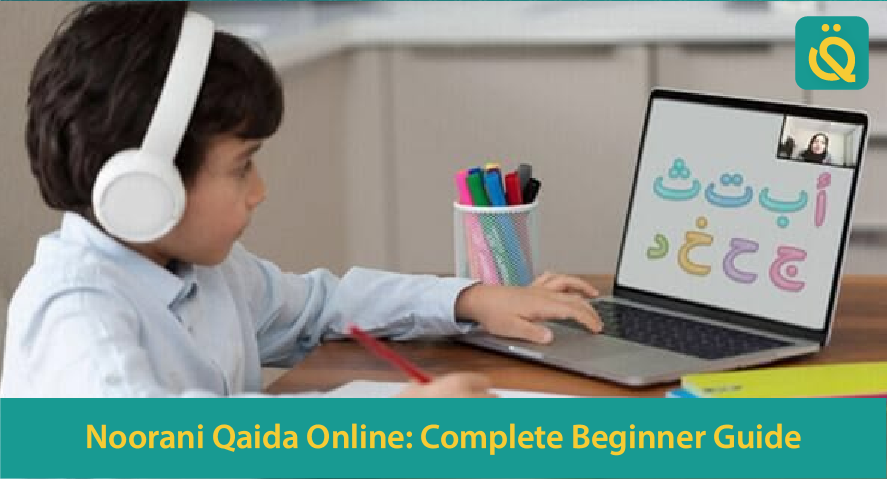
Noorani Qaida online gives beginners a structured way to build the reading skills needed for the Quran.
The learner typically moves from Arabic letters to connected forms, short vowels, Tanween, Sukoon, Shaddah, basic Madd, and increasingly complex reading patterns.
The purpose is not simply to finish a Qaida book.
It is to build reading skills that can transfer into the Mushaf.
This guide explains what Noorani Qaida teaches, who may benefit from it, how online lessons work, and how the learner progresses toward Quran reading.
What Is Noorani Qaida Online?
Noorani Qaida online is a structured way to learn Quran-reading foundations through live online lessons and guided practice.
A beginner may work through:
- Arabic-letter recognition
- Connected letter forms
- Fathah, Kasrah, and Dammah
- Tanween
- Sukoon
- Shaddah
- Basic Madd patterns
- Connected words and phrases
Different Qaida editions may organize these skills differently.
What matters is the progression:
Recognize the symbol → produce the sound → combine it correctly → read with less help → apply it in Quranic text
The learner should move forward because the reading skill is becoming stable, not simply because another page has been completed.
For the wider journey beyond Qaida, continue with How to Learn Quran Online.
What Do Beginners Learn in Noorani Qaida Online?
| Learning Stage | Main Skill | Practical Goal |
|---|---|---|
| Arabic letters | Recognize individual letters | Identify letters accurately |
| Letter forms | Recognize connected writing | Follow changing letter shapes |
| Short vowels | Fathah, Kasrah, Dammah | Read basic vocalized sounds |
| Tanween | Double-vowel endings | Read common ending patterns |
| Sukoon | Unvowelled consonant | Join sounds without adding a vowel |
| Shaddah | Doubled consonant | Produce the repeated consonant clearly |
| Basic Madd | Long-vowel patterns | Distinguish short and long sounds |
| Combined reading | Connected words and phrases | Prepare for Quranic text |
The exact order may vary between Qaida editions and teachers.
A good learning sequence should allow the learner to recognize and apply each pattern before more complexity is added.
Who Should Learn Noorani Qaida Online?
Noorani Qaida can be useful for:
- Children beginning Quran reading
- Adults starting Arabic-script Quran reading
- Learners who recognize letters but struggle with connected forms
- Students who guess words instead of decoding them
- Learners whose weak reading foundations are limiting Tajweed progress
It is not only for young children.
An adult may need the same reading foundation with a different pace and teaching style.
For the adult-specific pathway, continue with Noorani Qaida for Adults: Can Beginners Start From Scratch?
Is Noorani Qaida Necessary Before Reading the Quran?
Not every learner needs the same book or complete Qaida sequence.
The important requirement is the reading foundation.
A learner should gradually be able to:
- Recognize letters
- Follow connected forms
- Read basic vowel patterns
- Handle Sukoon and Shaddah
- Distinguish short and long sounds
- Decode unfamiliar combinations
If these skills are already stable, repeating a complete beginner Qaida may be unnecessary.
For the full decision, continue with Is Noorani Qaida Necessary to Learn Quran?
How Do Online Noorani Qaida Lessons Work?
Online Noorani Qaida lessons should involve active reading, not only watching the teacher.
A simple lesson cycle is:
Teacher models → learner reads → teacher corrects → learner tries again → the skill appears in another example
For a Sukoon lesson, for example, the teacher may:
- Review a familiar pattern.
- Introduce the new reading target.
- Model a few examples.
- Let the learner read.
- Correct the priority mistake.
- Ask for another attempt.
- Test the pattern in a different example.
The learner should spend meaningful lesson time actually reading.
Where Should Beginners Start in Noorani Qaida Online?
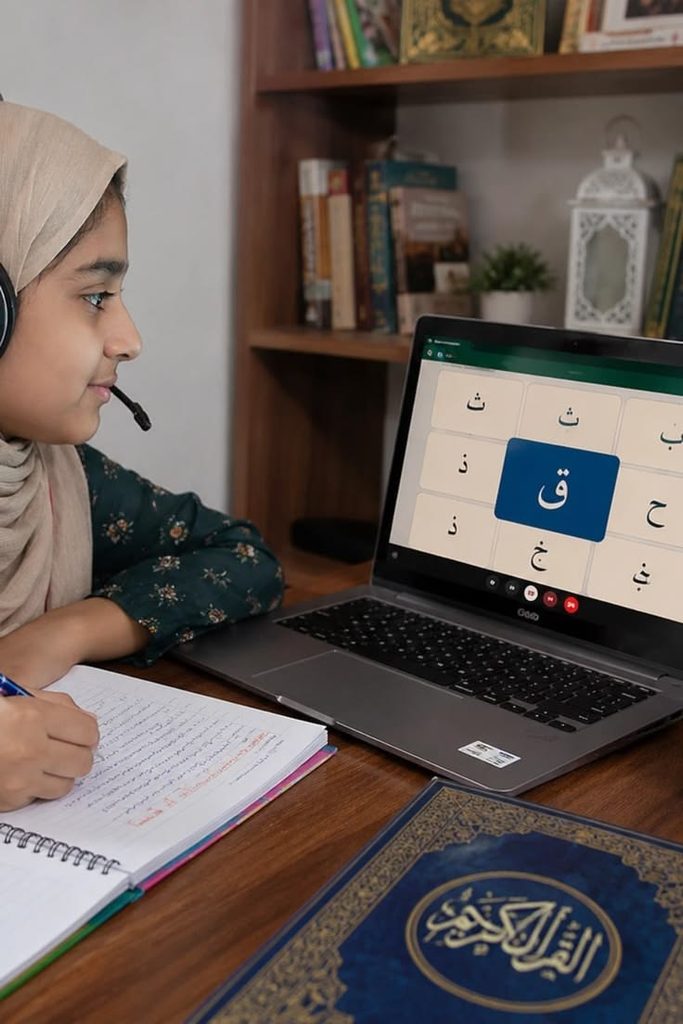
Beginners should start with the earliest unstable reading skill rather than automatically repeating material they already know.
A complete beginner may need letter recognition.
Another learner may know the alphabet but struggle with connected forms.
Someone else may decode words but repeatedly add vowels where Sukoon requires none.
A short starting assessment should identify:
- What is already stable
- Where reading breaks down
- Which pattern should come first
- Whether pronunciation or decoding is the main problem
This keeps the learning path focused.
Noorani Qaida vs. Quran Reading vs. Tajweed
| Area | Main Question |
|---|---|
| Noorani Qaida | Can I recognize and combine the basic reading patterns? |
| Quran Reading | Can I apply those skills in real Quranic text? |
| Tajweed | Can I pronounce and apply the recitation rules accurately? |
These stages overlap, but they are not identical.
Finishing Qaida does not automatically create fluent Quran reading, and decoding Quranic words does not mean every Tajweed rule is accurate.
For the Tajweed pathway, continue with Learn Quran Tajweed Online: A Complete Beginner Roadmap.
For the detailed comparison, continue with Noorani Qaida vs. Tajweed: What Is the Difference?
How Long Does It Take to Complete Noorani Qaida?
There is no single completion time for every learner.
Progress depends on factors such as:
- Starting level
- Lesson frequency
- Practice between lessons
- Reading difficulty
- How well earlier skills are retained
Finishing quickly is not useful if unfamiliar combinations are still guessed.
A better question is:
Can the learner apply the current reading skill independently?
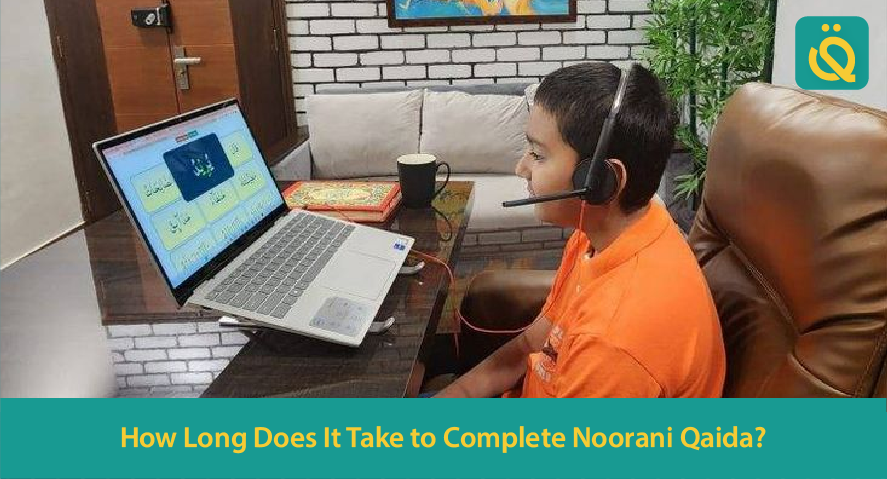
For a detailed timing discussion, continue with How Long Does It Take to Complete Noorani Qaida?
Can You Learn Noorani Qaida Without a Teacher?
Books, videos, and recordings can help learners become familiar with Qaida patterns and repeat known material.
The main limitation is verification.
A beginner may not notice that a letter sound, vowel pattern, or connected word is being read inaccurately.
Teacher feedback becomes more useful when pronunciation or decoding cannot be checked independently.
For the complete self-study decision, continue with Can You Learn Noorani Qaida Online Without a Teacher?
How Should Beginners Practise Noorani Qaida at Home?
Home practice should reinforce the current lesson rather than introduce several new patterns.
A short session may include:
- Review one familiar pattern.
- Read several examples independently.
- Repeat the combinations that remain difficult.
- Stop when accuracy begins to fall.
- Return to the same skill later.
Focused practice is more useful than long repetition of an inaccurate pattern.
For the complete practice method, continue with How to Practise Noorani Qaida at Home.
Common Noorani Qaida Mistakes
1. Memorizing the Page Instead of Reading It
Test the same pattern in an unfamiliar example.
2. Adding Extra Vowels
Sukoon should not receive an invented “a,” “i,” or “u” sound.
3. Confusing Similar Letters
Visual recognition is not enough when the wrong sound is repeatedly produced.
4. Moving Forward Before the Skill Is Stable
Completing more pages does not automatically create stronger reading.
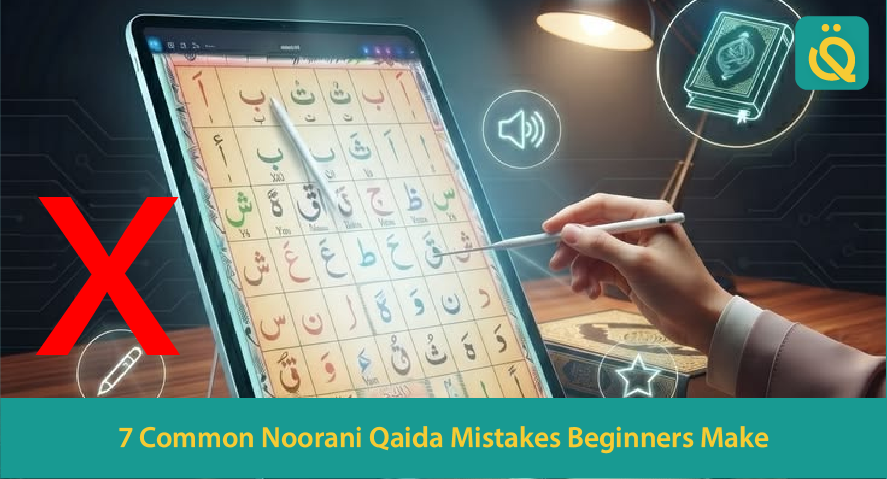
For detailed diagnosis and correction, continue with Common Noorani Qaida Mistakes Beginners Make.
When Are You Ready to Move From Noorani Qaida to Quran Reading?
Page completion alone does not determine readiness.
A learner is closer to the transition when they can:
- Recognize common connected forms
- Read basic vowel patterns
- Handle Sukoon and Shaddah
- Distinguish short and long vowels
- Decode unfamiliar combinations
- Attempt short Quranic words with less support
Perfect fluency is not required.
Qaida practice and short Quran-reading practice may overlap during the transition.
For the complete next-step process, continue with What Comes After Noorani Qaida? From Qaida to Quran Reading and Tajweed.
What Should Parents Check in Noorani Qaida Online Classes?
For children, parents should check whether:
- The starting level is assessed
- The child reads actively during lessons
- Mistakes receive clear correction
- Unfamiliar examples are tested
- Practice tasks are short and specific
- Progress is explained clearly
- The pace suits the child
A trial lesson can also show how the child responds to the teacher’s correction style.
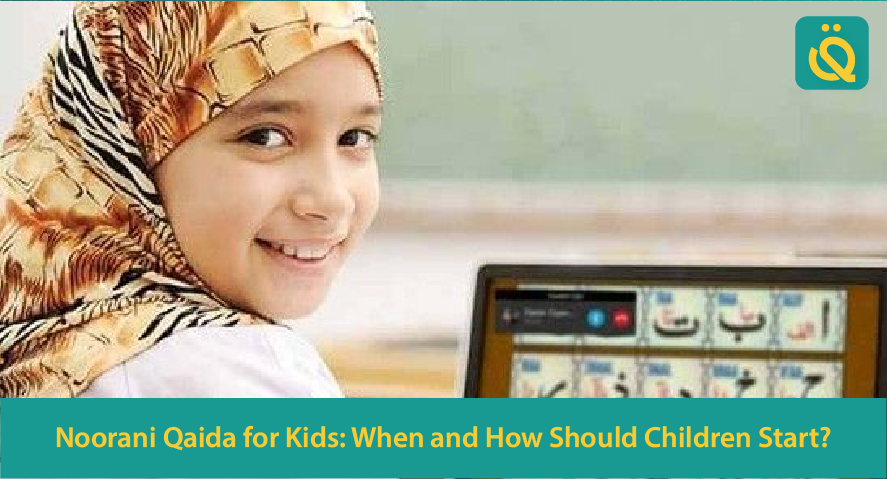
For the child-specific starting pathway, continue with Noorani Qaida for Kids: When and How Should Children Start?
For the wider child-learning decision, review the Online Quran Classes for Kids: Parent’s Guide.
Frequently Asked Questions
1. What Is Noorani Qaida?
Noorani Qaida is a structured beginner method used to build Quran-reading foundations, including Arabic letters, vowel patterns, connected forms, Sukoon, Shaddah, and basic long-vowel reading.
2. Can Beginners Learn Noorani Qaida Online?
Yes.
Online lessons can allow a teacher to model a reading pattern, listen to the learner, correct mistakes, and test whether the learner can apply the same skill in another example.
3. Is Noorani Qaida Only for Kids?
No.
Children commonly use it, but adults who are starting Quran reading may also benefit from Noorani Qaida or another structured reading foundation.
4. Does Finishing Noorani Qaida Mean I Can Read Quran Fluently?
Not automatically.
Completing Qaida develops foundational decoding skills. Fluency still requires transferring those skills into real Quranic text and reading with increasing independence.
5. Is Noorani Qaida the Same as Tajweed?
No.
Noorani Qaida primarily develops reading foundations, while Tajweed focuses on accurate Quranic pronunciation and recitation rules.
Conclusion: Noorani Qaida Online Should Build Quran Reading Skills
Noorani Qaida online gives beginners a structured path from Arabic letters to increasingly complex reading patterns.
The useful progression is:
Recognize → read → receive correction → repeat → transfer
Do not measure success only by completed pages.
A stronger result is when the learner can recognize unfamiliar combinations, apply reading patterns with less prompting, and begin transferring those skills into Quranic text.
Qaida is the foundation.
The goal is increasingly independent and accurate Quran reading.
Continue Your Quran Reading Journey
1. Is Your Child Starting Noorani Qaida?
Continue with Noorani Qaida for Kids: When and How Should Children Start?
Use this guide for the child-specific starting pathway, including readiness and the first stage of learning.
2. Wondering Whether Noorani Qaida Is Necessary?
Continue with Is Noorani Qaida Necessary to Learn Quran?
Use this guide to decide whether the learner needs the full Qaida pathway or only particular reading foundations.
3. Ready to Move Beyond Qaida?
Continue with What Comes After Noorani Qaida? From Qaida to Quran Reading and Tajweed.
Use this guide when the learner is ready to transfer Qaida skills into Quranic text.
Prefer to Check the Starting Level First?
Ask the teacher to listen to a short reading sample and identify whether the learner should begin with letter recognition, connected forms, vowel patterns, or Quran reading.