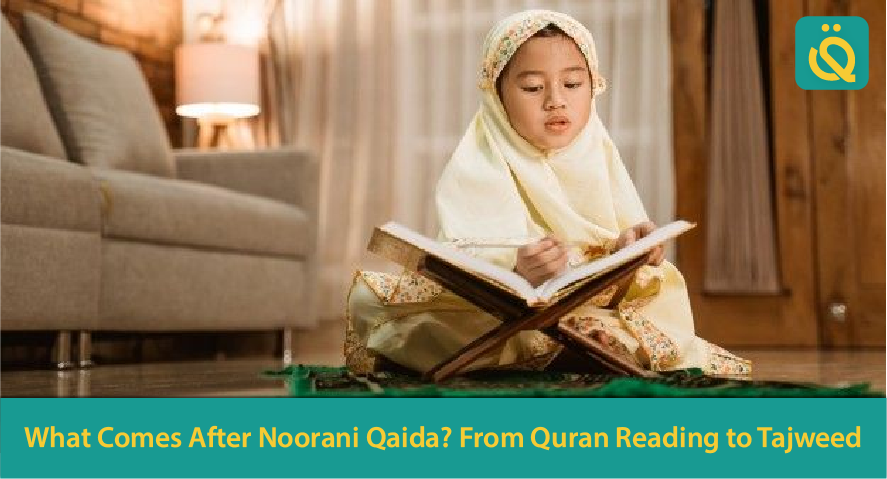
Knowing what comes after Noorani Qaida is important because finishing the Qaida should not become the end of the learning journey.
The next goal is to transfer the reading patterns into real Quranic text.
A learner who has developed stable letter recognition, vowels, Sukoon, Shaddah, connected reading, and basic long-vowel awareness can gradually begin spending more time in the Mushaf.
The transition usually looks like this:
Noorani Qaida foundations → guided Quran reading → stronger fluency → pronunciation correction → deeper Tajweed application
The important word is gradually.
You do not need to wait for perfect reading before opening the Quran, and you should not abandon the foundation before it is stable enough to support real Quran reading.
Quick Answer: What Comes After Noorani Qaida?
After Noorani Qaida, the learner should gradually move into guided Quran reading.
The next stage usually focuses on:
- Reading short Quranic passages
- Applying familiar Qaida patterns inside real text
- Reducing hesitation and guessing
- Correcting pronunciation
- Building reading fluency
- Introducing Tajweed rules according to the learner’s level
- Reading increasingly unfamiliar passages with less support
The goal is not:
Finish Qaida → immediately study every Tajweed rule
A better progression is:
Transfer the foundation → strengthen Quran reading → correct pronunciation → add Tajweed depth
For the complete foundation behind this transition, continue with Noorani Qaida Online: Complete Beginner Guide.
How Do You Know You Are Ready to Move Beyond Noorani Qaida?
Reaching the final page is useful, but it should not be the only test.
A learner may be ready for more Quran reading when they can:
- Recognize common Arabic letter forms with less hesitation
- Read basic short vowels accurately
- Handle Sukoon and Shaddah with reasonable consistency
- Distinguish basic short and long sounds
- Read connected combinations without constant modelling
- Attempt unfamiliar examples rather than relying on memorized rows
Perfection is not required.
What matters is that the foundation is stable enough to survive outside the Qaida page.
A learner who still needs full teacher modelling for most basic combinations may benefit from more targeted foundation work before increasing the Quran-reading load.
What Should Quran Reading Look Like After Noorani Qaida?
The first Quran-reading stage should be manageable.
Instead of beginning with long passages, a teacher may use:
- Short ayat
- Familiar Surahs
- Carefully selected Quranic words
- Passages containing already learned reading patterns
The learner should attempt the text before hearing the complete answer.
This helps the teacher see whether the Noorani Qaida foundation is transferring into Quran reading.
A useful sequence is:
look → decode → read aloud → receive correction → read again
The teacher can then gradually increase passage length and complexity.
Why Can Quran Reading Feel Harder After Finishing Noorani Qaida?
This is normal.
Qaida exercises are controlled.
Quranic text combines many patterns together.
A learner may understand Sukoon, Shaddah, Madd, and connected forms separately but become slower when they all appear in one ayah.
That does not mean Noorani Qaida failed.
It means the learner is moving from:
isolated skill practice
to:
integrated Quran reading
This transition needs repetition.
The solution is usually not to restart the entire Qaida automatically.
Identify which foundation breaks down inside Quranic text and review that specific skill.
Should You Continue Noorani Qaida While Reading Quran?
Sometimes, yes.
The transition does not need to be all-or-nothing.
A learner may spend most of the lesson reading Quran while still returning briefly to Noorani Qaida for one unstable pattern.
For example:
- Quran reading reveals weak Sukoon
- The teacher returns to a short Qaida exercise
- The pattern is corrected
- The learner applies it again in the Quranic passage
This creates a useful bridge between foundation and application.
Qaida becomes a reference tool, rather than a book the learner must either completely use or completely abandon.
What Comes After Noorani Qaida for Pronunciation?
Once basic decoding becomes easier, pronunciation usually deserves more attention.
A learner may be able to identify the correct letter but still produce the sound inaccurately.
That is a different problem.
For example:
Correct letter recognition + inaccurate sound = pronunciation issue
rather than:
inability to identify the written pattern = decoding issue
At this stage, correction can increasingly focus on:
- Letter articulation
- Similar sounds
- Clear vowel production
- Heavy and light qualities
- Accurate sound transitions
For detailed articulation work, continue with Learn Quran Online With Tajweed: Makharij and Pronunciation Correction.
When Should Tajweed Begin After Noorani Qaida?
Basic pronunciation correction can happen throughout Noorani Qaida.
But deeper Tajweed study becomes easier when the learner can read without spending all their attention on decoding.
The learner may gradually begin working with areas such as:
- Makharij
- Noon Sakinah and Tanween
- Meem Sakinah
- Ghunnah
- Qalqalah
- Madd
- Tafkheem and Tarqeeq
- Waqf and Ibtida
These should not all be introduced at once.
The teacher can prioritize the rules that actually appear in the learner’s recitation.
For the full distinction between the two stages, continue with Noorani Qaida vs Tajweed: What Is the Difference?
How Do You Build Quran Reading Fluency After Noorani Qaida?
Fluency grows when decoding becomes more automatic without sacrificing accuracy.
A learner can build fluency by:
- Reading short passages regularly
- Re-reading corrected passages
- Practising unfamiliar Quranic text
- Reducing unnecessary pauses
- Recognizing common patterns faster
- Receiving correction before errors become habits
Speed should not become the main goal.
Fast inaccurate reading is not useful progress.
A stronger sequence is:
accuracy first → smoother reading → greater independence
As recognition improves, the learner can gradually read longer passages without stopping after every word.
A Short Transition Example
Yusuf had completed his main Noorani Qaida lessons and could read familiar exercises confidently.
When he began reading Quranic text, however, his pace became slower and several patterns that looked easy in the Qaida required more attention.
Instead of returning to the beginning, the teacher kept Quran reading as the main activity and reviewed only the specific foundation patterns that caused hesitation.
Over time, the transition became smoother because the learner was practising those skills in real Quranic context.
This is an illustrative example, not a documented student case study.
The important lesson is:
Difficulty during the transition does not always mean the learner should restart Noorani Qaida.
Often, targeted review plus continued Quran reading is the better next step.
What Should You Avoid After Finishing Noorani Qaida?
1. Stopping Reading Practice
Qaida skills need to transfer into Quranic text.
Finishing the book and then taking a long break can weaken that transition.
2. Rushing Into Advanced Tajweed
Too much terminology can overwhelm a learner who is still building Quran-reading fluency.
3. Ignoring Foundation Gaps
If Sukoon, Shaddah, or connected reading repeatedly breaks down, review the specific skill.
4. Reading Only Familiar Surahs
Memorized passages can hide weak decoding.
Include unfamiliar text gradually.
5. Measuring Progress Only by Speed
Reading faster is useful only when accuracy remains stable.
How Do You Know Quran Reading Is Improving After Noorani Qaida?
Look for changes such as:
- Faster recognition of familiar patterns
- Less hesitation between letters and words
- Fewer decoding mistakes
- Better reading of unfamiliar passages
- Less teacher prompting
- Corrections remaining in later lessons
- More attention available for pronunciation and Tajweed
These are stronger indicators than page count alone.
A learner is moving beyond foundation work when more attention can shift from:
“What does this say?”
to:
“How should I recite this accurately?”
Should You Start Hifz After Noorani Qaida?
Some learners may begin memorizing short Surahs while still developing Quran-reading skills.
However, memorization should not replace reading development.
A learner may memorize a passage accurately by listening without being able to decode the same text independently.
If Hifz becomes part of the learning plan, continue developing:
- Quran reading
- Correct pronunciation
- Revision
- Independent decoding
For families considering memorization, the Complete Guide to Quran Hifz for Kids explains the wider Hifz journey without turning this article into a memorization guide.
What Should the Learning Plan Look Like After Noorani Qaida?
A simple transition plan may look like this:
| Stage | Main Focus |
|---|---|
| 1. Foundation Check | Confirm the main Qaida patterns are stable |
| 2. Guided Quran Reading | Apply those patterns in short Quranic passages |
| 3. Reading Fluency | Reduce hesitation while protecting accuracy |
| 4. Pronunciation Correction | Improve letter sounds and recurring errors |
| 5. Tajweed Development | Add relevant recitation rules gradually |
| 6. Independent Reading | Read unfamiliar passages with less support |
This is not a fixed timetable.
Learners may move back and forth between stages when a foundation skill needs review.
The important thing is that each stage responds to the actual reading evidence.
Frequently Asked Questions
1. What Comes After Noorani Qaida?
After Noorani Qaida, learners should gradually move into guided Quran reading, develop fluency, receive pronunciation correction, and begin applying Tajweed according to their level.
2. Should I Start Reading Quran Immediately After Noorani Qaida?
Yes, when the main reading patterns are sufficiently stable.
Quran reading can also begin gradually before the final Qaida lesson if the teacher believes the learner is ready.
3. Do I Need Tajweed Immediately After Noorani Qaida?
Basic pronunciation correction should continue, but detailed Tajweed does not need to be introduced all at once.
Add rules gradually as Quran reading becomes more stable.
4. Why Is Quran Reading Hard After Noorani Qaida?
Real Quranic text combines several reading patterns at once.
The learner may need time to transfer skills from controlled Qaida exercises into natural Quran reading.
5. Should I Repeat Noorani Qaida After Finishing It?
Not automatically.
If specific foundation gaps remain, targeted review is often more useful than restarting the entire Qaida.
Conclusion: What Comes After Noorani Qaida Is Application
Understanding what comes after Noorani Qaida is really about moving from controlled foundation exercises into real Quran reading.
The next journey is:
Qaida foundation → Quran reading → fluency → pronunciation correction → Tajweed → increasing independence
Do not abandon the foundation too early.
But do not remain in Qaida indefinitely when the learner is ready to apply those skills.
Use Quranic text to reveal what is stable and what still needs correction.
Then review only the weak foundation when necessary.
The real goal after Noorani Qaida is not another book.
It is increasingly accurate, confident, and independent Quran reading.
Continue Your Quran Learning Journey
1. Ready for the Wider Quran Reading Path?
Continue with How to Learn Quran Online to understand how reading, correction, practice, and later learning stages fit together.
2. Ready to Develop Tajweed More Systematically?
Continue with Learn Quran Tajweed Online: A Complete Beginner Roadmap for the next stage of pronunciation and recitation development.
3. Want to Know Whether Tajweed Is Becoming Stable?
Continue with How to Measure Tajweed Progress in Online Classes when the learner has moved beyond basic decoding and needs a clearer way to measure recitation progress.
Prefer to Check Whether You Are Ready to Move Beyond Noorani Qaida?
Read a short unfamiliar Quranic passage and ask the teacher to identify whether your next priority should be more Qaida review, Quran-reading fluency, pronunciation correction, or Tajweed.