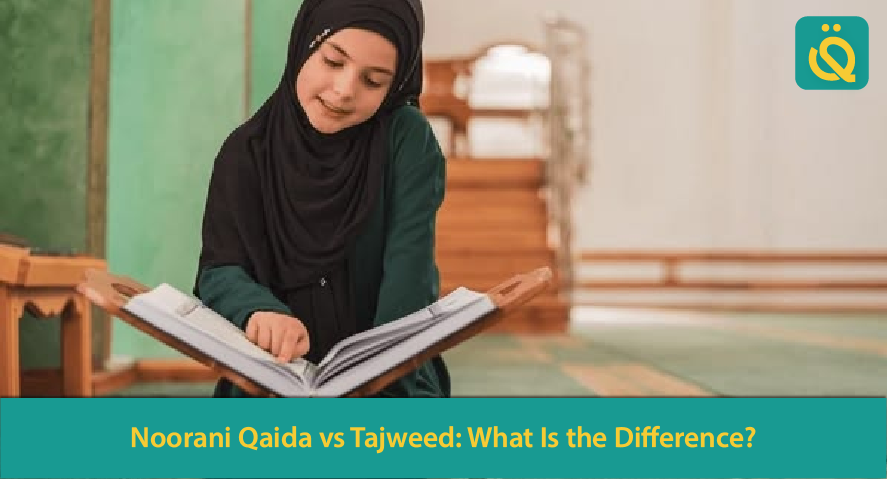
Noorani Qaida vs Tajweed is an important distinction for beginners because the two stages solve different Quran-reading problems.
Noorani Qaida mainly develops the foundation needed to recognize letters, vowel patterns, connected forms, Sukoon, Shaddah, and basic reading combinations.
Tajweed focuses on how Quranic recitation should be pronounced and how recitation rules are applied accurately.
In simple terms:
Noorani Qaida helps you learn how to read.
Tajweed helps you improve how that Quran reading is pronounced and recited.
The two stages are connected, but they are not interchangeable.
Quick Answer: Noorani Qaida vs Tajweed — What Is the Main Difference?
The main difference is the skill each one develops.
| Area | Noorani Qaida | Tajweed |
|---|---|---|
| Main purpose | Build Quran-reading foundations | Improve accurate Quran recitation |
| Typical beginner focus | Letters, vowels, joining, Sukoon, Shaddah | Pronunciation and recitation rules |
| Best for | Learners who cannot yet decode Quran confidently | Learners who can read and need recitation correction |
| Main outcome | Increasingly independent reading | Increasingly accurate recitation |
| Starting requirement | Can begin from zero | Usually easier when basic reading is already developing |
A complete beginner often benefits from strengthening reading foundations before studying many detailed Tajweed rules.
For the full Noorani Qaida learning structure, continue with Noorani Qaida Online: Complete Beginner Guide.
What Does Noorani Qaida Teach?
Noorani Qaida teaches the foundational mechanics of reading Arabic script used in the Quran.
A learner may work on:
- Arabic-letter recognition
- Connected forms
- Fathah, Kasrah, and Dammah
- Tanween
- Sukoon
- Shaddah
- Basic long-vowel recognition
- Connected reading patterns
The purpose is not simply to memorize a sequence of Qaida pages.
The learner should gradually become able to see a written pattern and decode it with less help.
This is why Noorani Qaida is often useful before advanced Tajweed study.
What Does Tajweed Teach?
Tajweed develops accurate Quranic pronunciation and recitation.
It includes areas such as:
- Makharij
- Noon Sakinah and Tanween
- Meem Sakinah
- Ghunnah
- Qalqalah
- Madd
- Tafkheem and Tarqeeq
- Waqf and Ibtida
This article will not teach those rules individually.
They belong to the dedicated Tajweed learning pathway.
For that complete roadmap, continue with Learn Quran Tajweed Online: A Complete Beginner Roadmap.
Should You Learn Noorani Qaida or Tajweed First?
For a complete beginner, Noorani Qaida or another structured Quran-reading foundation usually comes first.
That is because detailed Tajweed becomes difficult to apply when the learner is still struggling to:
- Recognize letters
- Join sounds
- Read basic vowels
- Decode unfamiliar words
- Handle Sukoon and Shaddah
A learner who spends most of their attention trying to identify the word has less attention available for detailed recitation rules.
But this does not mean Tajweed must be completely postponed.
A teacher can correct basic pronunciation while the learner is still studying Noorani Qaida.
The distinction is:
Reading foundation leads the learning plan.
Basic pronunciation correction can happen alongside it.
Can You Learn Noorani Qaida and Tajweed at the Same Time?
Yes, to a limited extent.
A beginner does not need to finish every Qaida lesson before hearing correct pronunciation.
For example, while teaching a letter, the teacher should model the sound accurately.
While teaching Madd at a basic reading level, the learner can hear the difference between short and long sounds.
But the learner does not need to study the complete technical Tajweed system at the same time.
A practical progression is:
build reading → correct basic pronunciation → increase Quran reading → add Tajweed depth gradually
This keeps the learner from becoming overloaded with terminology before the reading itself is stable.
How Do You Know Noorani Qaida Should Come First?
Noorani Qaida should remain the main priority when the learner:
- Cannot recognize many Arabic letters
- Struggles with connected forms
- Guesses unfamiliar words
- Confuses basic vowels
- Adds sounds that are not written
- Needs full teacher modelling for simple combinations
In these cases, adding more Tajweed terminology may not solve the main problem.
The stronger first step is to stabilize decoding.
For the broader beginner journey, read How to Learn Quran Online.
How Do You Know You Are Ready for More Tajweed?
The learner may be ready to increase Tajweed study when they can read Quranic text with less effort spent on basic decoding.
Useful signs include:
- Letters are recognized quickly
- Connected words can be attempted independently
- Basic vowel patterns are stable
- Sukoon and Shaddah are reasonably familiar
- Reading no longer depends on memorizing the page
- Teacher correction can focus increasingly on pronunciation rather than basic word recognition
This does not require perfect fluency.
The goal is simply to reach a point where reading mechanics are no longer blocking every Tajweed correction.
Noorani Qaida vs. Tajweed for Pronunciation Problems
Sometimes the learner can read the word but still pronounces a letter incorrectly.
That is different from a decoding problem.
For example:
- If the learner cannot recognize the written letter → reading foundation issue
- If the learner recognizes the correct letter but produces the wrong sound → pronunciation issue
This distinction matters because the solution changes.
Repeating more Qaida pages may not fix a pronunciation problem that needs focused articulation correction.
For that specific issue, continue with Learn Quran Online With Tajweed: Makharij and Pronunciation Correction.
A Simple Example: When the Learner Needs Qaida Before More Tajweed
Sara had already heard several Tajweed terms and could name some basic rules.
But when she opened an unfamiliar Quranic passage, she still hesitated over connected letters and basic vowel patterns.
The issue was not that she needed more Tajweed terminology.
Her reading foundation needed to become more stable first.
The learning plan therefore returned to selected Noorani Qaida patterns before adding more detailed recitation rules.
Once reading required less effort, Tajweed correction became easier to apply inside Quranic text.
This is an illustrative example, not a documented student case study.
The lesson is:
Knowing Tajweed terminology does not replace the ability to decode Quranic text.
Can Someone Know Tajweed Without Reading Quran Fluently?
A learner may understand some Tajweed rules theoretically without being able to apply them consistently.
For example, they may know what Qalqalah means but still struggle to read the surrounding word.
This creates a gap between:
rule knowledge
and:
rule application
That is why practical Quran reading matters.
Tajweed becomes more useful when the learner can meet the rule naturally inside real recitation rather than only identify it in a lesson.
Can Someone Finish Noorani Qaida Without Knowing Tajweed?
Yes.
Finishing Noorani Qaida does not mean the learner has mastered Tajweed.
Qaida provides a reading foundation.
After that, the learner may still need significant work on:
- Articulation
- Sound quality
- Rule recognition
- Timing
- Stopping and restarting
- Consistent application during recitation
That is normal.
Noorani Qaida and Tajweed represent different stages of development.
What Should Come After Noorani Qaida?
Once the foundation becomes stable, the learner should gradually spend more time reading actual Quranic text.
At this stage, teaching may shift toward:
- Quran-reading fluency
- Pronunciation correction
- Applying Tajweed inside recitation
- Reading unfamiliar passages
- Reducing teacher prompting
The transition should depend on reading evidence, not simply on finishing the final Qaida page.
The dedicated next-step article will cover this in full:
What Comes After Noorani Qaida? From Qaida to Quran Reading and Tajweed
Common Mistakes When Choosing Between Noorani Qaida and Tajweed
1. Starting Advanced Tajweed Before Basic Reading Is Stable
The learner may understand explanations but struggle to apply them.
2. Staying in Qaida Too Long
A learner who can already decode confidently may need more Quran reading rather than repeating foundation pages indefinitely.
3. Assuming Qaida Automatically Teaches Complete Tajweed
Basic pronunciation and reading patterns do not replace detailed Tajweed study.
4. Treating Every Pronunciation Problem as a Qaida Problem
Sometimes the learner can decode correctly but needs focused articulation correction.
5. Measuring Progress by Terminology
Knowing the names of rules matters less than applying them accurately during Quran recitation.
Frequently Asked Questions
1. What Is the Difference Between Noorani Qaida and Tajweed?
Noorani Qaida primarily builds Quran-reading foundations, while Tajweed develops accurate pronunciation and the application of Quranic recitation rules.
2. Should I Learn Noorani Qaida or Tajweed First?
If you cannot yet read Arabic script confidently, begin with the reading foundation.
Basic pronunciation correction can happen alongside Qaida, while deeper Tajweed study can increase as reading becomes stable.
3. Does Noorani Qaida Include Tajweed?
Noorani Qaida may introduce basic sound and reading features that support later Tajweed, but it does not replace a complete Tajweed learning pathway.
4. Can I Start Tajweed Before Finishing Noorani Qaida?
Yes, basic pronunciation correction can begin early.
However, detailed Tajweed is easier to apply when the learner has a stronger reading foundation.
5. Is Noorani Qaida Enough to Read Quran Correctly?
Noorani Qaida can build the decoding foundation, but learners still need Quran-reading practice and further pronunciation and Tajweed development.
Conclusion: Noorani Qaida vs Tajweed Is About Foundation vs. Recitation Quality
The key difference in Noorani Qaida vs Tajweed is the skill being developed.
Noorani Qaida answers:
Can I recognize and decode the Quranic reading pattern?
Tajweed answers:
Can I pronounce and recite it accurately?
For many beginners, the logical progression is:
reading foundation → Quran reading → deeper Tajweed application
The stages can overlap.
But they should not be confused.
If decoding is weak, strengthen the foundation.
If the learner can read but pronunciation is inaccurate, increase Tajweed correction.
The right next step depends on the actual reading problem—not simply the name of the course.
Prefer to Check Which Stage You Need?
Read a short unfamiliar Quranic passage during an assessment and ask the teacher whether the main difficulty is decoding, pronunciation, or Tajweed application.