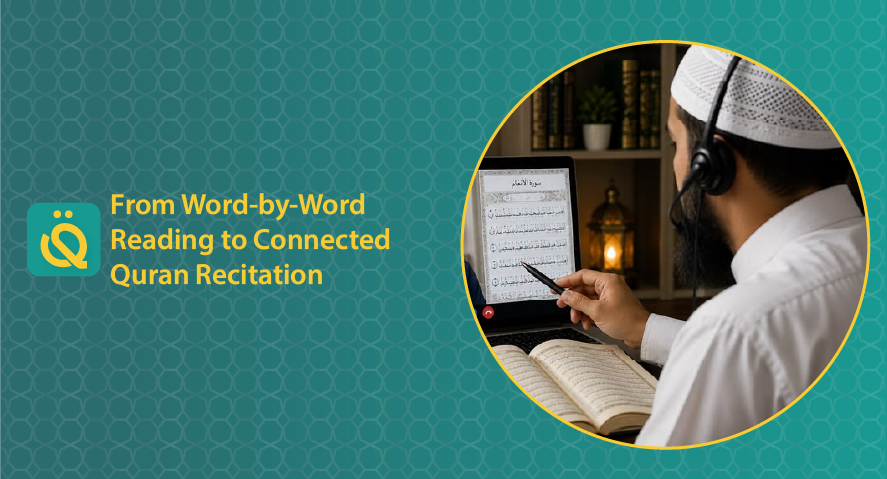
Word-by-word Quran reading is a normal stage when a learner is still decoding Arabic carefully.
The problem begins when every word remains isolated even after the learner can read most of those words accurately.
The recitation may sound like:
word → stop → word → stop → word → stop
The learner is reading, but the phrase never becomes connected.
Trying to fix this by simply saying:
“Read faster.”
usually creates another problem.
The learner may rush, guess, lose vowels, or weaken pronunciation.
The better goal is:
Keep the words accurate → connect a little more text → preserve the correction → extend the phrase gradually.
Connected Quran recitation should grow from accurate reading, not replace it.
Quick Answer: How Do You Move From Word-by-Word Quran Reading to Connected Recitation?
To move beyond word-by-word Quran reading, start by connecting only two or three accurately read words at a time.
Use this progression:
- Read each word accurately.
- Identify unnecessary pauses.
- Connect two words without rushing.
- Add a short phrase.
- Keep pronunciation stable.
- Pause where the phrase naturally allows it.
- Test the same skill in another passage.
The goal is not continuous reading with no pauses.
It is:
fewer unnecessary pauses + accurate phrase-level reading
For the complete fluency system behind this transition, continue with Quran Reading Fluency: How to Read More Smoothly Without Losing Accuracy.
If the learner is still struggling to decode the individual words themselves, use the Noorani Qaida Online: Complete Beginner Guide before making connected recitation the main goal.
When Is Word-by-Word Quran Reading Normal?
Word-by-word reading is expected during early learning.
A beginner may need time to process:
- Arabic letters
- Connected forms
- Short vowels
- Sukoon
- Shaddah
- Long vowels
- Word endings
At that stage, stopping between words may protect accuracy.
There is no need to force phrase-level fluency before the words themselves are stable.
Word-by-word reading becomes more of a concern when:
- Common words are already accurate
- The learner recognizes basic patterns
- Every word still receives an automatic pause
- The same fragmented rhythm appears in easy passages
- Reading remains heavily segmented despite regular practice
The issue is then less about knowing the words and more about connecting them.
How Do You Know Word-by-Word Reading Has Become a Habit?
Use this distinction:
| What You Notice | Likely Meaning |
|---|---|
| Difficult word causes a pause | Normal decoding effort |
| Every word causes a pause | Segmented reading habit |
| New text is slower than familiar text | Normal to a degree |
| Familiar text is still completely fragmented | Continuity may need focused practice |
| Learner pauses because they are checking a vowel | Accuracy still needs attention |
| Learner already knows the word but stops anyway | Pause may be habitual |
Not every pause should be removed.
The goal is to remove pauses that no longer serve reading accuracy or appropriate stopping.
Why Does Word-by-Word Quran Reading Continue?
Several different causes can create the same fragmented sound.
1. The Learner Is Still Decoding Each Word From Scratch
Every word requires significant mental work.
The reading foundation may need more development.
2. The Learner Has Learned to Stop After Every Word
The pause has become part of the reading rhythm.
3. Fear of Making Mistakes
The learner feels safer finishing one word completely before attempting the next.
4. Too Much Teacher Interruption
If correction happens after almost every word, the learner begins expecting a stop.
5. Breath Is Poorly Planned
The learner takes many small breaths instead of reading manageable phrases.
6. Tajweed Requires Too Much Conscious Attention
The learner may pause to prepare each rule before continuing.
Different causes require different solutions.
Connected reading should not be trained in exactly the same way for every learner.
The Connected Quran Reading Ladder
Do not jump from isolated words to long ayat.
Use a gradual ladder.
| Level | Reading Target |
|---|---|
| 1. Word Accuracy | Read individual words correctly |
| 2. Two-Word Connection | Join two accurate words |
| 3. Short Phrase | Read a small meaningful group continuously |
| 4. Longer Phrase | Extend continuity while protecting accuracy |
| 5. Ayah Segment | Maintain control through a larger section |
| 6. Connected Recitation | Read naturally with appropriate stopping |
A learner can move backward temporarily when a difficult passage appears.
That is normal.
The ladder describes development, not a permanent label.
How to Connect Two Quran Words Without Rushing
Start small.
Choose two words that the learner can already read accurately.
First:
read word 1
Then:
read word 2
Then ask the learner to read them together without inserting an unnecessary full stop.
The goal is not increased speed.
The goal is removing the artificial break.
If pronunciation or vowels become weaker when the words are connected, return to the slower attempt and try again.
Use:
accuracy → connection → accuracy check
not:
accuracy → speed
How to Move From Two Words to a Short Quran Phrase
Once two-word connections become stable, increase the phrase slightly.
For example:
two words → three words → short phrase
Keep one question in mind:
Can the learner maintain the same reading quality while connecting slightly more text?
If yes, continue.
If not, reduce the phrase length again.
This makes fluency practice measurable.
Where Should You Pause During Connected Quran Recitation?
Connected reading does not mean reading endlessly without stopping.
Appropriate pauses still matter.
The learner should begin distinguishing between:
- A pause caused by decoding difficulty
- A pause caused by breath
- A pause required or preferred by the recitation context
- An unnecessary pause after every word
That distinction is important.
A learner who removes every pause may begin rushing through places where stopping should be considered carefully.
For the dedicated stopping system, use Quran Stop Signs: Meanings, Waqf and Ibtida for Beginners.
The Pause Map: A Simple Connected-Reading Test
During one reading attempt, mark every pause.
Then classify it.
| Pause Type | Keep, Review, or Reduce? |
|---|---|
| Difficult word needed decoding | Review the word |
| Breath genuinely needed | Keep or improve breath planning |
| Quran stop sign / meaningful pause | Keep when appropriate |
| Automatic pause after an easy word | Reduce gradually |
| Pause waiting for teacher help | Build independence |
| Pause caused by uncertainty after guessing | Repair accuracy first |
This turns “read more smoothly” into something observable.
Instead of criticizing the overall rhythm, identify which pauses actually need changing.
How Teacher Correction Can Affect Connected Quran Reading
Correction is necessary.
But too many interruptions can unintentionally train fragmented reading.
Consider:
learner reads word → teacher corrects → learner reads next word → teacher corrects
Even when each correction is useful, the learner never gets enough uninterrupted reading to develop phrase continuity.
A better structure can be:
- Choose one priority correction.
- Let the learner complete a short phrase.
- Correct the priority issue.
- Reread the phrase.
- Continue.
This keeps correction inside connected recitation.
What If Accuracy Drops When Words Are Connected?
That means the connection is currently too demanding.
Do not force it.
Return to the last stable level.
For example:
five-word phrase causes errors
Reduce to:
two or three connected words
Then rebuild.
This is why connected recitation should grow gradually.
If basic accuracy itself remains the main question, continue with Quran Reading Accuracy vs Fluency: Which Should Come First?
What If the Learner Starts Guessing to Sound More Fluent?
Then fluency practice has moved too far ahead.
Connected reading should never require the learner to predict the word before fully processing it.
Warning signs include:
- Changed word endings
- Skipped vowels
- Familiar-looking words substituted
- Reading starts before the complete word is inspected
Reduce pace.
Restore accurate decoding.
Then rebuild continuity.
The dedicated guessing guide How to Stop Guessing Quran Words While Reading owns this problem in full.
How Familiar Surahs Can Help Connected Recitation
Familiar Surahs are useful for practising phrase continuity because less attention is required for decoding.
The learner can focus more on:
- Connection
- Breath
- Pronunciation
- Rhythm
- Appropriate stopping
This makes familiar material a good practice environment.
But connected reading should eventually transfer elsewhere.
If the learner sounds fluent only in memorized material, unfamiliar text should also be tested.
The dedicated article Why Familiar Surahs Can Hide Weak Quran Reading Skills explains that gap in detail.
How to Practise Connected Reading With Unfamiliar Quran Text
Use a short unfamiliar passage.
Do not expect the same fluency as a familiar Surah.
Instead:
- Read the words accurately.
- Identify where decoding is genuinely difficult.
- Connect only the easier section first.
- Correct the main bottleneck.
- Reread the phrase.
- Test another short section.
The aim is:
transfer connected reading into new Quranic text
not:
make unfamiliar text instantly sound memorized.
For the full unfamiliar-text routine, continue with How to Practise Unfamiliar Quran Passages Without Memorizing Them.
An Illustrative Example: Maryam Could Read Every Word but the Ayah Never Flowed
Maryam could read the individual words in a short Quranic passage accurately.
But after every word, she stopped.
Her teacher initially asked her to “read more smoothly.”
That instruction did not change much.
The practice was then reduced to a more specific target.
Maryam read two words together.
Once that became stable, she added a third.
Then she read the short phrase again while keeping the same pronunciation.
Her reading did not suddenly become fast.
It became less fragmented.
This is an illustrative example, not a documented student case study.
The lesson is:
Phrase-level fluency develops more reliably when connection increases in manageable units.
Connected Quran Recitation vs. Fast Quran Reading
These are not the same.
| Connected Recitation | Fast Reading |
|---|---|
| Removes unnecessary pauses | Increases pace |
| Protects accurate words | Can sacrifice accuracy |
| Uses appropriate stopping | May rush stopping points |
| Develops gradually | Can be forced immediately |
| Supports natural recitation | May create guessing |
The target is connection, not raw speed.
A learner can read moderately slowly and still have good connected recitation.
How Tajweed Fits Into Connected Quran Recitation
As reading becomes more connected, Tajweed needs to survive the transitions between words and phrases.
Some corrections that work in isolation may weaken when reading becomes continuous.
Do not introduce every Tajweed rule at once.
Choose one priority if needed.
For example:
Maintain Madd while connecting this phrase.
If the rule consistently disappears when continuity increases, continue with Why Does Tajweed Disappear When You Read Quran Faster?
How Breath Control Affects Phrase-Level Reading
Some learners stop frequently because they do not plan breathing around manageable phrases.
The solution is not taking one huge breath and forcing the whole ayah.
Instead:
- Identify a short manageable phrase
- Read it with controlled breath
- Pause appropriately
- Continue with the next section
Good breath planning supports continuity without turning recitation into a stamina contest.
If reading quality declines during longer sessions, the issue may be endurance rather than phrase connection.
The dedicated article How to Build Quran Reading Stamina Without Losing Accuracy covers that separately.
When Should You Repeat a Connected Phrase?
Repeat when the next attempt has a clear goal.
For example:
- Remove one unnecessary pause
- Preserve a corrected vowel
- Keep Madd stable
- Connect one additional word
- Reduce teacher prompting
Do not repeat simply to make the phrase faster.
When the target becomes stable, move to another phrase.
The full decision framework belongs to When Should You Repeat a Quran Passage and When Should You Move On?
A Simple Connected Quran Reading Practice Routine
Use this short structure:
1. Accurate Word Reading
Confirm the individual words.
2. Two-Word Connection
Remove the first unnecessary break.
3. Phrase Expansion
Add another word or short segment.
4. Correction Check
Confirm that accuracy and pronunciation remain.
5. New Phrase
Test the same skill elsewhere.
The sequence is:
accurate word → connected words → short phrase → stable correction → new phrase
That is more useful than simply saying:
“Try to sound fluent.”
How Do You Know Connected Quran Reading Is Improving?
Look for:
- Fewer automatic word-level pauses
- Longer accurate phrases
- Less teacher prompting
- More natural breath use
- Better recovery after difficult words
- Tajweed remaining stable through phrases
- Unfamiliar text becoming less fragmented
- Less pressure to increase speed
One of the best signs is:
The learner stops thinking about connecting every individual word because phrase-level reading begins to feel more natural.
How Should Connected Recitation Be Measured?
Do not measure only how quickly the passage is completed.
Track:
- Number of unnecessary pauses
- Length of accurate connected phrases
- Prompt dependence
- Accuracy within the phrase
- Transfer to unfamiliar text
- Whether corrections remain
For the complete measurement framework, continue with How to Measure Quran Reading Fluency Without Using Speed Alone.
What Quran Reading Habits Can Keep Word-by-Word Reading Stuck?
Phrase-level reading may remain weak when the learner repeatedly:
- Restarts after every error
- Waits for teacher prompts
- Reads only familiar material
- Tries to avoid every possible mistake
- Corrects several things simultaneously
- Rushes instead of connecting
These are reading behaviors rather than one missing Quran rule.
For the broader habit-level diagnosis, continue with Common Quran Reading Habits That Slow Down Progress.
What If an Adult Has Read Word by Word for Years?
Long-standing reading habits can take time to change.
The learner may understand Quranic script reasonably well but have spent years using the same segmented rhythm.
Do not automatically restart all foundations.
First check:
- Are the words accurate?
- Is decoding independent?
- Is pronunciation stable?
- Is the pause mainly habitual?
If yes, phrase-level practice may be more useful than beginner exercises.
For adult-specific long-term reading struggles, continue with Quran Reading for Adults Who Still Struggle After Years of Practice.
Frequently Asked Questions
1. How Do I Stop Reading Quran Word by Word?
Begin by connecting two accurately read words, then gradually extend to short phrases while protecting pronunciation and accuracy.
2. Is Word-by-Word Quran Reading Wrong?
No.
It is a normal beginner stage. It becomes a fluency issue when accurate words remain unnecessarily isolated after the reading foundation has developed.
3. Should I Read Quran Faster to Improve Connected Recitation?
No.
Focus on reducing unnecessary pauses while keeping the text accurate. Natural speed can increase later.
4. How Many Quran Words Should I Connect at Once?
Start with the amount you can read accurately. Two or three words may be enough before gradually extending the phrase.
5. Why Do I Go Back to Word-by-Word Reading in New Passages?
Unfamiliar text requires more decoding effort. Some slowing is normal while connected-reading skills are transferring.
Moving beyond word-by-word Quran reading does not require rushing.
The progression is:
accurate word → two connected words → short phrase → longer phrase → increasingly natural recitation
Remove unnecessary pauses gradually.
Keep meaningful and appropriate pauses.
If accuracy collapses, reduce the phrase length.
If guessing begins, return to decoding.
If individual words are already stable, stop treating every word as a separate reading event.
Connected Quran recitation becomes stronger when accuracy and continuity grow together.
The goal is not to make the Quran sound fast.
It is to make accurate reading feel increasingly connected, controlled, and independent.
Continue Your Quran Learning Journey
1. Need the Wider Quran-Learning Roadmap?
Continue with How to Learn Quran Online for the broader path from reading foundations to increasingly independent recitation.
2. Is Pronunciation Preventing Connected Reading?
Use Learn Quran Online With Tajweed: Makharij and Pronunciation Correction when the letter sound itself needs focused correction.
3. Is Quran Memorization One of the Next Goals?
Use the Complete Guide to Quran Hifz for Kids to understand how reading, memorization, and revision should support one another.
Stay Connected With Qibla Academy
Follow Qibla Academy on Facebook, Instagram, Telegram, and X.
For direct questions about Quran-reading lessons, contact Qibla Academy through WhatsApp.
Want to Check Whether Word-by-Word Reading Is Still Necessary?
Read one short unfamiliar Quranic passage during a trial lesson and ask the teacher whether your pauses are caused by decoding difficulty, pronunciation, habit, breath, or weak phrase continuity.