
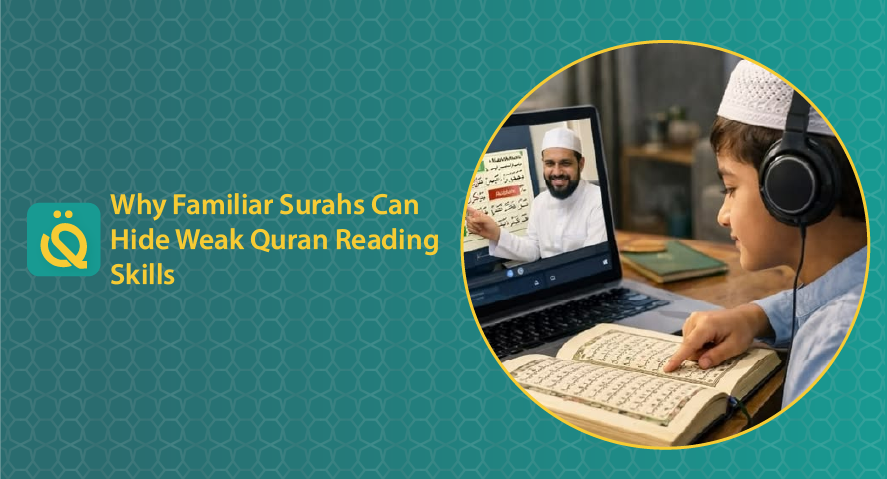
Familiar Surahs and Quran reading can create an important illusion.
A learner may recite a familiar Surah smoothly, with few pauses and strong confidence, but struggle significantly when asked to read an unfamiliar Quranic passage at a similar level.
That does not mean the familiar recitation is false or unhelpful.
Memory, repetition, and previous correction are supporting the reading.
The problem begins only when familiar recitation is used as the only evidence of independent Quran-reading ability.
A learner can know how a passage sounds without fully decoding every written pattern.
The goal is not to stop reading familiar Surahs.
It is to know what familiar reading can prove—and what it cannot.
Quick Answer: Can Familiar Surahs Hide Weak Quran Reading Skills?
Yes.
Familiar Surahs can make Quran reading appear more fluent because the learner already knows:
- The word order
- The expected sounds
- Common verse endings
- The rhythm of the passage
- Corrections from previous lessons
- Parts of the Surah from memory
This reduces the amount of decoding needed during reading.
A useful test is:
Read one familiar passage → then read one unfamiliar passage at a similar level
If accuracy, confidence, and continuity drop dramatically in the unfamiliar text, memory may be supporting more of the familiar reading than expected.
That does not mean the learner should stop using familiar Surahs.
It means progress should be checked in both:
familiar text + unfamiliar text
For the complete fluency framework, continue with Quran Reading Fluency: How to Read More Smoothly Without Losing Accuracy.
If the learner still struggles with Arabic letters, connected forms, Sukoon, or Shaddah themselves, use the Noorani Qaida Online: Complete Beginner Guide before treating familiarity as the main issue.
Why Familiar Surahs Feel Easier to Read
A familiar Surah gives the learner several forms of support at once.
They may remember:
- What word comes next
- How the ayah ends
- Where the teacher previously corrected them
- How the recitation sounds
- Where the natural pauses occur
That means the learner is not processing the page from zero.
This is completely normal.
Repeated exposure is part of learning.
But it changes the question.
Instead of asking:
Can the learner recite this Surah well?
you may need to ask:
Can the learner decode Quranic text that they do not already know?
Those are related skills, but they are not identical.
Familiar Quran Reading vs. Independent Decoding
| Familiar Quran Reading | Independent Decoding |
|---|---|
| Memory may support the next word | Written text must be processed directly |
| Rhythm is already familiar | Phrase structure may be new |
| Previous corrections are remembered | New mistakes become visible |
| Confidence may be higher | Real hesitation is easier to observe |
| Useful for fluency and retention | Useful for testing transfer |
Neither one is “better.”
They answer different questions.
Familiar reading tells you:
Can the learner maintain and improve a practised passage?
Unfamiliar reading tells you:
Can the learner apply those skills somewhere new?
How Memory Can Support Quran Reading
Memory can support reading in several ways.
Auditory Memory
The learner remembers how the ayah sounds.
Visual Memory
The page layout or word shape feels familiar.
Sequence Memory
The learner knows what comes next.
Correction Memory
Previous teacher feedback is already attached to a particular word.
All of these can make reading smoother.
Again, this is not a problem.
It becomes a problem only when the learner depends on those supports so strongly that new Quranic text becomes dramatically weaker.
Signs Familiar Surahs May Be Hiding a Reading Gap
Look for patterns such as:
- Familiar Surahs are smooth but new passages become very slow
- Word endings are guessed in unfamiliar text
- The learner can recite a word correctly but cannot identify its written pattern elsewhere
- Reading confidence disappears when the page changes
- Teacher prompts increase significantly in new passages
- Similar-looking words are substituted
- The learner struggles when verse order changes
- Correct pronunciation weakens outside memorized material
One sign alone does not prove weak reading.
Look for the difference between familiar and unfamiliar performance.
The Familiar–Unfamiliar Reading Gap
A useful way to observe progress is to compare both types of reading.
| Reading Area | Familiar Passage | Unfamiliar Passage |
|---|---|---|
| Accuracy | High | Much lower |
| Hesitation | Low | High |
| Prompting | Rare | Frequent |
| Connected reading | Strong | Weak |
| Confidence | High | Low |
| Self-correction | Frequent | Limited |
A large gap suggests that familiarity is doing significant work.
A smaller gap suggests reading skills are transferring more independently.
The goal is not to make both performances identical immediately.
It is to gradually reduce the difference.
Does Reading Familiar Surahs Mean the Learner Is Guessing?
Not automatically.
Familiarity and guessing are not the same.
A learner can read a memorized Surah accurately while still following the written text carefully.
Guessing appears when the learner begins using expectation instead of the written pattern.
For example:
- Seeing the first part of a familiar word
- Predicting the ending
- Continuing without fully checking what is written
If this becomes common, the dedicated guide How to Stop Guessing Quran Words While Reading is the better place to diagnose the problem.
How to Test Whether the Learner Is Really Reading
Use a simple three-part check.
Test 1: Familiar Passage
Choose a Surah or passage the learner knows well.
Observe:
- Accuracy
- Continuity
- Confidence
- Prompt dependence
Test 2: Unfamiliar Passage
Choose a short passage at a similar reading level.
Observe the same areas.
Test 3: Similar Reading Pattern
Find another example containing a pattern the learner handled well in the familiar passage.
Ask:
Does the same skill still work here?
This gives stronger evidence than testing only one familiar page.
Why Unfamiliar Text Should Be Similar in Difficulty
A poor comparison can make the learner look weaker than they really are.
For example:
Familiar Test
Short, simple Surah.
Unfamiliar Test
Long passage with much more complex vocabulary and reading patterns.
The second passage may be difficult because of level, not because familiarity was hiding a problem.
Choose unfamiliar material that is:
- Short
- Level-appropriate
- Not strongly memorized
- Similar in complexity to the familiar passage
This makes the comparison more meaningful.
For the full unfamiliar-text method, continue with How to Practise Unfamiliar Quran Passages Without Memorizing Them.
Why Familiar Surahs Are Still Valuable
Do not react by removing familiar reading.
Familiar Surahs are excellent for:
- Building confidence
- Strengthening retention
- Practising connected reading
- Stabilizing pronunciation
- Applying Tajweed
- Developing reading stamina
- Experiencing smoother recitation
The important thing is to use them for the right purpose.
A familiar passage can be ideal for:
fluency practice
while an unfamiliar passage can be better for:
decoding assessment
A strong Quran-reading routine can include both.
Familiar Surahs and Quran Reading Fluency
Familiarity can help the learner experience what smoother reading should feel like.
For example, a learner who normally reads word by word may begin connecting phrases naturally in a Surah they know well.
That can be useful.
The teacher can then ask:
What helped this passage feel smoother?
Possible answers may include:
- Faster word recognition
- Better confidence
- Fewer pauses
- Familiar phrase structure
The next challenge is transferring some of that continuity into new Quranic text.
What If the Learner Reads Familiar Surahs Perfectly but New Text Very Slowly?
Do not immediately tell them to read faster.
First identify what changes.
Possible causes include:
- Connected forms are less automatic
- The learner relies heavily on memory
- New words require more decoding
- Teacher prompts have become a habit
- Confidence drops when the passage is unfamiliar
The learner may need transfer practice, not speed practice.
If slow reading itself becomes the main issue, continue with Why Can I Read Quran but Still Read Very Slowly?
An Illustrative Example: Layla Sounded Fluent Until the Surah Changed
Layla could read several short Surahs with confidence.
Her pauses were limited, and her pronunciation was generally stable.
When her teacher selected another short passage at a similar level, the reading changed.
Layla hesitated more, guessed a few endings, and waited for help on words she had not seen recently.
The teacher did not conclude that Layla “could not read.”
Instead, the lesson began including a small amount of unfamiliar Quranic text alongside her familiar recitation.
Over time, the gap between the two types of reading became smaller.
This is an illustrative example, not a documented student case study.
The lesson is:
Familiar fluency can be genuine while independent decoding still needs development.
How Should Teachers Use Familiar Surahs in Reading Lessons?
A teacher can use familiar Surahs strategically.
For Warm-Up
Begin with something the learner reads comfortably.
For Fluency
Practise connected phrases and controlled continuity.
For Tajweed
Apply a correction inside text the learner already knows.
For Confidence
Let the learner experience successful recitation.
Then add:
one short unfamiliar passage
to test transfer.
This creates a balanced lesson instead of treating familiar and unfamiliar material as competitors.
How Should Parents Use Familiar Surahs at Home?
Parents can continue encouraging familiar recitation.
But they can also observe:
- Does the child look at the text while reading?
- Can they identify the same pattern elsewhere?
- Do they immediately struggle when the page changes?
- Are they reciting from memory or decoding?
Parents do not need to test the child constantly.
Occasional comparison is enough.
For wider home-support principles, use How Parents Can Help Children Memorize Quran at Home.
Why Familiar Reading Can Hide Prompt Dependence
The learner may need fewer prompts in familiar text simply because they already know what comes next.
That can hide a dependence that becomes obvious elsewhere.
A useful check is:
Does the learner attempt the unfamiliar word independently before waiting?
If not, prompt dependence may be limiting transfer.
Reducing prompts gradually helps the learner trust their own decoding.
Familiar Surahs vs. Memorized Surahs
A passage can be familiar without being fully memorized.
And a learner can memorize a Surah without being able to independently decode every word.
Keep those concepts separate.
Familiar
The learner has seen and practised the passage many times.
Memorized
The learner can reproduce the passage from memory.
Independently Read
The learner can decode the written text without relying heavily on previous familiarity.
One learner may demonstrate all three.
Another may demonstrate only one or two.
How Familiar Surahs Can Affect Tajweed Assessment
Tajweed may sound stronger in familiar text because decoding requires less attention.
That gives the learner more mental space for:
- Madd
- Ghunnah
- Qalqalah
- Makharij
- Waqf
When the passage becomes unfamiliar, some of those corrections may weaken.
That does not necessarily mean the Tajweed rule was forgotten.
The learner may simply be managing a higher reading load.
If rules disappear specifically as the pace or reading load increases, continue with Why Does Tajweed Disappear When You Read Quran Faster?
How Do You Know Familiarity Is No Longer Hiding the Reading Level?
Look for:
- Smaller difference between familiar and unfamiliar passages
- Better unfamiliar-word accuracy
- Fewer guessed endings
- Less teacher prompting
- Similar pronunciation across different passages
- More stable connected reading
- Faster recovery after hesitation
- Better transfer of corrected patterns
The goal is not identical performance everywhere.
A familiar passage will often remain easier.
The question is whether unfamiliar Quran reading is becoming manageable rather than collapsing.
A Simple Familiar vs. Unfamiliar Progress Check
Use the same framework for both passages:
| Area | Familiar Passage | Unfamiliar Passage |
|---|---|---|
| Accuracy | ___ | ___ |
| Unnecessary pauses | ___ | ___ |
| Teacher prompts | ___ | ___ |
| Guessing | ___ | ___ |
| Connected phrases | ___ | ___ |
| Self-correction | ___ | ___ |
Repeat the comparison after a meaningful period of practice.
Do not focus only on scores.
Look for whether the gap is narrowing.
For a complete fluency-measurement framework, continue with How to Measure Quran Reading Fluency Without Using Speed Alone.
When Should the Learner Move Beyond the Familiar Passage?
Move into new text when the familiar passage is no longer revealing much.
For example:
- Accuracy is stable
- Corrections remain
- Reading is naturally connected
- Teacher prompting is minimal
- Another repetition changes very little
At that point, repeating the same passage may still help memorization or confidence.
But it gives less information about reading transfer.
The dedicated article When Should You Repeat a Quran Passage and When Should You Move On? provides the full decision framework.
Frequently Asked Questions
1. Can Familiar Surahs Hide Weak Quran Reading Skills?
Yes.
Memory and repeated exposure can support familiar recitation, making reading appear stronger than it is in unfamiliar Quranic text.
2. Is It Bad to Practise Familiar Surahs?
No.
Familiar Surahs are valuable for confidence, fluency, retention, pronunciation, Tajweed, and memorization.
3. How Can I Test My Real Quran Reading Level?
Compare one familiar passage with a short unfamiliar passage of similar difficulty and observe accuracy, hesitation, prompts, and connected reading.
4. Why Do I Read Familiar Surahs Faster Than New Ones?
Familiarity reduces decoding effort because you already know many of the words, sounds, and phrase patterns.
5. Should I Stop Reading Memorized Surahs to Improve Quran Reading?
No.
Continue using memorized material, but include unfamiliar reading as well if you want to strengthen independent decoding and transfer.
Conclusion: Familiar Surahs Are Valuable, but They Should Not Be the Only Reading Test
Familiar Surahs and Quran reading work well together.
Familiarity can improve confidence, connected recitation, pronunciation, and retention.
But it can also make reading look stronger because memory already supports the passage.
Use both:
familiar Quran → practise stability and fluency
unfamiliar Quran → test decoding and transfer
Do not reduce the value of familiar recitation.
Just avoid using it as the only evidence of reading ability.
The strongest Quran reader is not someone who sounds fluent only in passages they already know.
It is someone whose reading skills increasingly survive when the page changes.
Continue Your Quran Learning Journey
1. Want the Wider Quran Reading Roadmap?
Continue with How to Learn Quran Online for the broader sequence from foundations to reading, pronunciation, and Tajweed.
2. Is Quran Memorization Part of the Learner’s Goal?
Use the Complete Guide to Quran Hifz for Kids to separate memorization, reading, revision, and sustainable progress.
3. Does the Learner Need More Connected Quran Reading?
Continue with From Word-by-Word Reading to Connected Quran Recitation when individual words are accurate but phrases remain fragmented.
Stay Connected With Qibla Academy
Follow Qibla Academy on Facebook, Instagram, Telegram, and X.
For direct questions about Quran-reading lessons or reading assessment, contact Qibla Academy through WhatsApp.
Want to Compare Familiar and Unfamiliar Quran Reading?
Read one familiar Surah and one unfamiliar passage of similar difficulty during a trial lesson, then ask the teacher to compare accuracy, hesitation, independence, and phrase continuity.