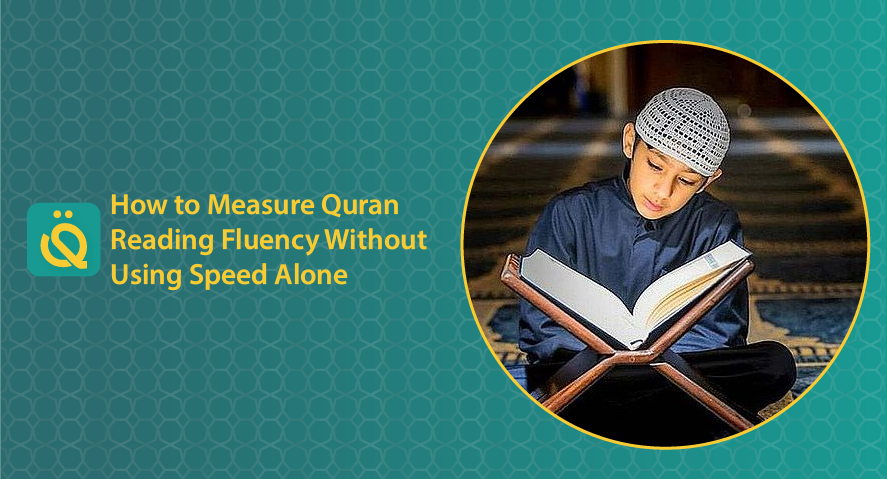
Learning how to measure Quran reading fluency is important because faster reading does not always mean better reading.
A learner may complete a passage more quickly while making more mistakes, guessing unfamiliar words, losing Tajweed, or depending heavily on teacher prompts.
Another learner may read at almost the same speed as before but:
- Hesitate less
- Correct themselves more often
- Connect phrases more naturally
- Need fewer prompts
- Read unfamiliar Quranic text more accurately
The second learner may have made more meaningful progress.
Quran reading fluency should therefore be measured through reading quality, not speed alone.
Quick Answer: How Should You Measure Quran Reading Fluency?
Measure Quran reading fluency across six areas:
- Accuracy — Is the written Quranic text being read correctly?
- Hesitation — Are unnecessary pauses decreasing?
- Continuity — Can the learner connect more of the phrase naturally?
- Independence — Is less teacher prompting required?
- Transfer — Does the skill appear in unfamiliar Quranic text?
- Stamina — Does reading quality remain stable for longer?
A useful fluency check asks:
Is the learner reading more accurately, with fewer unnecessary pauses and less outside help, even when the passage changes?
That is more useful than asking only:
How many words or pages can the learner read per minute?
For the complete fluency framework, continue with Quran Reading Fluency: How to Read More Smoothly Without Losing Accuracy.
If basic decoding is still unstable, use the Noorani Qaida Online: Complete Beginner Guide before treating fluency measurement as the main priority.
Why Quran Reading Speed Alone Can Be Misleading
Speed is easy to measure.
That makes it attractive.
But it can hide several problems.
A learner may increase reading speed by:
- Guessing word endings
- Skipping vowel details
- Reducing pauses without improving recognition
- Ignoring pronunciation corrections
- Using memorized passages
- Rushing through difficult words
The stopwatch may show progress.
The recitation may not.
Consider:
| Reading Change | Does It Prove Better Fluency? |
|---|---|
| Same accuracy, fewer unnecessary pauses | Usually positive |
| Faster reading with more mistakes | No |
| Same speed with less prompting | Yes, meaningful progress |
| Faster familiar Surah only | Not enough evidence |
| Better unfamiliar-text reading | Strong evidence |
| Longer accurate phrases | Strong evidence |
Speed can be one signal.
It should never be the only one.
Measure Quran Reading Fluency Through Accuracy
Accuracy is the foundation.
Before asking whether reading became smoother, ask:
Is the learner still reading what is actually written?
Track repeated errors such as:
- Wrong letters
- Incorrect vowels
- Changed word endings
- Added sounds
- Missed reading patterns
- Guessed words
You do not need zero mistakes.
Instead, compare the pattern of errors over time.
Useful progress looks like:
repeated mistake → occasional mistake → self-corrected mistake → stable reading
If speed rises while accuracy falls, fluency has not improved.
Measure Hesitation, Not Just Reading Time
Two learners may take the same amount of time to read a passage.
But their reading can be very different.
Learner A
Pauses briefly at one difficult word, corrects it, then continues.
Learner B
Pauses after almost every word despite recognizing them correctly.
The total reading time may be similar.
The hesitation profile is not.
Track:
- Number of unnecessary pauses
- Length of pauses
- Where pauses occur
- Whether the same patterns repeatedly cause hesitation
- Whether the learner recovers independently
A useful question is:
Are pauses becoming more purposeful rather than simply becoming fewer?
Quran reading still requires appropriate stopping.
The goal is to reduce unnecessary hesitation, not eliminate all pauses.
Measure Phrase Continuity
Fluency begins to develop when accurate words start functioning together as phrases.
A learner may progress from:
word → stop → word → stop
to:
two connected words → short phrase → longer controlled phrase
Measure how much Quranic text can remain connected without accuracy collapsing.
| Stage | What Reading Looks Like |
|---|---|
| Word level | Each word is treated separately |
| Short connection | Two or three words remain connected |
| Phrase level | Short phrases flow with controlled pauses |
| Extended phrase | Longer segments remain accurate |
| Natural connected reading | Continuity increases without rushing |
If phrase-level reading is the main barrier, continue with From Word-by-Word Reading to Connected Quran Recitation.
Measure Teacher-Prompt Dependence
A learner may appear fluent because the teacher is providing hidden support.
For example:
learner hesitates → teacher gives first sound → learner completes word
That can happen so quickly that both teacher and learner stop noticing it.
Track how often support is needed.
A simple prompt scale can help:
| Level | Teacher Support |
|---|---|
| 1 | Full model needed |
| 2 | First sound or strong clue needed |
| 3 | Small prompt needed |
| 4 | Learner self-corrects |
| 5 | Independent reading |
The goal is not to force independence before the learner is ready.
It is to see whether support gradually decreases.
The same reading speed with fewer prompts is real progress.
Measure Fluency in Unfamiliar Quran Passages
Familiar material can exaggerate fluency.
A learner may know:
- The next word
- The expected rhythm
- The verse ending
- Previous teacher corrections
That reduces reading load.
To measure transfer, periodically use a short unfamiliar passage at the same general level.
Compare:
Familiar Reading
Useful for:
- Confidence
- Retention
- Connected reading
- Pronunciation stability
Unfamiliar Reading
Useful for:
- Independent decoding
- Real hesitation
- Guessing detection
- Transfer
- Prompt dependence
If unfamiliar reading gradually becomes closer to familiar reading, fluency is becoming more transferable.
For a dedicated unfamiliar-text method, continue with How to Practise Unfamiliar Quran Passages Without Memorizing Them.
Measure Quran Reading Stamina
Fluency may look good for five minutes and break down after fifteen.
That matters.
Observe whether:
- Accuracy remains stable
- Hesitation increases
- Guessing begins
- Pronunciation weakens
- Prompts increase
- Connected reading collapses
A learner who maintains the same quality for longer is improving even if raw reading speed does not change.
For the complete stamina framework, continue with How to Build Quran Reading Stamina Without Losing Accuracy.
A Practical Quran Reading Fluency Scorecard
You do not need a complicated scoring system.
Use a simple review like this:
| Area | Needs Support | Developing | More Stable |
|---|---|---|---|
| Accuracy | Frequent repeated errors | Errors reduce with correction | Mostly stable |
| Hesitation | Frequent unnecessary pauses | Some pauses remain | Pauses are more controlled |
| Continuity | Mostly word-by-word | Short phrases connect | Longer phrases remain connected |
| Independence | Heavy prompting | Occasional prompts | Mostly independent |
| Transfer | Familiar text only | Some new text succeeds | Skill works in unfamiliar passages |
| Stamina | Quality drops quickly | Moderate stability | Good reading lasts longer |
This is not an exam grade.
It is a tool for deciding:
What should the learner practise next?
How Often Should You Measure Quran Reading Fluency?
Do not turn every lesson into an assessment.
Use:
- Small observations during normal lessons
- A more focused check after a meaningful period of practice
The exact interval depends on:
- Lesson frequency
- Current reading level
- Practice consistency
- The skill being targeted
Avoid comparing:
one unusually strong day
with:
one unusually tired day.
Use several reading samples before deciding whether the learner has genuinely improved or stalled.
Use Similar Passages When Comparing Progress
Comparison becomes weak when the passages are completely different in difficulty.
For example:
Week 1:
simple familiar Surah
Week 4:
long unfamiliar passage with complex patterns
The second reading may look worse even if the learner improved.
For clearer measurement, compare passages with:
- Similar length
- Similar difficulty
- Similar familiarity
- Similar reading conditions
Then add an unfamiliar transfer test separately.
This gives you two useful questions:
Has the learner improved under similar conditions?
and:
Does the improvement survive somewhere new?
How to Create a Simple Quran Reading Baseline
Before trying to measure improvement, capture the starting point.
Use:
- One familiar passage
- One short unfamiliar passage
- The same general reading conditions
- A note of major errors
- The number of teacher prompts
- The main hesitation pattern
You do not need a complicated recording system.
A short note might say:
Familiar passage: accurate but word-by-word
Unfamiliar passage: frequent hesitation at connected words
Prompts: 7
Main target: phrase continuity
Later, compare the same dimensions.
That is more informative than:
“Reading seems better.”
What Does Real Quran Reading Fluency Progress Look Like?
Real progress may look like:
Before
- 6 repeated errors
- 8 prompts
- Frequent word-by-word pauses
- Strong familiar reading
- Weak unfamiliar reading
Later
- 3 repeated errors
- 3 prompts
- Several short phrases connected
- Familiar reading stable
- Unfamiliar reading less hesitant
The learner may still take almost the same total time.
But the quality of the reading has improved substantially.
That is exactly why speed alone is insufficient.
An Illustrative Example: Zayd Was Not Much Faster, but His Reading Was Better
Zayd’s parents expected fluency progress to mean noticeably faster reading.
After several weeks, his reading time had changed only slightly.
But his teacher noticed:
- Fewer restarts
- Less prompting
- Better unfamiliar-word decoding
- Longer connected phrases
- More self-correction
The stopwatch showed a small change.
The reading evidence showed much more.
This is an illustrative example, not a documented student case study.
The lesson is:
Progress can appear first in control and independence before it appears in speed.
How Do You Measure Improvement if the Learner Still Reads Slowly?
Slow reading can still improve.
Look for:
- More accurate first attempts
- Faster recovery after hesitation
- Less rechecking of familiar patterns
- Fewer teacher prompts
- Better phrase connection
- Smaller difference between familiar and unfamiliar passages
If slow reading itself remains the main barrier after these areas improve, continue with Why Can I Read Quran but Still Read Very Slowly?
What If Reading Gets Faster but Guessing Also Increases?
Then the fluency measurement is telling you something important:
speed increased before decoding became stable.
Do not celebrate the faster time and ignore the reading quality.
Reduce pace enough to restore accurate decoding.
Then rebuild continuity gradually.
For the dedicated guessing problem, continue with How to Stop Guessing Quran Words While Reading.
What If Tajweed Gets Worse as Fluency Improves?
That means the learner may be increasing continuity faster than Tajweed automaticity.
Measure:
- Which correction disappears first
- Whether it is stable at slower speed
- Whether it survives in short phrases
- Whether it transfers to unfamiliar text
If this pattern is consistent, continue with Why Does Tajweed Disappear When You Read Quran Faster?
Should You Count Quran Reading Mistakes?
You can—but raw error count needs context.
Ten minor self-corrected hesitations may be less concerning than two repeated word substitutions the learner never notices.
Consider:
- Type of mistake
- Frequency
- Repetition
- Self-correction
- Effect on reading flow
A useful distinction is:
one-time error
vs.
recurring pattern
Track patterns more carefully than isolated mistakes.
When Should You Repeat the Same Passage During Measurement?
Repeat when you want to check:
- Correction
- Retention
- Phrase continuity
- Reduced hesitation
But do not use repeated familiar material as the only fluency test.
After correction becomes stable, use another passage.
For the dedicated decision framework, continue with When Should You Repeat a Quran Passage and When Should You Move On?
How Should Parents Measure a Child’s Quran Reading Fluency?
Parents do not need to create formal scores.
Watch for practical changes:
- Does the child start reading with less hesitation?
- Do they attempt difficult words before asking for help?
- Are the same mistakes appearing less often?
- Can they read a short new passage?
- Do they remain focused for longer?
- Does the teacher report less prompting?
Avoid comparing the child with siblings or other students.
Compare:
the child today
with:
the same child several weeks earlier.
For broader guidance on choosing lessons and tracking a child’s learning experience, use the Online Quran Classes for Kids: Parent’s Guide.
When Should a Teacher Reassess the Fluency Plan?
Reassess when:
- The same hesitation persists for weeks
- Reading speed rises but accuracy falls
- Unfamiliar text remains dramatically weaker
- Prompt dependence does not decrease
- Stamina stays unchanged
- Practice feels repetitive without measurable improvement
The solution may be:
- A smaller target
- A different passage type
- More decoding work
- More connected reading
- Pronunciation correction
- Less prompting
Measurement should change the next teaching decision.
If it does not, it is only data collection.
Quran Reading Fluency vs. Tajweed Progress Measurement
These two assessments overlap but should remain separate.
Quran reading fluency measurement asks:
Is reading becoming more accurate, continuous, independent, transferable, and sustainable?
Tajweed progress measurement asks:
Are pronunciation and recitation rules becoming more accurate and stable?
A learner may improve in one before the other.
Do not merge both into one score.
If Tajweed itself is the primary measurement target, continue with How to Measure Tajweed Progress in Online Classes.
Frequently Asked Questions
1. How Do You Measure Quran Reading Fluency?
Measure accuracy, hesitation, connected reading, independence, transfer to unfamiliar text, and reading stamina rather than using speed alone.
2. Is Quran Reading Speed a Good Measure of Fluency?
It can be one signal, but it is not enough.
Faster reading with more mistakes or guessing is not stronger fluency.
3. How Do I Know My Quran Reading Is Improving?
Look for fewer repeated errors, less hesitation, more connected phrases, fewer prompts, stronger unfamiliar-text reading, and better reading stability over time.
4. Should I Time My Quran Reading?
You can use timing as secondary information, but do not make it the main measure.
Reading quality matters more.
5. How Often Should Quran Reading Fluency Be Measured?
Use small observations regularly and more structured comparisons after a meaningful period of consistent practice.
Conclusion: Measure Quran Reading Fluency by Quality, Not Speed Alone
Learning how to measure Quran reading fluency requires looking beyond a stopwatch.
Speed can improve while reading quality declines.
A better framework is:
Accuracy → hesitation → continuity → independence → transfer → stamina
Ask:
- Is the text more accurate?
- Are unnecessary pauses decreasing?
- Is the learner connecting more of the phrase?
- Is less help required?
- Does the skill work in unfamiliar text?
- Can the learner maintain the quality for longer?
If those areas improve, Quran reading fluency is developing—even when the learner is not dramatically faster.
The strongest fluency is not the fastest reading.
It is reading that becomes more accurate, more connected, and more independent over time.
Continue Your Quran Learning Journey
1. Does Your Reading Foundation Still Need Work?
Use Reading Quran in Arabic when Arabic-script decoding still needs strengthening.
2. Is Pronunciation the Main Barrier?
Continue with Learn Quran Online With Tajweed: Makharij and Pronunciation Correction when articulation itself needs focused correction.
3. Is Hifz One of the Learner’s Goals?
Use the Complete Guide to Quran Hifz for Kids to understand how reading, memorization, revision, and sustainable workload fit together.
Stay Connected With Qibla Academy
Follow Qibla Academy on Facebook, Instagram, Telegram, and X.
For questions about Quran-reading lessons or your current fluency level, contact Qibla Academy through WhatsApp.
Prefer to Measure Your Quran Reading Fluency With a Teacher?
Read one familiar and one unfamiliar Quran passage during a trial lesson and ask the teacher to compare your accuracy, hesitation, independence, phrase continuity, and reading stamina.