Noorani Qaida for adults can be a practical starting point for anyone who wants to read the Quran but cannot yet recognize Arabic letters confidently or combine them into words.
Adults often worry that they are starting too late.
They are not.
The real question is not age.
It is:
Which Quran-reading skills are already stable, and which foundation should come next?
An adult beginner may start with individual Arabic letters, while another may already know the alphabet but struggle with connected forms, Sukoon, Shaddah, or basic vowel patterns.
The right Noorani Qaida starting point should match the learner’s actual reading level.
Quick Answer: Can Adults Learn Noorani Qaida From Scratch?
Yes.
Adults can learn Noorani Qaida from the beginning even if they:
- Do not speak Arabic
- Cannot recognize all Arabic letters
- Have never studied Quran reading formally
- Learned some letters years ago but forgot them
- Can recite memorized Surahs but cannot read unfamiliar Quranic text
A useful progression is:
recognize → pronounce → combine → read → repeat → apply independently
Adults do not need to rush through the early lessons simply because the material looks basic.
A strong foundation makes later Quran reading easier.
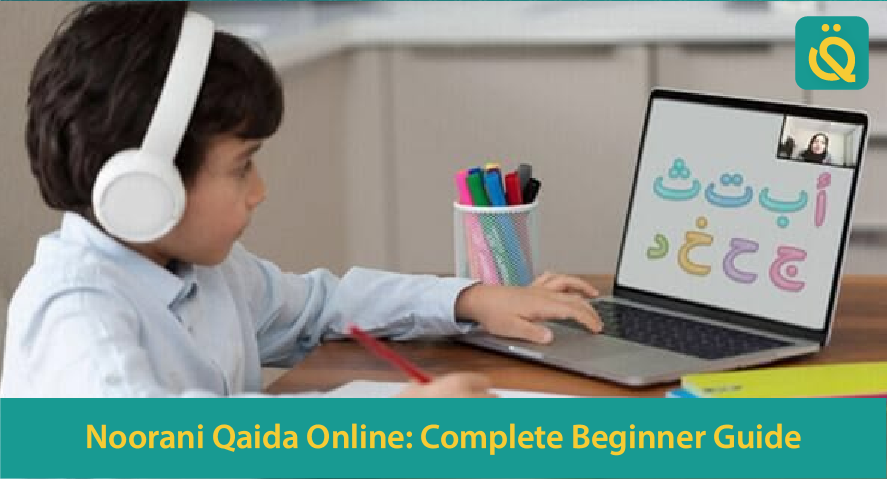
For the complete Noorani Qaida curriculum and sequence, continue with Noorani Qaida Online: Complete Beginner Guide.
What Does Noorani Qaida for Adults Teach?
Noorani Qaida for adults builds the basic decoding skills used in Quran reading.
A beginner may gradually learn:
- Arabic letters
- Different letter forms
- Short vowels
- Tanween
- Sukoon
- Shaddah
- Basic long vowels
- Connected combinations
- Early Quranic reading patterns
The goal is not to memorize terminology.
The goal is to recognize a written pattern and read it correctly with less help over time.
Where Should an Adult Beginner Start Noorani Qaida?
Adults should not automatically start from page one.
The starting point should depend on what they can already do.
| Current Ability | Possible Starting Point |
|---|---|
| Cannot recognize Arabic letters | Individual letters |
| Knows some letters but confuses them | Letter recognition and comparison |
| Knows the alphabet but cannot join sounds | Connected forms and vowel patterns |
| Reads simple combinations | Sukoon, Shaddah, and more complex patterns |
| Reads some Quran independently | Assess specific gaps before using the full Qaida |
A short reading assessment can prevent two common problems:
- Starting too far ahead
- Spending weeks repeating skills that are already stable
The best Noorani Qaida lesson begins at the first genuine gap, not simply the first page.
Is Noorani Qaida for Adults Different From Noorani Qaida for Kids?
The reading foundations may be similar, but the teaching style should be different.
Adults can often:
- Understand explanations faster
- Ask precise questions
- Compare patterns consciously
- Practise independently between lessons
- Recognize why a mistake keeps happening
Children may need more repetition, visual support, and shorter tasks.
An adult lesson therefore does not need to feel childish simply because the learner is studying beginner material.
The curriculum can remain foundational while the teaching style stays respectful and age-appropriate.
For the child-specific pathway, continue with Noorani Qaida for Kids: When and How Should Children Start?
Do Adults Need to Know Arabic Before Starting Noorani Qaida?
No.
Knowing conversational Arabic is not a requirement for beginning Noorani Qaida.
A learner can build Quran-reading skills without already speaking Arabic fluently.
What matters initially is learning how the written Arabic pattern connects to the correct sound.
An adult may understand very little spoken Arabic but still learn to:
- Recognize letters
- Read vowel patterns
- Join sounds
- Decode Quranic words
Language comprehension and Quran decoding are related learning goals, but they are not the same skill.
Why Do Some Adults Find Noorani Qaida Difficult at First?
Adult beginners may face challenges that children do not always experience in the same way.
1. Trying to Progress Too Quickly
Adults may feel embarrassed by beginner material and want to move immediately into Quran pages.
That can leave foundation gaps unresolved.
2. Translating Arabic Sounds Into English Letters
Romanized spellings can help briefly, but depending on them too heavily may prevent direct Arabic recognition.
3. Fear of Making Mistakes
Some adults hesitate to read aloud because they feel they “should already know.”
But correction requires the teacher to hear the reading.
4. Old Reading Habits
A learner who has recited familiar Surahs from memory for years may discover that memorized pronunciation and independent decoding are different skills.
The solution is not to study faster.
It is to identify the specific reading foundation that needs correction.
Can Adults Learn Noorani Qaida Online?
Yes.
Online Noorani Qaida for adults can work well when lessons remain interactive.
A useful lesson includes:
- Teacher modelling
- Adult learner reading aloud
- Immediate correction
- Another attempt
- An unfamiliar example
- Short review of earlier skills
The adult should spend meaningful lesson time reading rather than only listening.
Online learning can also make scheduling easier for adults balancing work, family responsibilities, and other commitments.
The delivery format matters less than whether the learner receives enough accurate reading practice and feedback.
Can Adults Learn Noorani Qaida Without a Teacher?
Some adults can independently review letters and familiar patterns.
The harder part is verifying pronunciation and recognizing errors that feel correct to the learner.
Self-study is most useful for:
- Review
- Repetition
- Familiar exercises
- Testing recall
Teacher feedback becomes more valuable when:
- Similar sounds remain confusing
- The same mistake keeps returning
- The learner cannot tell whether pronunciation is accurate
- Familiar pages are easy but new examples are difficult
For the full self-study comparison, continue with Can You Learn Noorani Qaida Online Without a Teacher?
How Should Adults Practise Noorani Qaida?
Adult learners often benefit from short, regular practice rather than occasional long sessions.
A simple routine can be:
- Review the current pattern.
- Read several examples without hearing them first.
- Repeat the difficult example.
- Try the same pattern in a different combination.
- Note one problem to ask the teacher about.
The practice should stay focused.
If Sukoon is the current problem, there is little value in introducing several unrelated patterns in the same session.
For the detailed routine, continue with How to Practise Noorani Qaida at Home.
A Short Adult-Learner Example
Ahmed had memorized several short Surahs but found it difficult to read unfamiliar Quranic words independently.
Instead of treating him as if he knew nothing, the learning plan focused on the foundation gaps that appeared during reading.
He reviewed selected Noorani Qaida patterns, practised connected reading, and received correction on the combinations that repeatedly caused hesitation.
The important change was not “finishing the book.”
It was becoming less dependent on memory and more able to decode what was written.
This is an illustrative example, not a documented student case study.
The point is simple:
An adult may already know parts of Quran recitation while still benefiting from targeted Noorani Qaida foundations.
How Do Adults Know Noorani Qaida Is Working?
Look for changes in actual reading.
Progress may appear as:
- Faster letter recognition
- Less hesitation with connected forms
- Fewer repeated vowel errors
- Better reading of unfamiliar combinations
- Less reliance on transliteration
- Less teacher prompting
- Greater confidence attempting new Quranic words
Completed pages can provide context.
They should not be the only measure.
A stronger question is:
Can I read a pattern I have not memorized before?
That shows whether the skill is transferring.
When Should an Adult Move From Noorani Qaida to Quran Reading?
The transition can begin when the main reading patterns are becoming stable.
Useful signs include:
- Connected letters are recognized with less hesitation
- Short vowels are generally accurate
- Sukoon and Shaddah are becoming manageable
- Short and long vowels sound more distinct
- Unfamiliar combinations can be attempted independently
- Simple Quranic words require less support
The learner does not need perfect fluency before beginning Quranic text.
Qaida and Quran reading can overlap gradually.
For the complete transition process, continue with What Comes After Noorani Qaida? From Qaida to Quran Reading and Tajweed.
Noorani Qaida for Adults vs. General Learn Quran Online Courses
These search intents should stay separate.
Noorani Qaida for adults focuses on:
building the foundational reading skills needed by an adult beginner.
A broader Learn Quran Online pathway may include:
- Quran reading
- Tajweed
- Recitation correction
- Memorization
- Further learning goals
If your foundation is already stronger than Qaida level and you need the wider learning path, use How to Learn Quran Online.
This article intentionally remains focused on the adult beginner foundation.
Frequently Asked Questions
1. Can Adults Learn Noorani Qaida?
Yes.
Noorani Qaida can be used by adults who need structured Quran-reading foundations, including complete beginners.
2. Is Noorani Qaida Only for Children?
No.
The foundational reading skills can be useful for learners of different ages. The teaching style and pace should simply match the adult learner.
3. Can I Learn Noorani Qaida if I Do Not Speak Arabic?
Yes.
Speaking Arabic fluently is not required to begin learning Arabic letters and Quran-reading patterns.
4. Is It Too Late to Learn Noorani Qaida as an Adult?
No.
Adult learners can begin Quran reading foundations at any age. Starting level and consistent practice matter more than age.
5. Do I Need to Complete All of Noorani Qaida?
Not always.
An adult with existing reading skills may need only targeted review. A short
assessment can identify whether the full Qaida sequence is necessary.
Conclusion: Noorani Qaida for Adults Can Start at Any Level
Noorani Qaida for adults is not about returning to childhood education.
It is about identifying the Quran-reading foundation that is missing and strengthening it systematically.
An adult may need to begin with Arabic letters.
Another may need only connected reading, Sukoon, Shaddah, or vowel correction.
Use this process:
identify the starting level → learn the pattern → read aloud → receive correction → test independently
Do not measure success only by how quickly the Qaida is completed.
Measure whether unfamiliar Quranic reading is becoming easier and less dependent on help.
The purpose of Noorani Qaida is the same at any age:
to build a stronger foundation for independent Quran reading.
Continue Your Quran Learning Journey
1. Are Pronunciation Problems Slowing Your Reading?
Continue with Learn Quran Online With Tajweed: Makharij and Pronunciation Correction when articulation—not basic decoding—is the main difficulty.
2. Ready to Add Tajweed After Building Your Reading Foundation?
Use Learn Quran Tajweed Online: A Complete Beginner Roadmap to understand how pronunciation and Tajweed rules fit together after basic reading becomes more stable.
3. Want Live Quran Learning With a Qualified Teacher?
Review Qibla Academy’s Quran Teachers when you are ready to compare teacher backgrounds and choose appropriate support.
Prefer to Find Your Starting Point First?
Read a short unfamiliar Arabic or Quranic sample during an assessment and ask the teacher whether your first priority should be Arabic letters, connected reading, vowel patterns, or direct Quran reading.