
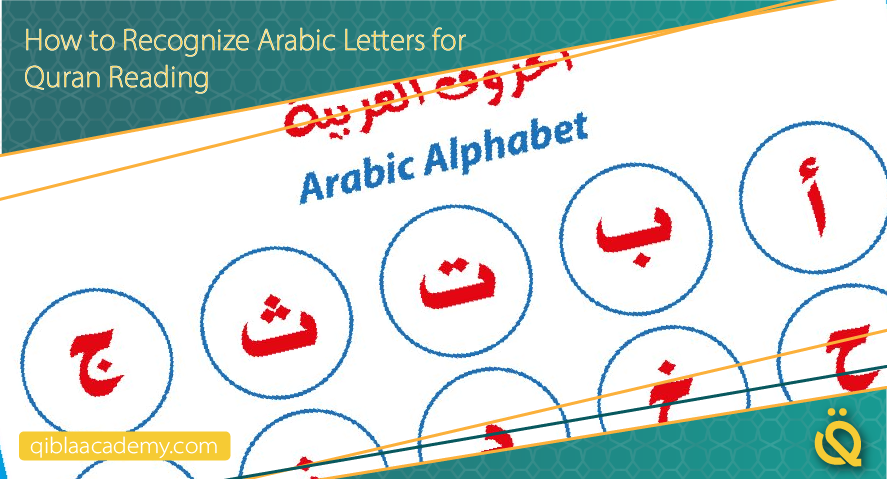
How to Recognize Arabic Letters for Quran Reading
Learning Arabic letters for Quran reading requires more than memorizing the alphabet in order.
A beginner may recite many letter names but fail to recognize them when the order changes. Another learner may identify the correct shape but connect it with the wrong sound.
Real letter recognition combines three elements:
- The main written shape
- The number and position of dots
- The basic sound connected with the letter
For the complete learning journey, begin with the complete roadmap to learn Quran online. To see where letter recognition fits inside the wider skill order, review First Quran Learning Skills: A Step-by-Step Beginner Sequence.
This article focuses on one foundation:
How can a beginner recognize isolated Arabic letters accurately enough to begin joined-form practice?
Quick Answer: How Do You Learn Arabic Letters for Quran Reading?
Learn Arabic letters for Quran reading by studying each letter as a combination of shape, dots, and sound. Practise small letter groups, compare similar-looking families, test recognition in mixed order, and review the same letters later.
Use this sequence:
See the shape → check the dots → hear the sound → repeat it → identify the letter later
The skill is becoming stable when the learner recognizes letters outside alphabet order, distinguishes similar forms, and produces reasonably consistent sounds with less prompting.
Arabic Letter Recognition Check
Use this table to identify what is preventing reliable recognition.
| Learner Performance | What It Shows | Best Next Step |
|---|---|---|
| Recites letters only in alphabet order | The sequence may be memorized | Test letters in mixed order |
| Recognizes a letter only on one familiar page | Recognition depends on layout | Show it in a new layout |
| Confuses letters from one shape family | Dots are not being checked carefully | Compare the related letters directly |
| Identifies the shape but gives the wrong sound | Shape-to-sound connection is unstable | Repeat and review a clear sound model |
| Recognizes isolated letters but not connected forms | Recognition has not transferred into words | Begin simple joined-form practice |
| Recognizes letters in unfamiliar examples | Recognition is transferring | Add short connected combinations |
A learner does not need instant answers during the first lessons. However, recognition should gradually require less hesitation and fewer reminders.
Use unfamiliar examples because the exact order, flashcard, or page may become memorized.
For example, a learner may identify Baa correctly on one repeated worksheet but confuse it when the same letter appears beside Taa and Thaa on another page.
The purpose of testing is not to make the learner feel unsuccessful. It is to discover whether recognition depends on the actual letter or only on a familiar exercise.
Learn Each Letter Through Shape, Dots, and Sound
For every letter, notice:
- Its main shape
- The number of dots
- The position of the dots
- Its basic sound
- The similar letters it may be confused with
Use this learning cycle:
Look at the letter → check the dots → hear the sound → repeat it → identify it again later
The learner does not need to describe every feature verbally forever. This is a temporary recognition process that should become faster and more automatic with practice.
A learner who looks only at the general outline may confuse several letters. Checking both shape and dots provides stronger evidence for the correct answer.
For example, Baa, Taa, and Thaa share a similar base form. The number and position of dots distinguish them.
The learner should pause long enough to inspect the complete letter rather than guess from its general shape.
Simple tracing or copying may support learners who continue to confuse a letter’s structure or dot placement, but handwriting does not need to become a separate calligraphy lesson.
Compare Similar-Looking Letter Families
Several Arabic letters share one basic shape. Studying them as families helps the learner focus on the detail that changes.
| Shape Family | Letters | Main Difference |
|---|---|---|
| Baa family | ب ت ث | Number and position of dots |
| Jeem family | ج ح خ | Dot below, no dot, or dot above |
| Daal family | د ذ | No dot or one dot above |
| Raa family | ر ز | No dot or one dot above |
| Seen family | س ش | No dots or three dots above |
| Saad family | ص ض | No dot or one dot above |
| Taa family | ط ظ | No dot or one dot above |
| Ayn family | ع غ | No dot or one dot above |
| Faa and Qaaf | ف ق | Dot number and printed form |
Study one family at a time.
Use this process:
Compare → identify the changing detail → mix the order → test again later
The family label is a temporary comparison aid. The learner should eventually recognize each letter independently without mentally reciting the complete family.
For example, a learner may first compare Jeem, Haa, and Khaa side by side. Once the dot difference is clear, the letters should be mixed with unrelated forms so recognition no longer depends on the comparison layout.
Avoid introducing several difficult families during the same short practice session. One clear contrast is more useful than many comparisons that the learner cannot retain.
Connect Every Letter With Its Basic Sound
Visual recognition alone does not create Quran reading. The learner must connect the written symbol with a reasonably consistent sound.
Use this process:
Teacher models → learner repeats → teacher corrects → learner repeats again → sound is reviewed later
The first objective is not to teach a complete articulation-point course for every letter. It is to create a stable connection between the symbol and its basic sound.
A correction should not be judged only by one successful repetition. Review the sound again later to check whether it was retained.
When two letters repeatedly sound identical, compare them directly and focus on one contrast at a time.
A learner may correctly point to the letter but pronounce the sound associated with another one. This means the visual shape is becoming familiar while the sound connection remains unstable.
The teacher should avoid introducing several pronunciation corrections at once. One clear model, repeated carefully, is more useful than a long theoretical explanation the learner cannot apply.
Detailed Tajweed and articulation instruction belongs in the specialist Tajweed content, not in this letter-recognition article.
Transliteration may provide temporary support, but independent Quran reading requires a direct connection between the Arabic symbol and its sound.
Test Letters Outside Alphabet Order and Familiar Layouts
Alphabet order is useful for organization, but Quranic words do not present letters in that sequence.
Practise letters:
- In mixed order
- In small groups
- Beside similar-looking letters
- On a new page or screen
- At a slightly different size
- After a short delay
Begin with a manageable letter group. Introduce four or five letters, practise them clearly, and rearrange their order. Add new letters gradually while reviewing earlier ones.
Do not change fonts constantly during the earliest stage. First establish the main shape, then introduce controlled variation.
The aim is to recognize the letter itself rather than memorize its position on one page.
A learner who always sees Alif first and Baa second may depend on sequence clues. Presenting Baa before Alif reveals whether the letter is genuinely recognized.
Changing the layout can also show whether the learner recognizes the form or remembers only where it appeared on a specific worksheet.
Controlled variation should remain simple. The goal is not to make recognition unnecessarily difficult. It is to confirm that the skill transfers beyond one familiar presentation.
When Should Joined-Form Practice Begin?
Arabic letters may change shape according to their position inside a word.
A learner who recognizes isolated letters may still become confused when those letters connect. This does not necessarily mean the alphabet was forgotten. It means isolated recognition has not yet transferred into words.
Begin simple joined-form practice when most letters in the current group can be recognized independently and connected with reasonably consistent sounds.
Use short two-letter and three-letter combinations rather than long Quranic words.
The learner should still be able to identify the letters inside the combination. If every connected form requires guessing, return briefly to matching isolated and joined shapes.
This article should only explain the transition. For detailed connected-form instruction, continue with Why Joining Arabic Letters Feels Difficult.
Use a Short Letter-Recognition Routine
Practise one manageable letter group at a time.
Use this pattern:
Review known letters → mix their order → compare one confusing pair → produce the sound → test again later
A short session may include:
- Review four or five known letters.
- Add one or two new letters.
- Mix the complete group.
- Compare one similar-looking pair.
- Produce the sound of each letter.
- Find one familiar letter inside a simple connected form.
The exact group size depends on the learner. Reduce the number when earlier letters are repeatedly forgotten.
A complete beginner may need a small group with repeated review. A returning learner may move through familiar letters quickly but spend more time on one shape family.
Practice should end before guessing and frustration take over.
The learner should not move randomly between several alphabet videos, flashcards, books, and applications. Use one main sequence and treat other resources as support.
The purpose of the routine is to strengthen recognition, not to complete the alphabet as quickly as possible.
How to Know Whether Letter Recognition Is Improving
Use three checks:
- Independence: Does the learner need fewer prompts?
- Transfer: Can the letter be recognized in a different order, layout, or simple word?
- Retention: Is the same letter recognized in a later lesson?
Do not require instant recognition of every letter before introducing any connected forms.
However, most letters in the current group should be familiar enough that joined-form practice does not become continuous guessing.
Use this decision rule:
Move forward when the learner recognizes the letter in unfamiliar examples with less help—not merely when one flashcard set feels easy.
For example, a learner who identifies Taa on one familiar card should also recognize it beside Baa and Thaa, on a different page, and after a short delay.
Recognition is becoming useful when it survives these small changes.
A learner may still hesitate occasionally. The important evidence is that the hesitation decreases and the learner uses shape and dot information instead of guessing.
Letter-Recognition Problem, Cause, and Adjustment
| Problem | Likely Cause | Practical Adjustment |
|---|---|---|
| Letters are forgotten by the next lesson | Too many letters were introduced | Use smaller groups and spaced review |
| Similar letters are confused | Dot details are overlooked | Compare one shape family directly |
| Letter is recognized but the sound is wrong | Shape-to-sound link is unstable | Repeat a clear model and review later |
| Alphabet order is remembered but random letters are not | The sequence was memorized | Test mixed-order recognition |
| A new layout looks unfamiliar | Recognition depends on one presentation | Introduce controlled variation |
| Connected forms are not recognized | Isolated forms have not transferred | Begin simple joined-form matching |
| Learner guesses quickly | The recognition process is rushed | Pause and check shape and dots |
| Practice feels overwhelming | Too many targets are active | Reduce the current letter group |
Identify the most likely cause before changing the complete learning method.
Change one factor at a time. Reduce the letter group or simplify the task before replacing the teacher, book, and practice method together.
For example, if letters are forgotten between lessons, reduce the number and add delayed review. Changing the complete course may not be necessary.
If the learner recognizes letters but gives inconsistent sounds, keep the visual practice while adding more focused sound modelling.
If one new font causes confusion, return briefly to the familiar form and introduce controlled variation more gradually.
Common Mistakes When Learning Arabic Letters
1. Memorizing Alphabet Order Only
Alphabet recitation does not prove independent letter recognition. Test letters in mixed order.
2. Ignoring Dot Position
Dots may be the main feature separating letters that share the same basic shape.
3. Learning Shapes Without Sounds
Quran reading requires a direct connection between the written symbol and pronunciation.
4. Introducing Too Many Letters at Once
Large groups make it difficult to identify which letters are causing confusion.
5. Using One Familiar Page Only
Repeated layouts may become memorized. Introduce controlled unfamiliar examples after the main shape is understood.
How Qibla Academy Can Support Arabic Letter Recognition
Use a trial lesson to check whether the learner needs complete letter instruction, targeted family comparison, sound correction, or simple joined-form practice.
Ask the teacher to:
- Use a short mixed-order sample
- Identify which letters or families cause confusion
- Check both visual recognition and sound
- Explain how many letters should be introduced at once
- Assign one focused practice task
- Test the same letters again later
- Explain when joined-form practice should begin
The recommendation should reflect demonstrated ability rather than placing every beginner on the same page.
A useful trial should show whether the difficulty comes from shape recognition, dots, sound association, memory, or readiness for connected forms.
The learner should receive one clear practice task rather than a broad instruction to memorize the complete alphabet.
You can compare Qibla Academy’s Quran Teachers and review the Current Class Plans before selecting regular lessons.
Check Your Arabic Letter Starting Point
Attempt a short mixed-order sample, receive correction, and ask which letter group should come first.
Frequently Asked Questions
1. How Can I Memorize Arabic Letters for Quran Reading?
Study small groups, connect each shape with its sound, compare similar-looking families, and test the letters in mixed order. Independent recognition is more useful than alphabet recitation alone.
2. Why Do Arabic Letters Look Different Inside Words?
Arabic letters may change shape according to whether they appear in isolated, initial, medial, or final positions. The main identifying features still belong to the same letter.
3. Should I Learn Arabic Letter Names or Sounds First?
Both are useful, but Quran reading depends directly on recognizing the written letter and producing its expected sound. Do not learn names without practical sound association.
4. How Many Arabic Letters Should a Beginner Learn at Once?
There is no fixed number. Use a group small enough for the learner to recognize, pronounce, mix, and review without repeated confusion.
5. When Should I Start Joining Arabic Letters?
Begin simple joined-form practice when most letters in the current group can be recognized independently and connected with reasonably consistent sounds.
Conclusion: Build Reliable Letter Recognition Before Longer Words
Arabic letters for Quran reading should be learned through shape, dots, sound, and repeated recognition.
Do not measure progress only through alphabet recitation, completed pages, or one familiar flashcard set.
Check whether the learner can:
- Recognize letters in mixed order
- Distinguish similar-looking families
- Connect each letter with a more consistent sound
- Identify letters in a different layout
- Remember the same letters later
If alphabet order is remembered but random letters are difficult, continue mixed-order recognition. If dots cause confusion, compare one shape family. If the shape is clear but the sound is unstable, strengthen the shape-to-sound connection.
When isolated letters and sounds become reliable, begin simple joined-form practice.
A stable letter-recognition foundation makes connected forms, vowel marks, word decoding, and guided Quran reading easier to build.