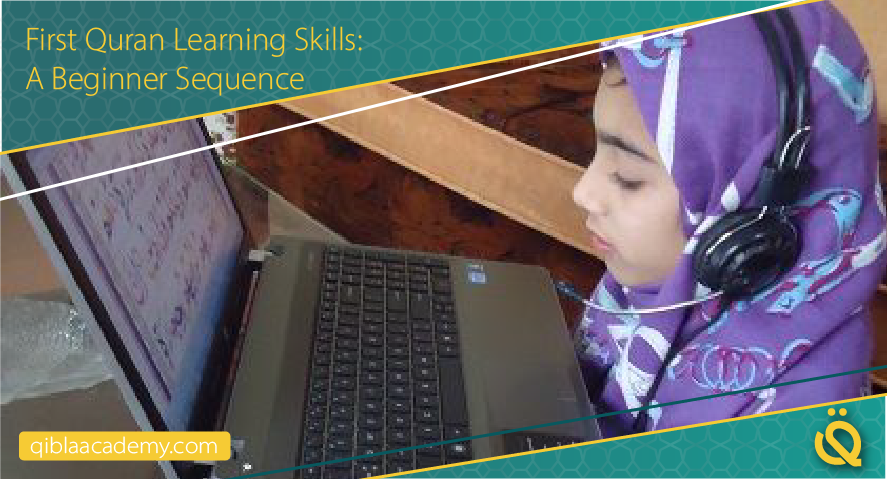
First Quran Learning Skills: A Step-by-Step Beginner Sequence
The first Quran learning skills should build on one another in a clear sequence.
A beginner normally starts by recognizing Arabic letters and connecting them with their sounds. The next stages include joined forms, vowel marks, short-word decoding, guided verse reading, and applied pronunciation correction.
Problems often appear when a learner moves forward before an earlier skill is usable in unfamiliar material. Someone may know the alphabet but become confused inside words. Another learner may read a repeated page but struggle when the layout or word changes.
For the complete learning journey, begin with the complete roadmap to learn Quran online. Learners who cannot identify their current reading problem should first review How to Start Reading Quran When You Cannot Read Arabic.
This guide focuses on a different question:
Which Quran reading skill should come next, and what evidence shows that the learner is ready to move forward?
Quick Answer: What Are the First Quran Learning Skills?
The first Quran learning skills are letter recognition, basic letter sounds, joined-form recognition, vowel-mark reading, short-word decoding, guided verse reading, and applied pronunciation correction. Each skill should become usable in unfamiliar material before the learner moves to the next stage.
Use this sequence:
Letter recognition → letter sounds → joined forms → vowel marks → decoding → guided verses → applied pronunciation
The goal is not to complete every beginner book. It is to build a connected reading process in which each skill supports the next one.
The First Quran Learning Skills in the Right Order
| Stage | Skill | What the Learner Should Do | Evidence of Readiness |
|---|---|---|---|
| 1 | Letter recognition | Identify letters outside alphabet order | Recognizes letters in mixed exercises |
| 2 | Basic letter sounds | Connect each letter with its basic sound | Produces the sound more consistently |
| 3 | Joined-form recognition | Identify letters inside connected words | Recognizes the same letter in different positions |
| 4 | Vowel-mark reading | Use written marks to determine the sound | Reads short marked examples accurately |
| 5 | Short-word decoding | Combine letters and marks without guessing | Reads unfamiliar words using the same process |
| 6 | Guided verse reading | Read short Quranic phrases with feedback | Needs fewer prompts and remembers corrections |
| 7 | Applied pronunciation | Correct recurring sounds during recitation | Applies feedback in later words and lessons |
The stages are connected, but they are not age levels.
A child, teenager, or adult may begin at any stage according to demonstrated ability. A returning learner may need targeted review rather than repeating the complete sequence.
The correct stage is the earliest skill that remains unreliable in unfamiliar material. A learner should not move forward only because a book, page, or exercise has been completed.
Skill 1: Recognize Arabic Letters
The first skill is recognizing individual Arabic letters independently.
Reciting the alphabet in order does not always prove recognition because the sequence itself may have been memorized. Test letters in mixed order and beside similar-looking forms.
The learner does not need instant recognition at first. However, hesitation should gradually decrease, and each letter should remain recognizable when the layout changes.
This distinction matters because Quranic words do not present letters in alphabet order. The student needs to recognize the written form without depending on the letter that appeared immediately before it.
A learner is ready to continue when most letters can be identified without depending on alphabet order or repeated prompts.
For focused instruction, continue with How to Recognize Arabic Letters for Quran Reading.
Skill 2: Connect Letters With Their Sounds
Recognizing a written letter is not enough. The learner must also connect it with a consistent basic sound.
Use this learning cycle:
See the letter → hear a clear model → repeat the sound → identify and repeat it later
The teacher should correct important sound differences without turning the foundation stage into a complete advanced Tajweed lesson.
Some learners correctly identify a letter visually but produce a sound associated with another letter. Others repeat the correct model once but return to the earlier pronunciation during the next example.
For this reason, the sound should be checked more than once and in more than one lesson.
The skill is becoming stable when the learner produces the sound more consistently across several attempts and remembers the correction later.
The immediate objective is not advanced theoretical knowledge. It is creating a reliable connection between the written letter, the sound heard from the teacher, and the learner’s own pronunciation.
Skill 3: Recognize Letters in Joined Forms
Arabic letters can change shape according to their position inside a word.
A learner who recognizes isolated letters may therefore become confused when the same letters appear connected. This does not mean the alphabet was forgotten; it means isolated recognition has not yet transferred into words.
Begin by matching isolated letters with their connected forms, then use short two-letter and three-letter combinations.
The learner should gradually understand that the underlying letter remains the same even when its visual form adapts to its position.
Joined-form recognition should be practised with more than one repeated word. A student may memorize the appearance of a familiar exercise without becoming able to identify the same letter elsewhere.
The skill is becoming stable when the learner can find the same letter at the beginning, middle, and end of unfamiliar words without guessing.
For a detailed explanation, continue with Why Joining Arabic Letters Feels Difficult.
Skill 4: Read Basic Quranic Vowel Marks
Once letters are recognizable, the learner needs to understand how written marks affect their sounds.
The main beginner marks are Fathah, Kasrah, Dammah, Sukoon, Shaddah, and basic Madd.
Teach one pattern clearly, practise it in short examples, and then test it in unfamiliar material. Long theoretical definitions are less useful when the learner still overlooks the written mark.
A student may identify all the letters in a word but pronounce it incorrectly because a vowel mark was missed. This is why learners should be encouraged to inspect the marks before attempting the complete word.
Introduce new patterns gradually. Combining several unfamiliar marks too early can make it difficult to identify the source of an error.
The skill is becoming stable when the learner notices the mark before producing the sound and applies the same pattern in a new word.
For detailed instruction, see How Beginners Learn Quranic Vowel Marks.
Skill 5: Decode Unfamiliar Short Words
Decoding means reading through the letters and marks instead of recognizing a word only because it has been memorized.
Use this process:
Identify the letters → notice the marks → produce the sounds → combine carefully
A repeated word may become familiar without proving genuine reading. Test the same pattern in a new word.
For example, a learner may read a word correctly after seeing and hearing it several times. When presented with a different word containing the same pattern, the learner should attempt the same reading process rather than depend on memory.
The purpose of decoding practice is to combine the earlier skills into one usable reading method.
The skill is becoming stable when the learner can decode unfamiliar short words with less prompting and without guessing from the first letter.
Careful decoding should come before speed. Reading quickly is not useful when the learner skips letters, ignores vowel marks, or invents familiar endings.
Skill 6: Read Short Quranic Verses With Guidance
Foundational exercises should eventually transfer into Quranic text.
Begin with a short phrase or verse rather than a full page. The selected passage should contain patterns the learner has already practised while still providing a small, manageable challenge.
Use this correction flow:
Student reads → teacher identifies the main error → teacher models it → student repeats → student reads in context → teacher checks it later
Correction should focus on the most important recurring problem instead of interrupting every sound equally.
The aim is to help the learner use letter recognition, marks, and decoding inside authentic Quranic text without becoming overwhelmed by the length of the passage.
A short unfamiliar phrase can reveal whether the student is applying the reading process or relying on memorized recitation.
The skill is becoming stable when the learner reads short unfamiliar passages with fewer pauses, less guessing, and better recall of previous corrections.
Learners whose main need is guided reading can review the Quran Recitation Course.
Skill 7: Retain Basic Pronunciation Correction
Basic pronunciation correction can begin during early Quran lessons.
A learner should hear the difference, repeat the correct model, apply it in the current word, and remember the correction when the same sound appears later.
The goal is not to memorize every advanced Tajweed rule before reading. It is to retain the pronunciation feedback that directly affects current recitation.
A student may produce the corrected sound accurately immediately after the teacher but forget it in the next lesson. This means the learner can imitate the model, but the correction has not yet become stable.
Practice between lessons should therefore return to one or two priority sounds rather than attempt to correct every pronunciation issue simultaneously.
The skill is becoming stable when an earlier correction appears in later reading without a complete explanation from the teacher.
For detailed Tajweed instruction, continue with Learn Quran Online With Tajweed.
How to Know When a Quran Skill Is Stable
Completing a page or chapter does not automatically prove readiness.
Use three checks:
- Independence: Can the learner perform the skill with less prompting?
- Transfer: Can the learner use it in unfamiliar material?
- Retention: Does the skill or correction remain in a later lesson?
A familiar page may become easy because it has been repeated several times. Transfer tests whether the learner understands and can use the skill beyond that exact material.
Retention is equally important. A correction that disappears before the next lesson may need more focused practice before the student moves forward.
Use this decision rule:
Move forward when the learner can apply the skill in new material with less help—not merely when familiar exercises feel easy.
Moving forward does not mean abandoning previous foundations. Earlier skills should continue to appear during practice and review.
Problem, Missing Skill, and Practical Adjustment
| Learning Problem | Likely Missing Skill | Practical Adjustment |
|---|---|---|
| Alphabet is remembered but words are unreadable | Joined-form recognition | Practise letters inside short combinations |
| Correct letters are identified but sounds are wrong | Sound association | Repeat clear models with focused correction |
| Letters are clear but words are guessed | Vowel marks or decoding | Slow down and check each mark |
| Familiar exercises are easy but new ones are difficult | Skill transfer | Add unfamiliar examples |
| Short words are possible but verses contain many pauses | Guided phrase reading | Use shorter passages with repeated patterns |
| Corrections disappear by the next lesson | Retention | Repeat one corrected skill between lessons |
| Reading becomes less accurate at speed | Accuracy before fluency | Reduce speed and prioritize decoding |
| Several skills remain weak | Starting level is too advanced | Return to the earliest unstable foundation |
Identify the earliest missing skill before changing the complete programme.
Change one factor at a time. Replacing the teacher, book, schedule, and level together makes it difficult to know which adjustment helped.
For example, if a learner recognizes letters but cannot read joined words, changing to an advanced Tajweed course will not repair the missing connected-form skill. The adjustment should address the earliest unstable stage.
Does Every Learner Spend the Same Time on Each Skill?
No. The sequence is connected, but the time spent at each stage depends on demonstrated ability.
A complete beginner may need structured work across all seven skills. A returning learner may recognize letters and marks but need review of joined forms or decoding. Use unfamiliar material to identify where focused practice should begin.
Age alone should not determine the starting point. An adult may need letter recognition from the beginning, while a child with previous study may be ready for guided verse reading.
Likewise, completing a beginner book does not prove that every skill is stable. The learner should still demonstrate recognition, decoding, and retained correction outside familiar pages.
The sequence remains the same, but learners may enter it at different stages and progress at different speeds.
How to Practise the First Quran Learning Skills
Practice should reinforce the current skill rather than introduce several unrelated topics.
Use this pattern:
One focused lesson → short practice → one unfamiliar example → teacher review
The task should be specific. For example, the learner may identify a small letter set, match joined forms, read one vowel pattern, decode several unfamiliar words, or repeat one corrected sound.
A specific instruction gives the learner a clear purpose and makes the next review more useful.
“Practise Quran reading” is too broad for a beginner who does not know whether the current problem is letter recognition, marks, decoding, or pronunciation.
Short, regular practice is generally easier to maintain than long, unfocused sessions.
Quran.com may support listening and following short passages, but it cannot confirm whether each sound is being produced accurately.
Use listening as support for a teacher’s correction, not as proof that the learner’s own pronunciation is correct.
Common Mistakes When Learning the First Quran Skills
1. Moving Forward Because a Page Was Completed
Page completion does not prove application. Test the skill in unfamiliar material.
2. Learning Letters Without Stable Sounds
Visual recognition alone does not create accurate reading. Connect each letter with a clear and repeatable sound.
3. Skipping Joined-Form Practice
A learner may know the alphabet but remain unable to recognize the same letters inside words.
4. Prioritizing Speed Before Accuracy
Reading faster while guessing reinforces an unreliable process. Accurate decoding should come first.
5. Using Only Familiar Examples
Familiarity can hide weak recognition, decoding, and retention. Include new examples that require the same skill.
How Qibla Academy Can Support Foundational Quran Skills
Once the learner’s earliest unstable skill is clear, use a trial lesson to check whether the teacher and learning plan match that need.
Ask the teacher to use a short unfamiliar sample and explain:
- Which skill should come first
- Why it is the current priority
- How it will be taught and corrected
- What should be practised between lessons
- How the skill will be tested in new material
- What evidence will show readiness for the next stage
The recommendation should reflect demonstrated ability rather than age or previous book completion.
A useful recommendation should identify one clear priority. Placing every learner in the same beginner material may overlook a specific gap or force a returning learner to repeat skills that are already stable.
You can compare Qibla Academy’s Quran Teachers and review the Current Class Plans before selecting regular lessons.
Identify the First Skill to Build
Read a short unfamiliar sample, receive initial feedback, and ask which Quran learning skill should come first.
Frequently Asked Questions
1. What Are the First Quran Learning Skills?
The first skills are letter recognition, basic letter sounds, joined forms, vowel marks, short-word decoding, guided verse reading, and applied pronunciation correction.
2. Should a Beginner Learn Letters or Tajweed First?
A complete beginner should usually build letter recognition and decoding while receiving basic pronunciation correction. Detailed Tajweed study can expand as reading becomes more stable.
3. How Do I Know Whether a Quran Skill Is Stable?
Check whether the learner can perform it with less prompting, apply it in unfamiliar material, and retain it in a later lesson.
4. When Is a Beginner Ready to Read Quran Verses?
A beginner may begin short guided verses when joined letters and basic vowel marks are recognizable and unfamiliar short words can be decoded with limited help.
5. Does Completing Noorani Qaida Prove That a Student Can Read Quran?
Not automatically. The learner should demonstrate the same skills in unfamiliar words and Quranic passages. Application is stronger evidence than page completion.
Conclusion: Build Each Quran Skill Before Moving Forward
The first Quran learning skills form a connected sequence.
Begin with letter recognition and basic sounds. Add joined forms and vowel marks. Use those foundations to decode unfamiliar short words, then move into guided Quranic reading and applied pronunciation correction.
Do not measure readiness only through completed pages, memorized examples, or lesson attendance.
Use three forms of evidence:
- The learner needs less help
- The skill appears in unfamiliar material
- The correction remains in a later lesson
When those signs begin to appear, introduce the next Quran learning skill while continuing to review the foundations already learned.
A clear sequence prevents the learner from moving into advanced material before the reading process is ready to support it.