How Beginners Learn Quranic Vowel Marks
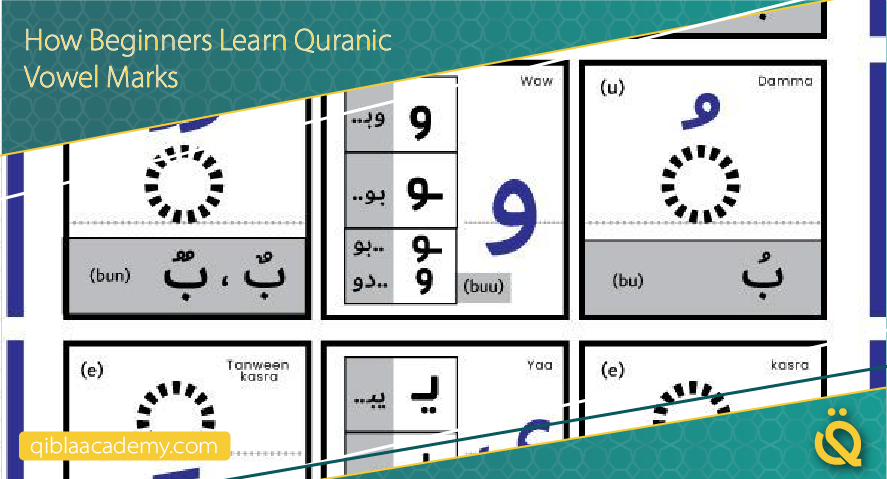
Quranic vowel marks tell a beginner how Arabic letters should be read inside words.
A learner may recognize the letters and their connected forms but still produce the wrong word because a mark above or below the text was overlooked. Another learner may know the names Fathah, Kasrah, and Dammah but fail to apply them in an unfamiliar example.
The problem is often not letter recognition. It is the connection between the written mark and the sound the learner should produce.
For the complete learning journey, begin with the complete roadmap to learn Quran online. Learners who still struggle to identify connected letters should first review How to Join Arabic Letters for Quran Reading.
This guide focuses on one foundation:
How can beginners recognize Quranic vowel marks and apply them accurately inside short unfamiliar words?
Quick Answer: How Do Beginners Learn Quranic Vowel Marks?
Beginners learn Quranic vowel marks by studying one pattern at a time, applying it to familiar letters, and then testing it inside unfamiliar short words. Start with Fathah, Kasrah, and Dammah. Add Sukoon, Shaddah, and basic Madd only after the earlier patterns are becoming stable.
Use this sequence:
Recognize the letter → check above and below it → identify the mark → produce the sound → combine carefully → test a new example
The skill is becoming stable when the learner notices the mark before reading and applies it without guessing from memory.
Understand What Quranic Vowel Marks Do
Arabic letters provide the main written shapes of a word. Vowel and reading marks show how those letters should be pronounced.
For beginners, the main patterns are:
- Fathah
- Kasrah
- Dammah
- Sukoon
- Shaddah
- Basic Madd
These marks may show:
- Which short vowel follows a letter
- That a letter has no short vowel
- That a consonant is doubled
- That a vowel sound is lengthened
The immediate goal is not to memorize long definitions. It is to see the written mark and produce the expected reading pattern.
A learner who recognizes the correct letters but ignores their marks may still read the word incorrectly. This is why vowel-mark practice should begin only after the learner can identify the letters well enough to focus on the additional visual detail.
Quran Vowel Marks for Beginners
| Mark | Arabic Form | Basic Function | Beginner Reading Cue |
|---|---|---|---|
| Fathah | َ | Adds a short vowel after the letter | Notice the mark above and keep the sound short |
| Kasrah | ِ | Adds a short vowel after the letter | Check below the letter |
| Dammah | ُ | Adds a short rounded vowel | Distinguish it from Fathah |
| Sukoon | ْ | Shows that the letter has no short vowel | Connect without inserting an extra vowel |
| Shaddah | ّ | Shows that the consonant is doubled | Strengthen the consonant before releasing the vowel |
| Basic Madd | ا / ي / و in the relevant pattern | Lengthens a vowel sound | Distinguish a long sound from a short one |
This is an introductory reading guide, not a complete Tajweed explanation.
English labels such as “a,” “i,” and “u” are approximate. The learner should hear a clear Arabic model and repeat the sound inside real examples.
Begin with one mark on letters the learner already recognizes. Do not introduce unfamiliar letters and several new reading patterns in the same exercise.
The purpose of the table is to give the beginner a simple visual reference. The actual sound should still be learned through listening, repetition, and correction.
Start With Fathah, Kasrah, and Dammah
Fathah, Kasrah, and Dammah are the first three short-vowel patterns most beginners learn.
Use one familiar letter and compare the marks:
- Fathah appears above the letter
- Kasrah appears below the letter
- Dammah appears above the letter
Use this learning cycle:
See the letter → check the mark → hear the model → repeat the sound → compare it with another mark
Practise one mark across several familiar letters before switching quickly between all three.
For example, the learner may first read several familiar letters with Fathah. Once the pattern becomes clear, the same letters can be presented with Kasrah. Dammah can then be introduced as a third contrast.
Then reverse the task. Show one familiar letter with different marks and ask the learner to explain what changed.
The learner should not read the letter name or assume that one letter always produces the same spoken pattern.
A common beginner problem is recognizing the letter correctly but reading the sound associated with a previous exercise. This suggests that the learner is relying on memory rather than checking the current mark.
The teacher should therefore vary the order gradually and ask the learner to look before responding.
Teach the Learner to Look Before Reading
Many vowel-mark mistakes occur because the learner begins speaking before checking the complete written form.
Use this visual order:
- Identify the letter.
- Check whether it is connected.
- Look above and below it.
- Identify the mark.
- Produce the combined sound.
- Move to the next letter.
A finger, pointer, or cursor may provide temporary support.
Use this decision rule during early practice:
Do not guess the complete word before checking its letters and marks.
The process should gradually become faster. It is a temporary method for building careful visual attention, not a permanent requirement to explain every step aloud.
A learner who guesses may occasionally produce the correct answer on a familiar word. However, the same approach often fails when the letter order or mark changes.
The teacher should encourage a brief pause before the first sound. That pause gives the learner time to inspect both the letter and the mark.
When the learner becomes more experienced, the visual process becomes automatic and reading begins to flow more naturally.
Introduce Sukoon After Short Vowels
Sukoon shows that the letter does not carry a short vowel.
This requires the learner to connect the consonant carefully without inserting an extra Fathah, Kasrah, or Dammah.
Begin with short combinations in which:
- The first letter has a familiar short vowel
- The following letter has Sukoon
- Both letters are already recognizable
- No additional new pattern appears
Use this process:
Read the first marked letter → move directly into the Sukoon letter → avoid adding another vowel
The teacher should model the complete combination and review the same pattern later.
A learner may pause before the Sukoon letter because earlier exercises trained every letter to carry a short vowel. Another learner may add an extra sound after it because the no-vowel pattern feels unfamiliar.
If the learner pauses, skips the Sukoon letter, or adds an extra vowel, return to a shorter two-letter unit.
Keep the surrounding letters familiar so the exercise tests Sukoon rather than introducing several new visual problems at once.
The skill is becoming more stable when the learner can connect the marked letter and the Sukoon letter without inserting an extra sound.
Add Shaddah as a Doubled Consonant
Shaddah tells the learner that the consonant is doubled or strengthened.
Two common mistakes are:
- Reading the letter only once
- Lengthening the vowel instead of doubling the consonant
Use this process:
Notice the Shaddah → strengthen the consonant → release it with the accompanying vowel
Compare a normal marked letter with the same letter carrying Shaddah.
Keep the letters and surrounding marks familiar so the learner can focus on the difference between a single and doubled consonant.
A learner may notice the Shaddah visually but still produce the same sound as an ordinary marked letter. This means the symbol has been recognized but its function has not yet transferred into recitation.
Another learner may hold the vowel for too long instead of strengthening the consonant. The teacher should model the contrast clearly and allow several careful attempts.
Shaddah requires listening and guided repetition. A written definition alone is not enough.
The learner should eventually recognize that the mark changes how the consonant is produced, not simply the length of the following vowel.
Introduce Basic Madd Without Teaching Full Tajweed
Basic Madd introduces the difference between a short vowel and a lengthened vowel.
The beginner should hear and compare:
Short sound → long sound
Use familiar letters and simple patterns. The learner should not yet study every Madd category, timing rule, or advanced exception.
The immediate goal is to avoid:
- Reading a long sound as short
- Stretching every vowel
- Confusing Madd with Shaddah
- Applying advanced rules before recognizing the basic pattern
Detailed Madd rules belong in the dedicated Tajweed path.
For this article, recognition of the short-versus-long pattern is sufficient.
The teacher should select examples in which the visual pattern is clear and the surrounding letters are already familiar.
A learner who does not yet distinguish basic short and long sounds is not ready for a detailed discussion of advanced Madd categories.
The foundation becomes more useful when the learner can hear the difference, recognize the relevant pattern, and reproduce it inside a short word.
Combine Marks Gradually Inside Short Words
Once individual marks are becoming recognizable, apply them inside short connected words.
Use:
- Familiar letters
- Short combinations
- One main reading pattern
- One unfamiliar example
- A clear teacher model
Introduce a small contrast at a time:
- A short-vowel example
- The same letters with another short vowel
- A simple Sukoon combination
- One Shaddah example
- One basic short-versus-long comparison
Do not place every mark inside one word simply to make the exercise look advanced.
If the target is Fathah, keep the letter shapes and other patterns familiar. If the target is Sukoon, do not add a new letter family and a new Madd pattern at the same time.
A well-designed exercise should make the source of an error easy to identify.
If the learner reads the letters correctly but produces the wrong vowel, the mark is the likely problem. If the learner cannot identify the connected letters, return briefly to joined-form practice.
The teacher should avoid turning every short word into a full Tajweed lesson. The immediate purpose is accurate recognition and application of the current reading mark.
Test Vowel Marks in Unfamiliar Words
Repeated pages may become memorized.
Change one element at a time:
- The letter
- The mark
- The letter order
- The final sound
- One simple connected form
Use three checks:
- Recognition: Does the learner notice the correct mark?
- Transfer: Can the same mark be applied to a new letter or word?
- Retention: Is the pattern remembered in a later lesson?
Do not measure progress only by mark names or completed pages.
Use this question:
Can the learner apply the mark inside a new short word without relying on memory?
If the answer is no, continue with the current pattern before increasing complexity.
For example, a learner may read one repeated Fathah page correctly. The teacher should then show a new familiar letter with Fathah or change the order of the letters.
If the learner still applies the correct short-vowel pattern, the skill is beginning to transfer.
Retention should also be checked later. Immediate repetition shows that the learner can imitate the model, but later use shows whether the reading pattern has become more stable.
Vowel-Mark Problem, Cause, and Practical Adjustment
| Reading Problem | Possible Cause | Practical Adjustment |
|---|---|---|
| Learner reads the letter name | The mark is being ignored | Identify the mark before sounding |
| Fathah and Dammah are confused | Marks above the letter are not distinguished | Compare one letter with both marks |
| Kasrah is frequently missed | Learner does not check below the letter | Use deliberate above-and-below scanning |
| An extra vowel is added with Sukoon | The no-vowel pattern is unfamiliar | Contrast Sukoon with short vowels |
| Shaddah is read as one consonant | Doubling is not heard clearly | Compare single and doubled forms |
| Madd is read as a short vowel | Lengthening is not recognized | Compare short and long patterns |
| Familiar words are correct but new ones are guessed | The exercise was memorized | Add unfamiliar marked words |
| Learner becomes overwhelmed | Too many patterns were introduced | Return to one primary mark |
Identify the earliest repeated problem.
If the letters themselves remain unclear, return to letter or joined-form recognition. If the letters are clear but the spoken pattern is wrong, focus on the mark and its sound.
Do not change the teacher, book, lesson schedule, and practice method at the same time.
If Kasrah is repeatedly overlooked, begin by training the learner to scan below the line. If Sukoon receives an extra vowel, return to a simple two-letter contrast.
If Shaddah and Madd are confused, compare one doubled consonant with one long vowel instead of adding more advanced rules.
The adjustment should address the specific reading problem.
Build a Short Vowel-Mark Practice Routine
Use one primary mark or contrast during each short practice session.
Use this pattern:
Review familiar letters → identify one mark → read short combinations → add one unfamiliar example → review later
A session may include:
- Familiar letters with one short vowel
- The same letters with a second vowel
- One controlled comparison
- One short unfamiliar example
Add Sukoon, Shaddah, or Madd only when that pattern is the lesson target.
The exact number of examples depends on the learner. Reduce the amount when the learner begins guessing or overlooking marks.
A complete beginner may need more listening and repetition. A returning learner may move quickly through Fathah, Kasrah, and Dammah but require focused work on Sukoon or Shaddah.
Do not prescribe a complete daily or weekly schedule. Duration and lesson frequency belong in their dedicated articles.
The practice task should remain specific enough that the learner knows what the teacher will review during the next lesson.
Common Mistakes When Learning Quranic Vowel Marks
1. Learning Mark Names Without Applying Them
Knowing the name “Fathah” does not prove that the learner can use it inside a word.
2. Introducing Every Mark Together
Too many new patterns make it difficult to identify the source of confusion.
3. Looking Only Above the Letter
Kasrah may be missed when the learner never checks below the Arabic text.
4. Adding a Vowel to Sukoon
Sukoon requires the learner to connect the consonant without inserting an extra short vowel.
5. Confusing Shaddah With Madd
Shaddah doubles a consonant. Madd lengthens a vowel.
How Qibla Academy Can Support Quranic Vowel-Mark Learning
Use a trial lesson to identify whether the learner’s main difficulty involves short vowels, Sukoon, Shaddah, basic Madd, joined forms, or the connection between marks and sounds.
Ask the teacher to:
- Use letters the learner already recognizes
- Compare Fathah, Kasrah, and Dammah
- Check whether marks below the line are overlooked
- Introduce Sukoon through short combinations
- Model Shaddah and Madd clearly
- Use one unfamiliar marked word
- Assign one focused practice task
- Review the same pattern later
The recommendation should address the exact reading problem rather than restarting every beginner skill automatically.
A useful trial should identify whether the difficulty begins with the letter, the joined form, the mark, or the sound associated with the mark.
The learner should receive one clear next step, such as:
- Compare Fathah and Dammah
- Practise scanning below the line for Kasrah
- Review two-letter Sukoon combinations
- Contrast single and doubled consonants
- Compare short and long vowel patterns
You can compare Qibla Academy’s Quran Teachers and review the Current Class Plans before selecting regular lessons.
Check Your Quran Vowel-Mark Skills
Read a short marked sample, receive correction, and ask which reading pattern should come first.
Frequently Asked Questions
1. What Are the Main Quranic Vowel Marks for Beginners?
Beginners normally start with Fathah, Kasrah, Dammah, Sukoon, Shaddah, and basic Madd.
3. What Does Sukoon Mean in Quran Reading?
Sukoon shows that the letter does not carry a short vowel. The learner must connect it without adding an extra vowel sound.
4. What Is the Difference Between Shaddah and Madd?
Shaddah doubles or strengthens a consonant sound. Madd lengthens a vowel sound.
5. When Is a Beginner Ready to Read Marked Quranic Words?
A beginner may begin short marked words when the connected letters are recognizable and individual vowel patterns can be applied with limited help.
Conclusion: Read the Mark Before Guessing the Word
Quran vowel marks for beginners should be learned as practical reading instructions, not only names and definitions.
Begin with Fathah, Kasrah, and Dammah. Add Sukoon when the short-vowel patterns are becoming stable. Introduce Shaddah and basic Madd through clear listening and controlled comparisons.
Do not guess the word before checking its letters and marks.
Use familiar letters, one main pattern, and unfamiliar examples that reveal whether the learner can transfer the skill.
If connected letters remain difficult to identify, return to joined-form practice. If the letters are clear but Fathah, Kasrah, or Dammah are guessed, isolate one short-vowel pattern. If the basic marks are stable, begin decoding short unfamiliar words.
A stable vowel-mark foundation makes word decoding, guided Quran reading, and later Tajweed instruction easier to develop.