
How to Start Learning Quran Online as a Beginner
You may want to start learning Quran online but feel uncertain about what your first lesson should cover.
Perhaps you do not recognize Arabic letters yet. You may know the letters individually but become confused when they join inside a word. You may also recite a few short surahs from memory without being able to read unfamiliar verses.
All of these situations can describe a beginner, but they do not require exactly the same starting point.
The most useful first step is not choosing the longest course or the most advanced textbook. It is identifying the earliest reading skill you cannot perform consistently.
For the complete journey from reading foundations to Tajweed, fluency, and specialised study, begin with the practical roadmap to learn Quran online. This guide focuses only on how a beginner should identify and begin the first suitable stage.
Quick Answer: Where Should a Quran Beginner Start?
A beginner should start learning Quran online by identifying the first essential reading skill they cannot perform independently. Complete beginners usually begin with Arabic letters and sounds. Learners who recognize letters may need joined forms, vowel marks, or short-word decoding. Those who can decode words may be ready for guided Quran reading with live correction.
Use this rule:
Start with the first essential skill you cannot perform without guessing or repeated help.
The first objective is not to study every Quran subject. It is to build one stable foundation that makes the next stage possible.
First, Identify What “Beginner” Means for You
The word “beginner” can describe several different situations.
One learner may be seeing Arabic letters for the first time. Another may have studied a beginner book in childhood but forgotten how to join letters. A third learner may recite familiar surahs from memory while struggling to read new words.
Before choosing beginner Quran lessons online, test what you can do with unfamiliar material.
Do not rely only on:
- The books you previously completed
- The number of surahs you memorized
- How long you studied in the past
- Whether you recognize familiar words
- Your age or confidence
A learner who remembers several short surahs may still need help recognizing joined letters. Someone who completed Noorani Qaida years ago may need a focused review rather than starting from the beginning or moving directly into full Quran pages.
The correct starting point depends on demonstrated reading ability.
Beginner First-Step Check
| Beginner Situation | Correct First Step |
|---|---|
| I cannot recognize most Arabic letters | Begin with letter recognition and basic sounds |
| I recognize letters but not their joined forms | Practise letter positions and joining |
| I know joined letters but confuse vowel marks | Focus on Fathah, Kasrah, Dammah, Sukoon, and Shaddah |
| I read memorized words but cannot decode new ones | Practise unfamiliar short words with guidance |
| I can decode words but pause throughout a verse | Begin guided Quran reading with correction |
| I can read but repeat pronunciation mistakes | Focus on applied Tajweed and live feedback |
This is an initial guide rather than a formal placement test. A teacher may identify a different weakness after listening to the learner.
When two descriptions apply, begin with the earlier skill. For example, a learner who reads some short words but still confuses joined forms should strengthen joining before working on speed.
What Should a Complete Beginner Learn First?
A complete beginner normally needs four connected foundations:
- Arabic letters and their basic sounds
- Letters in joined forms
- Basic vowel marks
- Decoding short unfamiliar words
1. Arabic Letters and Sounds
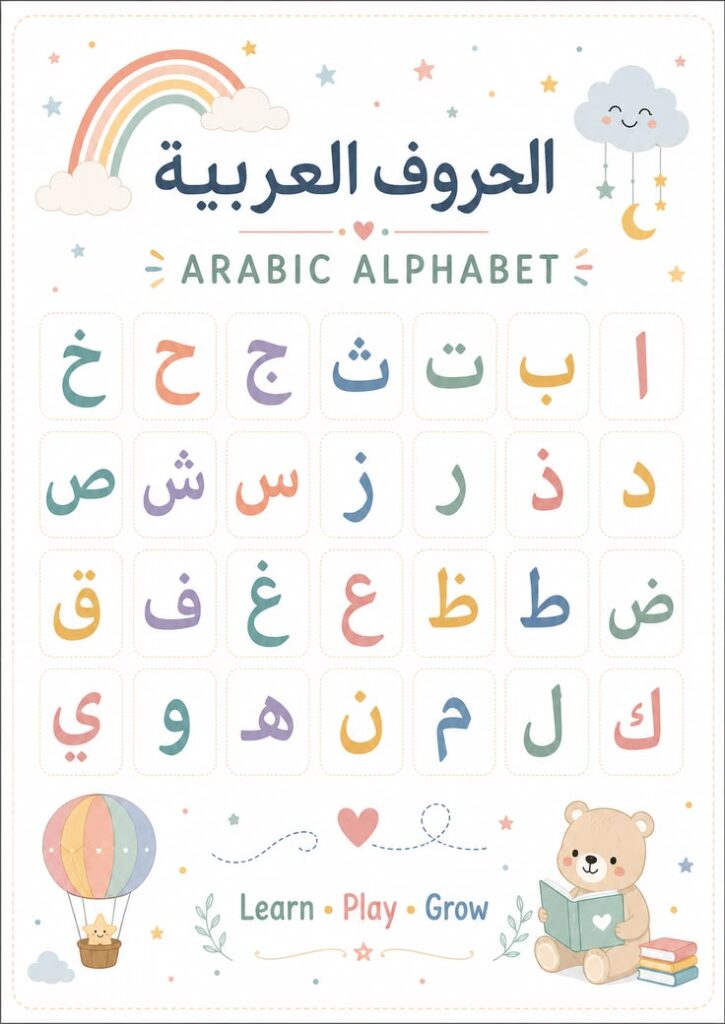
The learner should recognize individual letters and connect each one with its basic sound. Naming the alphabet in order is not enough; the learner should also recognize letters when they appear in mixed exercises.
A simple practice cycle is:
See the letter → hear the sound → repeat it → identify it again later
This process helps the learner connect the written shape with the sound instead of memorizing the alphabet as one sequence.
Letters that look similar should be introduced carefully. The immediate goal is accurate recognition, not speed.
2. Joined Letter Forms
Arabic letters can change shape according to their position inside a word. A learner who recognizes isolated letters may therefore still need structured joining practice.
The goal is to recognize the same letter at the beginning, middle, and end of words without guessing.
A learner should gradually become able to look at a short word, separate its letters mentally, and reconnect the sounds in the correct order.
Difficulty with joined forms does not mean the alphabet has been forgotten. It usually means the learner needs more practice transferring isolated-letter knowledge into connected text.
3. Basic Vowel Marks
The learner should gradually recognize Fathah, Kasrah, Dammah, Sukoon, Shaddah, and basic Madd in short examples.
Long theoretical explanations are unnecessary at this stage. The immediate goal is to see the mark and produce the expected sound.
A beginner may recognize the correct letter but still read the word incorrectly because the vowel mark was missed. Short, focused exercises help reveal whether the confusion comes from the letter shape or the mark placed around it.
Introduce one pattern clearly before combining several new patterns in the same exercise.
4. Short-Word Decoding
Decoding means reading through the letters and marks rather than identifying a word only because it has been memorized.
Use unfamiliar examples to test whether the skill is transferring. Careful reading should come before speed.
A learner who reads one familiar word correctly should be asked to read another word using the same pattern. If the second word requires guessing, the foundation may still need practice.
A beginner is ready to progress when these skills appear in new material with less prompting, not merely when familiar pages have been completed.
Do You Need Arabic Before Starting?
You do not need to speak conversational Arabic before learning to read Quran.
Reading Quranic script, speaking Arabic, and understanding grammar are related but separate goals. A beginner can learn letters, vowel marks, and basic reading before studying conversation or detailed grammar.
Choose Quran reading lessons when your immediate goal is to recognize and recite the text. Choose Quranic Arabic when vocabulary, sentence structure, and understanding are the primary goals.
The two paths can support each other, but Arabic study should not replace reading correction when decoding remains unstable.
For a detailed answer, continue with Do You Need Arabic Before Learning Quran Online?
Should You Start With Noorani Qaida?
Noorani Qaida can provide a graded sequence for letters, vowel marks, joined forms, and early pronunciation. However, not every learner needs to begin from the first page.
Use it when important foundation skills remain unstable. A learner who already recognizes letters, joined forms, and vowel marks may need targeted review or guided Quran reading instead.
The decision should depend on demonstrated ability, not age, previous book completion, or assumptions about the learner.
A child and an adult may use the same foundational resource differently. One may need slower repetition, while the other may move quickly through familiar sections and spend more time on pronunciation or decoding.
The value comes from using the resource to solve a specific weakness, not simply completing every page.
For the full decision process, see Is Noorani Qaida Necessary for Every Beginner?
Choose a Suitable First Lesson Format
Beginners can study through private lessons, group classes, recorded courses, apps, or a combination of resources.
Live private lessons are most useful when the learner needs an initial level check, direct pronunciation correction, personal pacing, or privacy while making mistakes.
Group lessons may work when students have similar starting levels and each learner receives sufficient reading and correction time.
Recorded lessons can explain letters and reading patterns, but they cannot hear the learner’s exact mistakes. Apps can support listening, reminders, and short review activities after the learner knows what to practise.
A useful beginner combination is:
Live assessment and correction + short independent practice + later teacher review
Each resource should have a clear purpose. A live lesson may provide correction, while a recording supports repetition and an app provides reminders.
Using several resources without a clear sequence may confuse a beginner, especially when each teacher or course introduces letters and marks in a different order.
For a detailed comparison, see Live Quran Lessons or Recorded Courses: What Works Better?
What Should Happen in Your First Online Quran Lesson?
The first lesson should help identify a suitable starting point. It should not consist only of an academy introduction or sales conversation.
A useful first lesson should include:
- A short discussion about the learner’s goal
- A simple letter or reading attempt
- One or two real corrections
- Identification of the first missing skill
- A small practice task for the next lesson
Pay attention to how the teacher responds to mistakes. The learner should hear a clear model, receive an opportunity to repeat it, and understand what to practise next.
The teacher does not need to correct every weakness during the first lesson. The more important outcome is identifying where the learning sequence should begin.
For example, the teacher may discover that the learner recognizes most letters but confuses joined forms. In that case, the first recommendation should focus on joining rather than repeating the complete alphabet or moving immediately into long Quranic passages.
A complete beginner should not feel embarrassed about being unable to read the sample. That result helps the teacher determine where instruction should begin.
For a detailed course breakdown, continue with What Happens in a Beginner Online Quran Course?
Build a Simple Beginner Practice Routine
A beginner does not need a complicated daily schedule.
Use this simple pattern:
One focused lesson → five to ten minutes of practice → repeat one corrected skill → review it in the next lesson
Practice should match the skill taught during the lesson. A learner may review a small group of letters, match joined forms, repeat one corrected sound, or decode a few unfamiliar words.
Short, regular practice is usually easier to maintain than one long session at the end of the week.
The purpose is not to complete as many exercises as possible. It is to repeat the current skill often enough for recognition and correction to become more stable.
Quran.com can support listening and repetition between lessons. However, audio playback cannot confirm whether the learner is producing each sound accurately.
Avoid moving randomly between several apps, videos, and books. Give each resource one clear purpose.
Common Beginner Mistakes to Avoid
1. Starting With Full Quran Pages Too Early
Full pages may encourage guessing when letters, joined forms, and vowel marks are not stable. Begin with material that isolates the missing skill.
A shorter exercise may look less advanced, but it can produce stronger progress when it targets the actual problem.
2. Memorizing Examples Without Decoding
A learner may repeat familiar words correctly without knowing how to read them. Use unfamiliar examples to check whether genuine decoding is developing.
Reading ability should transfer beyond the exact page or exercise that was memorized.
3. Studying Too Much Tajweed Theory Too Early
Basic pronunciation correction can begin immediately, but a complete beginner does not need every advanced rule before learning to decode words.
Introduce correction in connection with the learner’s current reading instead of turning the first stage into a long theoretical course.
4. Using Several Resources Without a Sequence
Different teachers, books, videos, and apps may introduce skills in different orders. Keep one main learning sequence and give each supporting resource a defined role.
Before adding a new tool, ask what specific problem it will solve.
5. Comparing Progress With Other Learners
Learners begin with different experiences, pronunciation needs, practice time, and goals. Compare current performance with the learner’s own earlier ability.
Someone who requires more time with joined letters may later progress quickly once that foundation becomes stable.
How Qibla Academy Can Help You Begin
Once you have identified your likely starting point, use a trial lesson to check whether the teacher, lesson format, and schedule suit your needs.
Ask the teacher to listen to a short sample and explain:
- Which foundation should come first
- How beginner mistakes will be corrected
- What should be practised between lessons
- How readiness for the next stage will be assessed
- Whether the proposed lesson length and schedule are realistic
The recommendation should reflect the learner’s demonstrated level rather than placing every beginner in the same lesson.
A useful recommendation should explain not only where to begin, but why that starting point is appropriate. The learner or parent should understand which skill is unstable and what evidence will show that it is improving.
You can compare Qibla Academy’s Quran Teachers and review the Current Class Plans before selecting regular beginner lessons.
Verify all statements about current teachers, plans, pricing, trials, and academy policies against the live website immediately before publishing.
Find Your First Quran Learning Step
Read a short sample, receive initial feedback, and ask which foundation should come first.
Frequently Asked Questions
1. Can I Learn Quran Online From Zero?
1. Can I Learn Quran Online From Zero?
2. What Is the First Thing a Quran Beginner Should Learn?
A complete beginner should usually begin by recognizing Arabic letters and connecting each letter with its correct basic sound. Joined forms and vowel marks can then be introduced gradually.
3. Can I Start Reading Quran Without Learning Arabic?
Yes. You can learn to read Quranic script without first speaking conversational Arabic. Quranic vocabulary and grammar can become a separate learning path later.
4. Is Noorani Qaida Necessary for Every Beginner?
No. It is useful when letter recognition, joining, and vowel marks are unstable. A learner who already demonstrates these skills may need targeted review or guided Quran reading instead.
5. Does a Beginner Need a Live Quran Teacher?
A live teacher is particularly useful for an initial level check, pronunciation correction, personal pacing, and accountability. Recorded courses and apps can support practice but may not diagnose individual mistakes.
Conclusion: Start With One Missing Foundation
The right way to start learning Quran online is to identify the first essential skill you cannot perform consistently.
Begin with Arabic letters if you cannot recognize them. Practise joined forms when familiar letters become confusing inside words. Focus on vowel marks when the letter is clear but the sound is not. Move into guided reading when you can decode short words but still need correction.
Do not choose a course because its title sounds advanced. Choose lessons that solve your first important reading problem and make the next stage possible.
A clear beginning should leave you knowing what to practise now, how correction will work, and what skill should come next.