From Arabic Letters to Reading Your First Quran Verse
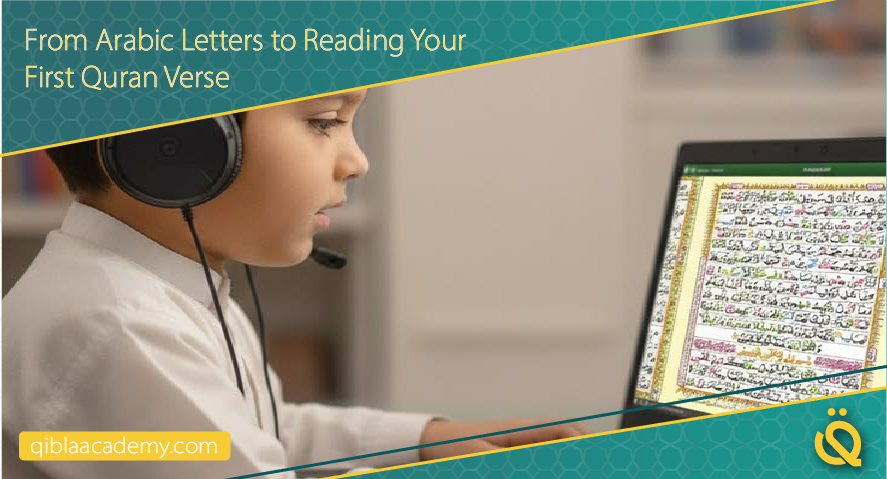
Moving from foundation exercises to reading a first Quran verse is a major transition.
A learner may recognize Arabic letters, joined forms, and basic vowel marks but still feel uncertain when those skills appear together inside authentic Quranic text.
This does not always mean the learner is unprepared. It may mean the transition needs to begin with a short, suitable passage and a controlled reading process.
For the complete learning journey, begin with the complete roadmap to learn Quran online. Learners who still guess basic reading marks should first review How Beginners Learn Quranic Vowel Marks.
This guide focuses on one question:
How can a beginner apply known reading skills inside a first Quranic phrase or verse without relying on memorization or becoming overwhelmed?
Quick Answer: How Do You Read Your First Quran Verse?
Begin with a short unfamiliar Quranic phrase containing letters, joined forms, and vowel patterns the learner already recognizes.
Preview the text, decode one word at a time, combine two or three words into a short phrase, receive focused correction, and read the same passage again with less help.
Use this sequence:
Confirm readiness → choose a suitable passage → preview the text → decode each word → combine short phrases → correct one priority → review later
The goal is not speed or perfect Tajweed. It is to transfer foundation skills into real Quranic reading.
First Quran Verse Readiness Check
| Skill | Ready for a Short Quranic Passage When… | Return to Foundation Review When… |
|---|---|---|
| Letter recognition | Most letters are identified independently | Many letters require alphabet-order clues |
| Joined forms | Letters can be identified inside short words | Connected forms look completely unfamiliar |
| Vowel marks | Basic marks are noticed before reading | Fathah, Kasrah, or Dammah are guessed |
| Sukoon and Shaddah | Simple examples can be read with guidance | Extra vowels are added or doubling is ignored |
| Short-word decoding | Unfamiliar words can be attempted carefully | Familiar words are read only from memory |
| Correction | A model can be repeated and applied again | The correction disappears immediately |
| Reading behaviour | Learner slows down and checks the text | Endings are guessed or letters are skipped |
A learner does not need perfect fluency before beginning Quranic text.
However, short-word decoding should be stable enough that every word does not require complete teacher modelling.
When several foundations remain weak, return to targeted review rather than beginning a full page.
For example, a learner who recognizes most letters but guesses vowel marks may be close to verse reading, but the first passage should remain short and use familiar mark patterns.
A learner who cannot identify connected letters inside basic words is not yet facing a verse-reading problem. The earlier foundation still needs attention.
The readiness check should be based on an unfamiliar sample. A memorized surah may sound fluent while hiding weak letter recognition or decoding.
Choose a Suitable First Quranic Passage
The first passage should match the learner’s existing skills.
Choose text that is:
- Short
- Visually clear
- Made mostly of familiar letters and marks
- Limited to one or two manageable reading challenges
- Easy to divide into short phrases
- Suitable for repeated review
Avoid selecting a passage only because it is famous or memorized.
A memorized surah may support confidence, but it does not prove that the learner is reading independently.
A teacher may begin with one short phrase from a verse rather than asking for the complete line immediately.
The goal is not to find the easiest verse in general. It is to select text that allows the learner to apply known reading foundations without continuous guessing.
The same passage may be suitable for one learner and too difficult for another.
A student who reads Sukoon and Shaddah confidently may handle a phrase containing those patterns. Another learner may need a passage with simpler short vowels first.
The teacher should also consider visual density. A short phrase with clear spacing may be more useful than a longer line containing several unfamiliar forms.
Preview the Verse Before Reading Aloud
Do not ask the learner to read an unfamiliar verse immediately at speed.
Use a short visual preview:
- Find the beginning of the phrase.
- Follow the text from right to left.
- Notice word boundaries.
- Identify obvious vowel marks.
- Find any familiar Sukoon or Shaddah.
- Mark one word that may need extra attention.
The preview should remain brief.
Its purpose is to reduce visual surprise and encourage the learner to inspect the text before guessing from memory or from the first letter.
The learner does not need a detailed explanation of every mark before attempting the passage.
The teacher should help the student notice the text structure without reading the complete answer aloud.
A useful preview may take only a few moments. It should prepare the learner to begin carefully, not turn the passage into a long theory lesson.
Decode One Quranic Word at a Time
Approach the passage as a sequence of manageable words.
Use this process:
Identify the letters → notice the marks → produce the sounds → combine carefully → read the complete word
Begin from the right and follow the actual letter order.
Do not provide the complete word immediately after the first hesitation. Give the learner enough time to inspect the text and attempt the reading process.
When a word is difficult, the teacher may:
- Point to the connected forms
- Isolate one overlooked mark
- Separate the word into smaller sound units
- Model one difficult sound
- Ask the learner to rebuild the word
- Use one simpler example with the same pattern
The aim is to support decoding without replacing the learner’s attempt.
The learner should continue looking at the Arabic text while producing the sounds.
If the teacher reads the complete word too quickly, the student may repeat it successfully without understanding how the letters and marks produced that reading.
A useful correction preserves the learner’s role in the process.
For example, the teacher may point to an overlooked Kasrah and ask the learner to try again rather than immediately supplying the complete word.
Combine Words Into Short Quranic Phrases
After two or three words can be decoded separately, combine them gradually.
Use this progression:
Read the first word → read the second word → repeat both together → add the next word → read the short phrase
Do not force the learner to read the complete verse in one breath.
The teacher may divide the passage into short, natural sections that match the learner’s level.
Slow, controlled reading is more useful than fast guessing.
The purpose of phrase reading is to reduce unnecessary pauses while protecting the accuracy developed during word-by-word decoding.
The learner may initially pause between every word. That is acceptable while each word is still being checked.
As the words become familiar through accurate reading, the pauses can gradually shorten.
The teacher should not push fluency before the learner can preserve the correct letters, marks, and word order.
Phrase reading becomes useful when the learner can combine words without losing the accuracy gained during individual decoding.
Use Focused Correction During the First Passage
The teacher should not treat every mistake as equally urgent.
Choose the error most closely connected to the learner’s current stage, such as:
- Misidentifying a connected letter
- Missing a vowel mark
- Adding a vowel to Sukoon
- Ignoring Shaddah
- Guessing a familiar word
- Repeating one inaccurate letter sound
Use this correction flow:
Learner reads → teacher identifies the main error → teacher models → learner repeats → learner reads the word in context → teacher checks it later
A correction should lead to another learner attempt.
One or two priority corrections may be enough during the first passage. Additional Tajweed details can be introduced later when decoding becomes more stable.
For example, if a learner misses several vowel marks, correcting every minor fluency issue may distract from the main problem.
If one letter sound remains repeatedly inaccurate, the teacher may isolate it briefly and then return to the word.
The correction should remain specific enough that the learner understands what changed.
“Read again” is less useful than pointing out the exact letter or mark that needs attention.
Repeat the Passage Without Replacing Reading With Memory
Repetition is useful only when the learner continues tracking the Arabic text.
Use this process:
- Read the word with help.
- Read it again with less help.
- Read it inside the phrase.
- Pause before repeating the passage.
- Ask the learner to point to the written word.
- Test one similar unfamiliar pattern later.
If the learner continues reciting correctly while no longer following the text, memorization may be replacing reading.
Memorization is valuable, but this lesson is testing whether the learner can decode authentic Quranic text.
A familiar passage may still be used when the teacher checks whether the learner follows each written word.
However, one unfamiliar word or similar pattern should be added to confirm that the reading skill transfers.
The objective is not to prevent memorization. It is to make sure memorization does not hide a missing reading foundation.
First-Verse Problem, Cause, and Practical Adjustment
| Reading Problem | Possible Cause | Practical Adjustment |
|---|---|---|
| Words are recognized only after hearing them | Memory is replacing decoding | Allow an independent attempt first |
| Long words become confusing | Too many connected forms are processed together | Separate the word into smaller units |
| Vowel sounds are guessed | Marks are not checked before reading | Pause and identify the mark |
| Text is followed from left to right | Directional tracking is unstable | Point from the right |
| Every letter is read separately | Combining skills are still developing | Build short sound and word units |
| Accuracy drops when speed increases | Fluency is being prioritized too early | Return to slow controlled reading |
| The same correction disappears later | Retention practice is weak | Repeat one corrected pattern |
| The passage feels overwhelming | It contains too many new features | Shorten the selected phrase |
Identify the main cause before changing the complete learning programme.
If joined forms are unclear throughout the passage, return briefly to connected-letter practice. If the main issue is one mark, isolate that pattern before retrying the verse.
A learner who reads correctly only after hearing the teacher may need more independent decoding time.
A learner who performs well slowly but makes mistakes when asked to speed up does not necessarily need easier material. The immediate adjustment may be to protect accuracy and delay fluency pressure.
Change the smallest relevant factor first.
How Much Tajweed Should Be Added?
Basic pronunciation correction should begin during the first Quranic passage.
However, the lesson should not become a complete advanced Tajweed class.
Prioritize:
- Correct letter identification
- Basic letter sounds
- Obvious vowel marks
- Simple Sukoon and Shaddah patterns
- One recurring pronunciation problem
- Slow, controlled reading
Delay detailed rule explanations when they distract from the immediate reading task.
As decoding becomes more stable, applied Tajweed can receive more lesson time.
This section explains the boundary only. Detailed Tajweed instruction belongs in the specialist Tajweed article.
The learner should understand that careful pronunciation matters from the beginning, but advanced terminology is not required before basic reading becomes reliable.
A teacher may model one correct sound or basic length pattern without introducing every rule present in the passage.
What Should Be Practised After the First Passage?
The practice task should reinforce the main difficulty revealed by the passage.
Use this pattern:
Review the corrected word → read it inside the phrase → attempt one similar unfamiliar example → return to the passage
A useful task may involve:
- Two difficult words
- One recurring vowel pattern
- One corrected letter sound
- One short connected form
- One phrase read slowly
Avoid assigning several new verses immediately.
The first practice task should make the existing passage more stable, not introduce an unrelated lesson.
For example, if the learner repeatedly adds a vowel to Sukoon, the practice should include one or two controlled Sukoon patterns before returning to the Quranic phrase.
If a connected letter is repeatedly missed, the teacher may compare that form with the isolated letter and then place it back inside the word.
The task should be specific enough that the learner knows what will be checked during the next lesson.
How Do You Know the First Passage Is Helping?
Use three forms of evidence:
- Independence: Does the learner need less help?
- Transfer: Can the same reading pattern be applied elsewhere?
- Retention: Is the correction remembered later?
A successful first-passage experience does not require perfect fluency.
It should show that the learner can begin applying letters, joined forms, and vowel marks inside authentic Quranic text with greater control.
A learner may still read slowly while demonstrating real progress.
The useful change is that fewer words require complete teacher modelling, corrections are applied more accurately, and the learner begins inspecting the text before speaking.
Do not measure success only by finishing the selected verse.
Common Mistakes When Reading a First Quran Verse
1. Choosing a Passage That Is Too Long
Long passages may combine too many unfamiliar words and patterns.
2. Using a Memorized Surah as the Only Test
Memorization can hide weak decoding.
3. Correcting Every Detail Immediately
Too many interruptions may prevent the learner from applying the basic reading process.
4. Pushing Speed Before Accuracy
Fast reading is not useful when letters and marks are guessed.
5. Moving Forward Without Reviewing the Same Pattern
Completing a verse does not prove that the reading skill is retained.
How Qibla Academy Can Help With a First Quranic Passage
Use a trial lesson to check whether the learner is ready for a short Quranic passage or still needs targeted review of letters, joined forms, or vowel marks.
Ask the teacher to:
- Use a short unfamiliar sample
- Confirm which foundations are stable
- Select a manageable phrase
- Let the learner attempt before modelling
- Correct one or two priority mistakes
- Ask the learner to reread in context
- Assign one focused practice task
- Review the same pattern later
The recommendation should match demonstrated ability rather than moving every learner into full Quran pages at the same stage.
A useful trial should make the next step clear.
The teacher may recommend immediate guided passage reading, a shorter phrase, or temporary review of one foundation.
You can compare Qibla Academy’s Quran Teachers and review the Current Class Plans before selecting regular lessons.
Read Your First Quranic Passage With Guidance
Attempt a short unfamiliar phrase, receive focused correction, and ask which foundation should be reviewed next.
Frequently Asked Questions
1. When Is a Beginner Ready to Read a Quran Verse?
A beginner may begin a short guided passage when letters, joined forms, and basic vowel marks are recognizable and unfamiliar short words can be decoded with limited help.
2. Should the First Quran Verse Be Memorized?
It may already be familiar, but memorization should not be the only evidence of reading. The learner should track and decode the written text.
3. Should Beginners Read a Full Quran Page?
Not initially. Short phrases and verses are usually more manageable while foundational reading skills are transferring.
4. How Much Tajweed Should a Beginner Use?
Basic pronunciation correction should begin early, but detailed Tajweed rules should not overwhelm the first decoding and reading practice.
5. What if the Learner Cannot Read the Passage?
Return to the earliest unstable skill, such as joined forms, vowel marks, or short-word decoding. Then retry a shorter or more suitable passage.
Conclusion: Move From Exercises to Quranic Text Gradually
Reading a first Quran verse is not a jump from beginner exercises into perfect recitation.
Choose a short passage containing mostly familiar reading patterns. Preview the text, decode one word at a time, combine short phrases, receive focused correction, and reread the passage with less support.
Do not judge readiness only by completed Qaida pages or memorized surahs.
Check whether the learner can apply known letters and marks inside unfamiliar Quranic text.
Use this decision rule:
If letters, joined forms, or basic marks still require continuous guessing, return to targeted foundation practice. If short words can be decoded but phrases contain many pauses, continue guided verse reading. If short passages are read accurately with less help, begin expanding the reading gradually.
The next stage should begin when foundation skills transfer into Quranic text—not simply when a book has been completed.