Common Hifz Mistakes Parents Make
How to Avoid Hifz Mistakes Without Adding Pressure
Every mother embarks on her child’s Quranic journey with pure intentions, hoping to see them carry the words of Allah in their hearts. In our foundational Complete Guide to Quran Hifz for Kids, we highlighted that the home environment serves as the launchpad for all spiritual and academic growth. However, even with the best intentions, it is incredibly easy for well-meaning parents to slip into subtle pedagogical errors that accidentally stall progress.
Here at Qibla Academy, we regularly consult with mothers who are deeply frustrated because their children have suddenly started resisting their daily lessons. Often, the root cause isn’t a lack of desire from the child, but rather systemic, hidden missteps in how the routine is managed at home. In our previous article, we mapped out the critical behavioral and cognitive Signs Your Child Is Struggling with Hifz, proving that early intervention is key.
To help you audit your home setup, this guide breaks down the most common Hifz mistakes parents make, the psychological impacts they leave on young minds, and how to take practical step-by-step switches to an empowering, stress-free strategy.
What Are the Most Common Hifz Mistakes Parents Make?
The most common Hifz mistakes parents make include:
- Prioritizing speed over retention.
- Neglecting daily Muraja’ah (revision).
- Comparing children to siblings or peers.
- Using guilt or pressure as motivation.
- Correcting every mistake immediately during recitation.
- Turning Quran time into a stressful experience.
The biggest problems usually begin when speed replaces retention, revision becomes inconsistent, or Quran time turns into pressure. Fixing these habits early can make Hifz more sustainable while protecting the child’s confidence and relationship with the Quran.
1. The Trap of Overloading: Forcing Speed Over Solid Retention
One of the most frequent missteps is rushing a child through new verses (Sabaq) to hit milestones faster, such as finishing a Juz or a Surah by a specific date.
When the daily memorization target is consistently higher than a child can retain comfortably, new verses begin competing with revision and repeated mistakes can increase. This error cuts directly into the core structure we established in the Daily Hifz Routine for Kids. Without a balanced workload, short-term memory cannot properly transfer verses into long-term retention.
The Compounding Debt of Weak Revision
When speed takes priority, older revision (Manzil) is almost always sacrificed. This structural breakdown is a primary catalyst behind Why Kids Forget Quran Quickly, creating a highly demoralizing loop where the child must constantly re-memorize the same portions over and over again.
Case Study: How Over-Expectation Stalled Maryam’s Progress
Consider the experience of Maryam, a ten-year-old student living in Sydney, Australia. Her parents set a strict timeline for her to complete the 30th Juz within two months. To achieve this, Maryam was forced to memorize five new verses every afternoon, regardless of her school workload or mental fatigue.
Within four weeks, Maryam began displaying clear signs of Hifz burnout. She started hiding her Mushaf, crying before her sessions, and mixing up basic verses she had known perfectly for months. Realizing the error, her mother reached out for an external evaluation. Her daily Sabaq was reduced to two lines, while more lesson time was given to revision and a calmer routine. Over time, Maryam became more comfortable with her sessions, her retention improved, and she began engaging with recitation more positively again.
Expert Pedagogical Note: A child’s brain does not process memorization like an adult’s. Persistent pressure to hit arbitrary speed metrics without stabilizing old retention damages a child’s academic self-esteem and links the Book of Allah with feelings of failure.

Practice Audit: Toxic Habits vs. Empowering Alternatives
To help you immediately adjust your daily approach, review this comprehensive comparison table of common home practices:
| The Common Parent Mistake | The Immediate Psychological Impact | The Empowering Alternative Approach |
| Comparing with Peers | Destroys self-confidence and breeds hidden resentment toward the Quran. | Celebrate only the child’s personal improvement against their own past week. |
| Skipping Daily Revision | Causes rapid memory erosion, leading to sudden classroom panic. | Anchor the Daily Hifz Routine for Kids firmly on solidifying old parts before adding new lines. |
| Using Hifz as a Punishment | Associates the holy words of Allah with guilt, anger, and disciplinary trauma. | Keep Quran time completely sacred, isolated from behavioral corrections. |
| Over-correcting minor stumbles | Creates paralyzing performance anxiety and stuttering during recitation. | Allow the child to finish the verse fully before gently pointing out the vowel error. |
2. Playing the Role of the Strict Taskmaster Instead of the Safe Haven
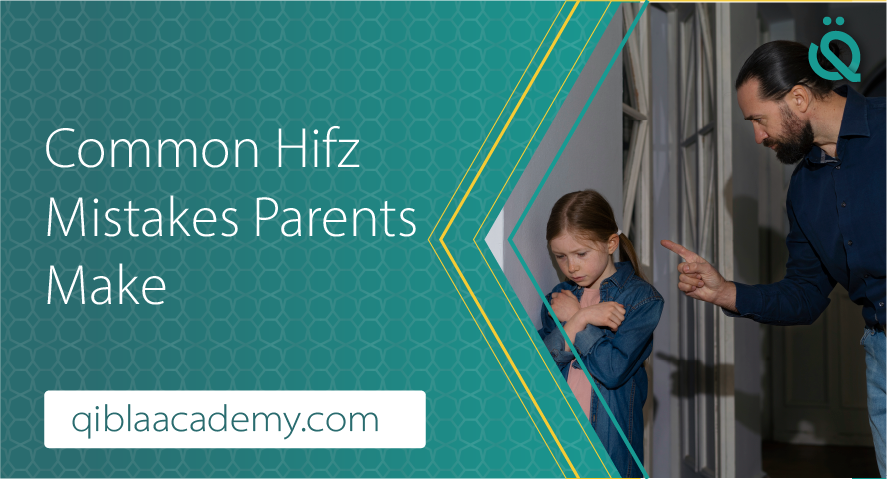
Many mothers accidentally fall into the role of a harsh examiner. Quran time turns into a tense interrogation where the mother sits with a pencil, waiting to pounce on every single mistake, vowel stumble, or hesitation.
How to Help a Child Struggling with Hifz at Home
If your daily routine has devolved into a power struggle filled with tension, your immediate goal must be to completely shift the emotional climate of the session.
- Separate Parenting from Pedagogical Pressure: If your child is constantly crying during your sessions, it may mean your role as their mother is clashing with the accountability required for Hifz. Transitioning them to a structured Online Quran Memorization Course for Kids allows you to step back into your natural role as the primary source of emotional support and encouragement, while an expert handles the academic metrics.
- Normalise Mistakes: Teach your child that stumbling on an Ayah is not a failure; it is a natural part of the human brain strengthening its neural pathways.
- Utilise Collaborative Reading: Instead of testing them from across the room, sit shoulder-to-shoulder. Read a verse, let them read the next, turning the struggle into a shared bonding experience.
3. Assuming Motivation Comes From Guilt and Spiritual Shaming
“If you don’t memorize, Allah will be angry with you,” or “Look at your cousin who has already finished three Juz!”
Using spiritual guilt or negative peer comparisons is an incredibly dangerous mistake. Children are motivated by immediate, positive, tangible reinforcement. Educational research consistently shows that positive reinforcement strengthens learning behaviors far more effectively than fear, shame, or punishment-based approaches. When Quran memorization repeatedly becomes associated with shame, fear, or comparison, a child may become more anxious and less willing to engage with the learning process.
How to Motivate a Child to Memorize Quran Without Pressure
If fear is a poor driver, mastering how to motivate a child to memorize Quran requires a complete strategic pivot. Instead of imposing rigid deadlines, turn memorization into an inspiring journey. Tie their consistency to an engaging rewards system, celebrate small wins, and let them track their milestones visually on a wall chart. The primary goal is to ensure they associate opening the Mushaf with praise, warmth, and maternal validation rather than anxiety.
Positive reinforcement works best when it celebrates effort and consistency rather than perfect results. A simple reward system for kids Quran memorization can help parents recognize small Hifz milestones without using comparison, guilt, or pressure.
Parental Self-Assessment Checklist: Are You Accidentally Creating Friction?

Take a quiet moment to evaluate your recent interactions by checking the boxes that apply to your home routine over the last two weeks:
- [ ] I find myself raising my voice or showing visible frustration during our Hifz sessions.
- [ ] I regularly compare my child’s progress speed to their siblings, classmates, or cousins.
- [ ] We frequently skip our scheduled revision days because we are too tired or behind on new lessons.
- [ ] My child looks visibly anxious, tenses up, or sighs heavily when I tell them it is time to open the Mushaf.
- [ ] I am unsure of the structural difference between Sabaq, Sabqi, and Manzil requirements.
If several of these patterns keep appearing, review your current Hifz routine and identify which source of friction needs attention first—daily workload, revision, correction style, or the emotional tone of the session.
How to Know If You Are Making Hifz Mistakes as a Parent
It can be highly challenging for an affectionate parent to recognize when their own habits are accidentally hindering progress. To help you evaluate your situation objectively, review these critical home warning signs:
- [ ] Your child was previously motivated but now actively resists Quran sessions.
- [ ] You spend more time arguing and negotiating than actually reviewing the verses.
- [ ] Your child’s retention is steadily decreasing despite increasing their daily study time.
- [ ] Your daily Quran time regularly ends in frustration, tears, or a tense standoff.
- [ ] You feel completely uncertain about exactly how much Sabaq, Sabqi, or Manzil your child should realistically complete each day.
If several of these signs appear repeatedly, avoid increasing the memorization load. First identify whether the main problem is revision, lesson pressure, correction style, or an unrealistic daily target, then adjust that part of the routine before pushing for faster progress.
When Should Parents Step Back and Seek Professional Support?
While making small adjustments to your home routine can fix minor friction points, some instructional mistakes require a complete change of scenery. Managing your child’s academic school workload while trying to build a flawless pedagogical Hifz system can heavily strain the parent-child relationship.
Consider bringing in specialized help if:
- Your daily Quran sessions consistently end in emotional standoffs, tears, or total refusal.
- You feel your own patience running thin, leading to a toxic cycle of shouting and subsequent guilt.
- Your child’s retention has completely stalled out for over a month despite cutting the daily workload in half.
- You lack the mastery of Tajweed rules or Arabic pronunciation required to properly guide their advanced memorization.
Sometimes, a child responds better when correction comes from a teacher outside the parent-child dynamic. A qualified Quran teacher can provide structured feedback while allowing the parent to focus more on encouragement and support at home.
Quick Summary for Busy Mothers
If you are balancing a packed schedule, use this executive cheat sheet to quickly audit and correct your teaching habits:
| If You Are Doing This | Stop Immediately And Try This | What This Change Supports |
| Pushing for a full page daily | Implement the “Halve the Load” rule | A more manageable memorization pace |
| Correcting every single syllable instantly | Circle the error lightly and review after they finish the full Ayah | Calmer recitation and more focused correction |
| Sitting across the table like an examiner | Sit shoulder-to-shoulder and practice shared recitation | A more supportive parent-child learning experience |
| Threatening to take away privileges | Switch to a structured, points-based Reward System | More positive engagement with the Hifz routine |
How to Respond When Hifz Problems Keep Repeating
To help you determine the safest pedagogical path forward for your household, refer to this diagnostic matrix before moving to the frequently asked questions:
| Situation | Best Approach | Target Outcome |
| Minor resistance | Adjust routine at home | Restores baseline comfort |
| Forgetting recent lessons | Increase Muraja’ah | Restabilises short-term memory |
| Frequent emotional distress | Seek professional evaluation | Uncovers underlying cognitive blocks |
| Complete refusal to memorize | Structured Hifz intervention | Rebuilds trust with external mentorship |
| Parent burnout or high tension | Professional mentoring support | Protects the primary parent-child bond |
Frequently Asked Questions About Parental Hifz Mistakes
I don’t know Tajweed perfectly. Can I still teach my child Hifz at home?
It is highly discouraged to teach new memorization if you are not fully confident in your Tajweed. Children absorb pronunciation like sponges; if they memorize a verse with incorrect vowels or missing characteristics (Sifat), unlearning that mistake later in life is incredibly difficult and frustrating for them.
My child listens to their teacher but completely ignores me when we review. Why?
This is entirely normal childhood behavior. The psychological boundary between “Mom” and “Teacher” is often blurred at home. Children feel safe pushing boundaries with their parents. This is exactly why an external, professional instructor yields better consistency and focus.
How do I handle a child who is naturally slow at memorizing compared to siblings?
Every single brain is wired differently. Some children possess brilliant audio retention, while others are highly visual. Embrace your child’s unique learning pace. Celebrate their consistency rather than their speed, and never, under any circumstances, discuss their academic speed lapses in front of siblings or family members.
Is it a mistake to let my child take a complete break during school exams?
A total abandonment of the Mushaf is a mistake, but pausing new memorization (Sabaq) is highly recommended. During heavy school periods, shift their routine entirely to a light, 10-minute daily review of their favorite, oldest Surahs to keep the spiritual habit alive without adding cognitive strain.
What Is the Biggest Hifz Mistake Parents Should Avoid?
One of the biggest mistakes is prioritizing faster memorization over stable retention. If new verses keep increasing while older portions become weaker, reduce the new memorization load and give more time to Muraja’ah before pushing forward.
What’s Next in Your Child’s Hifz Journey?
Recognising these common pitfalls is an incredible victory for your family—it shows you care deeply about the quality of your child’s spiritual upbringing. Now that you know what habits to avoid at home, the next big question is: How long should this journey actually take when structured correctly?
Once you have corrected the most common Hifz mistakes, the next step is setting a realistic pace. See how long Hifz takes for kids to compare timelines based on age, daily memorization, revision, reading ability, and consistency.
Many parents do not realize they are making these mistakes until their child begins losing confidence, retention, or motivation. A structured Hifz program removes the guesswork by providing expert teachers, personalized pacing, and a proven revision system that protects both progress and emotional well-being.
If your child is beginning to lose motivation, confidence, or consistency, the best time to intervene is before frustration becomes resistance. The right guidance at the right time can completely transform a child’s relationship with Quran memorization.
Explore the Best Online Hifz Program for Children at Qibla Academy and discover how personalized lesson plans, qualified teachers, and structured Muraja’ah systems help children memorize with confidence, consistency, and joy. Keep leading with love!