
Madd Rules in Tajweed: A Practical Guide to Lengthening
Madd rules in Tajweed explain when a Quranic vowel sound should be lengthened and how that length should remain controlled during recitation.
Beginners usually make one of two mistakes:
- A Madd sound is shortened too much
- A normal short vowel is stretched when no Madd is required
The practical goal is:
Recognize the Madd pattern → hear the required length → apply it consistently in Quran recitation
For the wider Tajweed system, continue with Learn Quran Tajweed Online: How the Core Tajweed Rules Fit Together.
If the underlying Arabic sounds are still unclear, review Learn Quran Online With Tajweed: Makharij and Pronunciation Correction first.
What Is Madd in Tajweed?
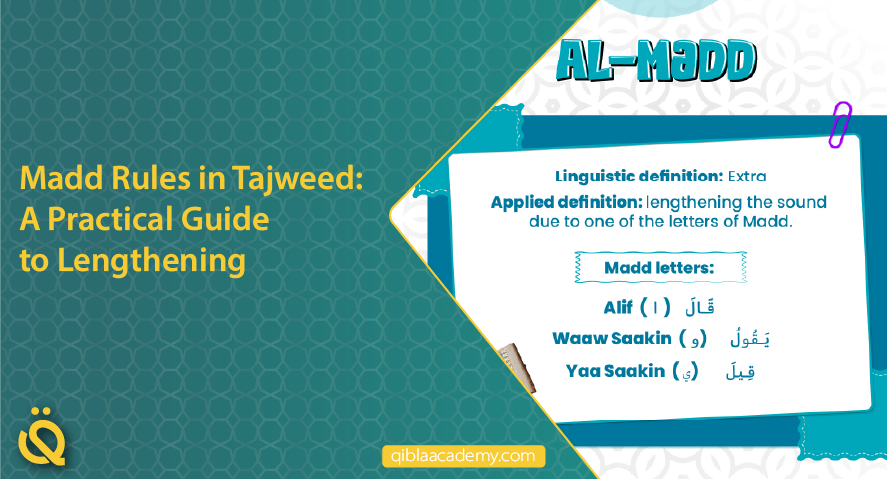
Madd means lengthening.
In Quran recitation, it refers to extending a vowel sound when a valid Madd pattern is present.
The three main Madd letters are:
ا و ي
when they occur with the appropriate preceding vowel.
The key beginner distinction is:
Short vowel ≠ Madd
Madd = controlled vowel lengthening
Do not stretch a sound simply because it feels natural.
The written pattern and Tajweed rule determine whether lengthening is required.
What Are the Madd Letters in Tajweed?
| Madd Letter | Typical Preceding Vowel | Basic Long Sound |
|---|---|---|
| ا | Fathah | Long “aa” |
| و | Dammah | Long “oo” |
| ي | Kasrah | Long “ee” |
A beginner should first hear the contrast between:
short vowel → long vowel
before studying several advanced Madd categories.
What matters is not memorizing ا و ي alone.
It is recognizing when one of them functions as a Madd letter in the correct vowel pattern.
Madd Asli in Tajweed: The Basic Natural Lengthening
Madd Asli, also called natural Madd, is the foundation of the lengthening system.
It is commonly taught as approximately:
Two counts
The sound should be long enough to remain distinct from a short vowel without becoming exaggerated.
In practice:
- Keep the timing steady
- Avoid rushing
- Avoid turning two counts into a dramatic pause
A teacher may use a simple rhythm during practice.
Once the contrast is clear, return to the Quranic phrase rather than continuing to count mechanically.
What Other Madd Rules May Beginners Encounter?
Some Madd patterns are longer than basic Madd because of additional conditions such as:
- Hamzah
- Sukoon
- Word structure
- Stopping
A beginner may later encounter names such as:
- Madd Muttasil
- Madd Munfasil
- Madd Lazim
- Madd Arid lil-Sukoon
This article does not teach the full technical classification of each category.
The useful progression is:
First distinguish short vowels from Madd Asli → stabilize basic timing → add longer Madd categories one at a time
The category name explains why the vowel is lengthened.
The practical skill is producing the correct duration in Quran recitation.
For the broader applied-rule comparison, continue with Online Tajweed Course: How Madd, Ghunnah, Qalqalah, and Waqf Are Taught.
How Should Madd in Tajweed Sound During Quran Recitation?
A good Madd should sound:
- Clear
- Controlled
- Consistent
- Connected to the word
- Appropriate to the rule
It should not sound like the reader suddenly stops the phrase simply to demonstrate lengthening.
A useful principle is:
Lengthen the vowel, not the entire word.
The timing should remain part of natural Quran recitation.
Madd vs. a Short Vowel: What Is the Difference?
This is one of the most important beginner distinctions.
A short vowel is brief.
A Madd sound is extended.
If both receive the same duration, the contrast disappears.
If every short vowel is stretched, the recitation becomes distorted.
Use:
Short vowel → brief
Madd → controlled extension
Listening to both patterns side by side is often more useful than reading a long definition.
This distinction directly solves one of the most common beginner problems.
How to Practise Madd Rules in Tajweed Correctly
Keep practice focused on one timing contrast at a time.
A useful progression is:
- Hear a short vowel.
- Hear the matching Madd sound.
- Compare the two.
- Read one Quranic word containing Madd.
- Return to the complete phrase.
- Repeat the same timing in another example.
- Add a new Madd category only after the earlier pattern is stable.
For example:
short a → long aa → Quranic word → phrase → unfamiliar example
Do not mix several Madd categories while basic timing is still inconsistent.
Once the length becomes stable, stop isolating the sound unnecessarily and return to normal recitation.
Common Madd Mistakes
1. Shortening Madd Too Much
If Madd becomes almost identical to a short vowel, the required length is lost.
2. Stretching Normal Short Vowels
Not every vowel should be lengthened.
Check whether a valid Madd pattern is present.
3. Counting Mechanically
Counts help during training, but Quran recitation should not sound like a metronome.
4. Changing the Length Randomly
The same Madd pattern should remain reasonably consistent.
5. Losing Madd When Reading Faster
Slow down until the timing remains stable inside longer Quranic phrases.
Madd vs. Ghunnah: What Is the Difference?
Both Madd and Ghunnah may involve measured timing, but they are different sound features.
Madd: lengthens a vowel sound
Ghunnah: controls nasal quality
Do not use the same sound technique for both.
For detailed nasal-sound application, continue with Ghunnah in Tajweed: When and How the Nasal Sound Applies.
How Do You Know Your Madd Is Improving?
Look for four signs:
- Short and long vowels remain clearly different
- Madd timing becomes more consistent
- The length remains stable in unfamiliar words
- Less prompting is needed
The strongest evidence is not memorizing more Madd category names.
It is keeping the correct length during real Quran recitation.
For detailed progress measurement, continue with Online Tajweed Classes: How to Measure Your Tajweed Progress.
When Should a Teacher Correct Madd?
Teacher feedback becomes useful when:
- Madd is regularly shortened
- Normal vowels are stretched
- Timing changes randomly between examples
- Counting becomes mechanical
- Madd disappears during faster recitation
- The learner knows the rule but cannot hear the correct duration
The teacher should identify the timing problem, model the sound, and ask the learner to repeat it in Quranic context.
For the full correction process, continue with Tajweed Quran Online: How Live Correction Improves Recitation.
Frequently Asked Questions
1. What Is Madd in Tajweed?
Madd is the controlled lengthening of a vowel sound in specific Quranic recitation patterns.
2. What Are the Three Madd Letters?
The three main Madd letters are:
ا و ي
when they occur with the correct preceding vowel.
3. How Long Is Basic Madd?
Madd Asli is commonly taught as approximately two counts.
The purpose is consistent timing rather than rigid mechanical counting.
4. Are All Madd Rules the Same Length?
No.
Different Madd categories may require different lengths depending on the recitation condition and the teaching system being followed.
5. Why Do I Keep Shortening Madd While Reading?
This often happens when reading speed increases before the timing becomes stable.
Slow the phrase, preserve the vowel length, and then gradually return to natural recitation speed.
Conclusion: Madd Rules in Tajweed Should Lengthen the Vowel Without Distorting the Word
Madd rules in Tajweed control when a Quranic vowel should be extended and how that length should remain consistent.
Begin with the foundation:
Recognize the Madd pattern → hear the correct length → apply it → keep it stable inside Quran recitation
Do not stretch every vowel.
Do not shorten every Madd.
And do not let counting overpower the natural flow of the Quran.
Start with Madd Asli and the difference between short and long vowels.
Then add longer Madd categories gradually as the basic timing becomes stable.
A good Madd remains clear enough to preserve the rule and controlled enough to stay part of natural recitation.
Continue Your Tajweed Learning
1. Want to See Where Madd Fits Into the Wider Tajweed System?
Continue with Learn Quran Tajweed Online: How the Core Tajweed Rules Fit Together.
Use this guide to see how Madd connects with Noon Sakinah, Meem Sakinah, Ghunnah, Qalqalah, and Waqf.
2. Want to Compare Madd With Other Applied Tajweed Sounds?
Continue with Online Tajweed Course: How Madd, Ghunnah, Qalqalah, and Waqf Are Taught.
This is the better next step when you want to compare lengthening, nasal quality, Qalqalah release, and stopping inside one applied Tajweed framework.
3. Need Help With Ghunnah Timing as Well?
Continue with Ghunnah in Tajweed: When and How the Nasal Sound Applies.
Use this guide when nasal quality and timing remain unclear and you need to separate Ghunnah from Madd.
Prefer to Check Your Madd During Recitation?
Read a short unfamiliar Quranic passage and ask the teacher to check whether your Madd timing is clear, controlled, and consistent.