Qalqalah in Tajweed: Letters, Levels, and Common Mistakes
Qalqalah in Tajweed becomes easier when you remember one principle:
A Qalqalah letter in a state of Sukoon needs a clear release without adding a new vowel.
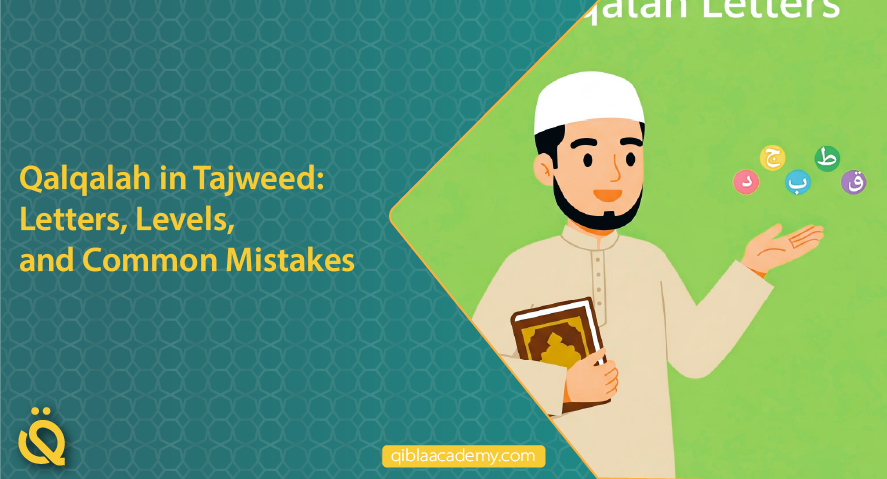
The five Qalqalah letters are:
ق ط ب ج د
They are commonly remembered through:
قطب جد
Beginners often hear Qalqalah described as an “echo.” That description can help, but it may also create a common mistake: turning a sakin consonant into a sound that resembles Fathah, Kasrah, or Dammah.
Qalqalah does not add a new vowel.
It preserves the clarity of the consonant when it is sakin.
For the wider Tajweed system, continue with Learn Quran Tajweed Online: How the Core Tajweed Rules Fit Together.
If the Qalqalah letter itself is difficult to pronounce accurately, review Learn Quran Online With Tajweed: Makharij and Pronunciation Correction first.

What Is Qalqalah in Tajweed?
Qalqalah is the controlled release heard when one of the five Qalqalah letters occurs in a state of Sukoon.
The letters are:
ق ط ب ج د
The practical question is:
Is one of these five letters sakin here?
If yes, the consonant needs its characteristic release.
The sound should remain part of the consonant itself.
It should not become:
- A new syllable
- An invented vowel
- A sudden increase in volume
Think of the process as:
Qalqalah letter → Sukoon → controlled release → continue or stop
What Are the Five Qalqalah Letters in Tajweed?
| Letter | Arabic | Main Beginner Focus |
|---|---|---|
| Qaf | ق | Keep the letter distinct without adding a vowel |
| Ta | ط | Preserve the consonant while controlling the release |
| Ba | ب | Release the consonant clearly |
| Jeem | ج | Avoid turning the release into a vowel |
| Dal | د | Keep the sound controlled, especially when stopping |
The mnemonic:
قطب جد
helps learners remember the group.
However, seeing one of these letters does not automatically mean Qalqalah applies.
The letter must be sakin.
When Does Qalqalah Apply in Tajweed?
Qalqalah applies when one of ق ط ب ج د is sakin.
This can happen in two common situations:
- The letter already carries Sukoon
- The letter becomes sakin because the reader stops on it
A simple recognition process is:
- Find one of ق ط ب ج د.
- Check whether it is sakin.
- Apply a controlled release.
- Continue the phrase or complete the stop naturally.
Do not apply Qalqalah to a normally vowelled letter simply because it belongs to قطب جد.
How Should Qalqalah Sound?
Good Qalqalah keeps the consonant clear without giving it a new vowel.
A sakin دْ should not deliberately become:
دَ
دِ
دُ
The same principle applies to all five Qalqalah letters.
Beginners often overproduce the “echo” and accidentally create another syllable.
Think instead:
Release the consonant clearly, but do not give it a new Harakah.
Listening to accurate Quran recitation is more useful than relying on the English word “echo” alone.
What Are the Levels of Qalqalah in Tajweed?
For beginners, the clearest practical distinction is between:
- Qalqalah during continuous recitation
- A more noticeable Qalqalah when stopping
Some Tajweed curricula distinguish an additional stronger level when stopping on a doubled Qalqalah letter.
Terminology may vary slightly between teaching systems.
The important point is not memorizing labels.
It is understanding how the release becomes more noticeable when the word ends on a Qalqalah letter.
Some curricula distinguish a separate strongest level when stopping on a doubled Qalqalah letter carrying Shaddah. Other curricula include it within the stronger stopping category.
Beginners should follow one teaching system consistently and focus on preserving the consonant without adding a vowel.
Qalqalah Sughra: The Lighter Level
Qalqalah Sughra commonly refers to a Qalqalah letter that is already sakin while recitation continues.
The release is present but remains controlled inside the word.
Sakin Qalqalah letter during continuous recitation → clear but restrained release
Do not make the sound dramatically louder simply to demonstrate the rule.
Qalqalah is a sound characteristic, not a volume effect.
Qalqalah Kubra: The Stronger Level When Stopping
Qalqalah becomes more noticeable when the reader stops on a Qalqalah letter at the end of a word.
Stop on a Qalqalah letter → clearer release → no added vowel
“Stronger” does not mean louder.
The release becomes more apparent because the consonant closes the word.
This matters especially when stopping: the Qalqalah consonant closes the word rather than remaining inside continuous recitation.
Qalqalah Levels at a Glance
| Recitation Situation | Practical Effect | Main Focus |
|---|---|---|
| Sakin Qalqalah letter while continuing | Lighter release | Keep the consonant clear |
| Stopping on a Qalqalah letter | More noticeable release | Preserve clarity without adding a vowel |
| Stopping on a doubled Qalqalah letter | Especially clear in curricula that distinguish this level | Preserve consonant strength and control |
Do not treat the levels as a volume scale.
A stronger Qalqalah is not simply a louder Qalqalah.
Qalqalah vs. a Vowel: What Is the Difference?
This is one of the most important distinctions in the rule.
Qalqalah:
- Releases the sakin consonant
- Keeps the original letter identifiable
- Does not intentionally add Fathah, Kasrah, or Dammah
A vowel:
- Gives the consonant a real Harakah
- Changes the syllable
If بْ begins to sound like بَ, the Qalqalah release has become too vowel-like.
This distinction matters because adding a vowel changes the sound rather than simply releasing the sakin consonant.
How to Practise Qalqalah in Tajweed Correctly
Practise the release before trying to collect many examples.
A useful progression is:
- Memorize ق ط ب ج د.
- Hear each letter in a sakin position.
- Compare a sakin Qalqalah letter with the same letter carrying a vowel.
- Practise the sound inside a Quranic word.
- Return to the complete phrase.
- Compare continuation with stopping.
- Mix unfamiliar examples later.
For example:
دْ → Quranic word → short phrase → stopping example → mixed review
Once the release becomes clear, stop isolating it unnecessarily.
The goal is accurate Qalqalah during normal Quran recitation.
Common Qalqalah Mistakes
1. Adding an Extra Vowel
Qalqalah should not turn a sakin consonant into a new vowelled syllable.
2. Applying Qalqalah Whenever You See One of the Five Letters
The letter must be sakin.
3. Making Every Qalqalah Equally Strong
A stopping Qalqalah may be more noticeable than one during continuous recitation.
4. Making the Release Too Weak
If the characteristic release disappears completely, the consonant may lose clarity.
5. Turning Qalqalah Into a Volume Effect
Qalqalah does not mean suddenly making one letter much louder than the surrounding phrase.
Qalqalah vs. Makharij: What Should You Correct First?
Makharij establishes the letter itself.
Qalqalah describes how one of the five target letters is released when it is sakin.
Makharij: Is the letter itself accurate?
Qalqalah: Is the sakin letter released correctly?
If ق is inaccurate even when it carries a normal vowel, the main problem begins with pronunciation rather than Qalqalah.
For detailed articulation correction, continue with Learn Quran Online With Tajweed: Makharij and Pronunciation Correction.
How Do You Know Your Qalqalah Is Improving?
Look for four signs:
- The consonant remains identifiable
- An extra vowel no longer appears
- The release remains controlled in unfamiliar words
- Less prompting is needed
One accurate isolated دْ or قْ does not prove the skill is stable.
The stronger sign is that Qalqalah remains accurate when you return to Quranic recitation.
For detailed progress measurement, continue with Online Tajweed Classes: How to Measure Your Tajweed Progress.
When Should a Teacher Correct Qalqalah?
Teacher feedback becomes useful when:
- Qalqalah repeatedly turns into a vowel
- The release disappears
- Every example becomes exaggerated
- Stopping examples remain unclear
- Qalqalah is added to vowelled letters
- The sound works in isolation but disappears in Quranic phrases
The teacher should identify whether the problem comes from the original consonant, the release itself, or an added vowel.
For the wider correction process, continue with Tajweed Quran Online: How Live Correction Improves Recitation.
Frequently Asked Questions
1. What Are the Five Qalqalah Letters?
The five Qalqalah letters are:
ق ط ب ج د
They are commonly remembered through:
قطب جد
2. When Does Qalqalah Apply?
Qalqalah applies when one of the five Qalqalah letters is sakin, either because it already carries Sukoon or because the reader stops on it.
3. What Are the Levels of Qalqalah?
A practical beginner distinction is between a lighter Qalqalah during continuous recitation and a more noticeable Qalqalah when stopping.
4. Should Qalqalah Sound Like a Vowel?
No.
Qalqalah releases the consonant without deliberately adding Fathah, Kasrah, or Dammah.
5. Is Qalqalah Stronger When Stopping?
It generally becomes more noticeable when the reader stops on a Qalqalah letter.
The sound should remain controlled rather than becoming louder or turning into an additional vowel.
Conclusion: Qalqalah Should Release the Letter Without Adding a Vowel
Qalqalah in Tajweed applies to five letters:
ق ط ب ج د
when they occur in a sakin condition.
The practical process is:
Find the Qalqalah letter → confirm Sukoon → release the consonant clearly → avoid adding a vowel → return to Quran recitation
The release may be lighter during continuous recitation and more noticeable when stopping.
Do not turn that difference into extra volume or another syllable.
A good Qalqalah keeps the consonant clear while allowing the recitation to remain natural.
Continue Your Tajweed Learning
1. Want to See Where Qalqalah Fits Into the Wider Tajweed System?
Continue with Learn Quran Tajweed Online: How the Core Tajweed Rules Fit Together.
Use this guide to see how Qalqalah fits alongside Noon Sakinah, Meem Sakinah, Ghunnah, Madd, and Waqf.
2. Is the Qalqalah Letter Itself Difficult to Pronounce?
Continue with Learn Quran Online With Tajweed: Makharij and Pronunciation Correction.

This is the better next step when the underlying ق, ط, ب, ج, or د is inaccurate even before Qalqalah is applied.
3. Want to Compare Other Applied Tajweed Sounds?
Continue with Online Tajweed Course: How Madd, Ghunnah, Qalqalah, and Waqf Are Taught.
Use it when you want to understand how Qalqalah compares with other applied sound rules inside a broader Tajweed course.
Prefer to Check Your Qalqalah During Recitation?
Read a short unfamiliar Quranic passage and ask the teacher to check whether your Qalqalah is clear, controlled, and free from an added vowel.