
Ghunnah in Tajweed: When and How the Nasal Sound Applies
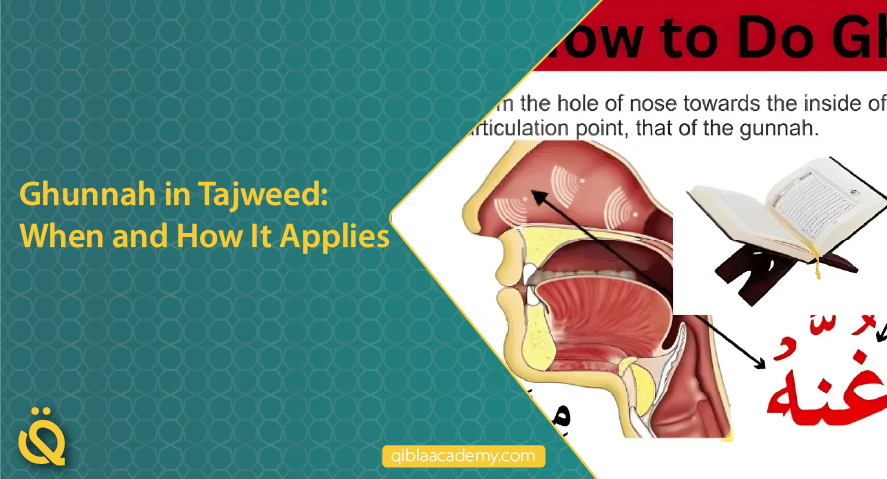
Ghunnah in Tajweed is a controlled nasal quality that appears in specific Quranic recitation patterns involving mainly Noon and Meem.
Beginners usually make one of two errors:
- The nasal sound becomes too weak
- The nasal sound becomes exaggerated
The practical goal is:
Recognize when Ghunnah applies → hear the correct sound → reproduce it → keep it controlled in Quran recitation
Ghunnah is related to Noon and Meem rules, but it is not the same thing as those rule systems.
The rule tells you what interaction is taking place.
Ghunnah describes the nasal quality that appears within that interaction.
For the wider Tajweed system, continue with Learn Quran Tajweed Online: How the Core Tajweed Rules Fit Together.
For the complete Noon system, review Noon Sakinah and Tanween Rules: A Practical Beginner Guide.
For Meem Sakinah, continue with Meem Sakinah Rules: Ikhfa, Idgham, and Izhar Explained.
What Is Ghunnah in Tajweed?
Ghunnah is a controlled nasal sound associated especially with:
ن and م
It resonates through the nasal passage and appears within specific Tajweed patterns.
Ghunnah is:
- Not an extra vowel
- Not a decorative sound
- Not something to stretch for dramatic effect
A better question is:
Does this recitation pattern require Ghunnah, and can I produce it without making it too weak or too strong?
The aim is controlled nasal quality that remains integrated into the Quranic word.
When Does Ghunnah Apply in Tajweed?
Ghunnah appears in several important contexts, including:
- Noon Mushaddadah
- Meem Mushaddadah
- Idgham with Ghunnah
- Ikhfa
- Iqlab
- Ikhfa Shafawi
- Idgham Shafawi
These contexts do not all use Ghunnah in exactly the same way.
The surrounding Tajweed rule determines how the nasal quality appears inside the recitation pattern.
For this guide, the important principle is:
Learn Ghunnah inside the rule and Quranic phrase where it occurs.
Do not treat it as an isolated sound exercise forever.
Ghunnah With Noon and Meem Mushaddadah
Ghunnah is especially clear when Noon or Meem carries Shaddah:
نّ
مّ
The learner should hear a distinct nasal quality while keeping the consonant clear.
Two common errors are:
- Producing the doubled letter strongly but losing the nasal quality
- Holding the Ghunnah so long that it becomes an exaggerated pause
The target is a controlled nasal sound integrated into the word.
How Ghunnah Works With Idgham
In Noon Sakinah and Tanween rules, Idgham with Ghunnah occurs before:
ي ن م و
The Noon or Tanween merges into the following letter while nasal quality remains.
Keep the distinction simple:
Idgham explains the merging.
Ghunnah explains the nasal quality within that merging.
For the full Idgham trigger letters, exceptions, and distinction between Idgham with and without Ghunnah, continue with Noon Sakinah and Tanween Rules: A Practical Beginner Guide.
How Ghunnah Works With Ikhfa
During Ikhfa, the Noon sound is concealed while nasal quality remains.
The learner should avoid two extremes:
- Pronouncing a fully clear Noon
- Removing the nasal quality too much
A useful beginner principle is:
Conceal the full Noon articulation while preserving the required Ghunnah.
The exact sound is easier to learn through listening and correction than through written description alone.
For the complete Ikhfa rule and its fifteen letters, use Noon Sakinah and Tanween Rules: A Practical Beginner Guide.
How Ghunnah Works With Iqlab
Iqlab occurs when Noon Sakinah or Tanween is followed by:
ب
The Noon changes toward a concealed Meem-like sound, and Ghunnah accompanies the transition.
Keep the distinction:
Iqlab determines the transformation.
Ghunnah provides the nasal quality.
For the complete Iqlab rule, continue with Noon Sakinah and Tanween Rules: A Practical Beginner Guide.
How Ghunnah Works With Meem Sakinah
Ghunnah also appears in Meem-related patterns, especially:
- Ikhfa Shafawi
- Idgham Shafawi
With Ikhfa Shafawi, Meem Sakinah is followed by ب.
With Idgham Shafawi, Meem Sakinah is followed by another م.
This article does not need to explain the complete Meem Sakinah system.
For the three Meem Sakinah rules, continue with Meem Sakinah Rules: Ikhfa, Idgham, and Izhar Explained.
How Long Should Ghunnah Be Held?
Ghunnah is commonly taught in beginner Tajweed as approximately two counts in stronger Ghunnah contexts.
However, “two counts” should not become a rigid stopwatch exercise.
The purpose is to develop consistent, controlled timing.
Avoid Ghunnah that is:
- Too short to hear
- Stretched beyond the recitation pattern
- Different every time the same context appears
A teacher may demonstrate the duration through a simple rhythm.
Once the learner can hear and reproduce the target, return to the Quranic phrase rather than continuing to count mechanically.
Ghunnah may sound slightly different according to the surrounding rule and letters, so beginners should follow the recitation context rather than forcing one identical nasal sound everywhere.
How to Practise Ghunnah in Tajweed Correctly
Start with one Ghunnah context at a time.
A practical progression is:
- Hear a clear model.
- Repeat Noon or Meem with Shaddah.
- Practise one Ghunnah context inside a word.
- Read the same sound inside a short Quranic phrase.
- Test a second example.
- Mix different Ghunnah contexts later.
A simple progression might be:
Noon Mushaddadah → short word → Quranic phrase → one Ikhfa or Idgham example → mixed review
Do not practise several unrelated Tajweed rules at the same time when Ghunnah is the target.
Once the nasal quality becomes stable, focus on keeping it natural during continuous recitation.
Your Ghunnah is becoming more stable when:
- The nasal quality is audible
- The surrounding consonants remain accurate
- The sound is not exaggerated
- Similar examples sound reasonably consistent
- You need less prompting
Use this principle:
Ghunnah should support the rule, not overpower the word.
Common Ghunnah Mistakes
1. Treating Every Noon and Meem as Ghunnah
The surrounding Tajweed rule determines whether and how Ghunnah applies.
2. Holding Ghunnah Too Long
An exaggerated nasal sound can distort the recitation pattern.
3. Making Ghunnah Too Short
If the nasal quality disappears, the sound may become incomplete.
4. Turning Ghunnah Into an Extra Vowel
Ghunnah does not create an additional vowel or syllable.
5. Focusing on the Nasal Sound While Losing the Letter
The surrounding letters still need accurate articulation.
Ghunnah vs. Makharij: What Is the Difference?
Makharij concerns where and how Arabic letters are articulated.
Ghunnah concerns nasal quality within specific Tajweed contexts.
A learner may produce Noon or Meem from the correct articulation area but still apply Ghunnah inaccurately.
Likewise, strong Ghunnah does not compensate for weak letter pronunciation.
Use:
Makharij: produce the letter correctly
Ghunnah: apply the required nasal quality correctly
For detailed articulation correction, continue with Learn Quran Online With Tajweed: Makharij and Pronunciation Correction.
When Should a Teacher Correct Ghunnah?
Teacher feedback becomes especially useful when:
- Ghunnah disappears during recitation
- The nasal sound is exaggerated
- The learner cannot distinguish Ghunnah contexts
- The sound changes from one example to another
- Ghunnah is correct alone but disappears in longer passages
The teacher should listen to the actual Quranic phrase, model the target sound, and ask the learner to repeat it in context.
For the wider feedback process, continue with Tajweed Quran Online: How Live Correction Improves Recitation.
Frequently Asked Questions
1. What Is Ghunnah in Tajweed?
Ghunnah is a controlled nasal sound associated especially with Noon and Meem in specific Tajweed contexts.
2. Which Letters Have Ghunnah?
Ghunnah is mainly associated with ن and م, but whether and how it appears depends on the Tajweed pattern.
3. How Long Is Ghunnah Held?
Ghunnah is commonly taught as approximately two counts in stronger Ghunnah contexts.
The timing should remain controlled and consistent rather than mechanically exaggerated.
4. Does Every Noon Have Ghunnah?
No.
The surrounding Tajweed rule determines whether and how Ghunnah applies.
5. Is Ghunnah the Same as Ikhfa?
No.
Ikhfa is a Tajweed rule involving concealment, while Ghunnah is the nasal quality heard within Ikhfa and other relevant patterns.
Conclusion: Keep Ghunnah Controlled and Connected to the Tajweed Rule
Ghunnah in Tajweed is a controlled nasal quality that appears in specific recitation patterns involving mainly Noon and Meem.
Do not treat it as a separate decorative sound.
First identify the Tajweed context.
Then listen to the correct nasal quality, reproduce it, and keep the timing controlled inside the Quranic phrase.
Use this principle:
Identify the rule → hear the Ghunnah → reproduce it → keep it controlled → return to the Quranic phrase
Do not apply the same nasal sound mechanically to every Noon or Meem.
The surrounding rule determines when and how Ghunnah appears.
With repeated listening and corrected recitation, the sound should become more natural without overpowering the word.
Continue Your Tajweed Learning
1. Need the Full Noon Sakinah and Tanween System?
Continue with Noon Sakinah and Tanween Rules: A Practical Beginner Guide.
Use this guide to understand where Idgham, Ikhfa, and Iqlab create Ghunnah-related contexts.
2. Want to Review Meem Sakinah Rules?
Continue with Meem Sakinah Rules: Ikhfa, Idgham, and Izhar Explained.
This is the better next step when you want to understand how Ghunnah connects with Ikhfa Shafawi and Idgham Shafawi.
3. Want the Wider Tajweed Rule System?
Continue with Learn Quran Tajweed Online: How the Core Tajweed Rules Fit Together.
Use it to see where Ghunnah fits alongside Noon Sakinah, Meem Sakinah, Madd, Qalqalah, Waqf, and Makharij.
Prefer to Check Your Ghunnah During Recitation?
Read a short unfamiliar Quranic passage and ask the teacher to check whether your Ghunnah is clear, controlled, and correctly connected to the Tajweed rule.