
Meem Sakinah Rules: Ikhfa, Idgham, and Izhar Explained
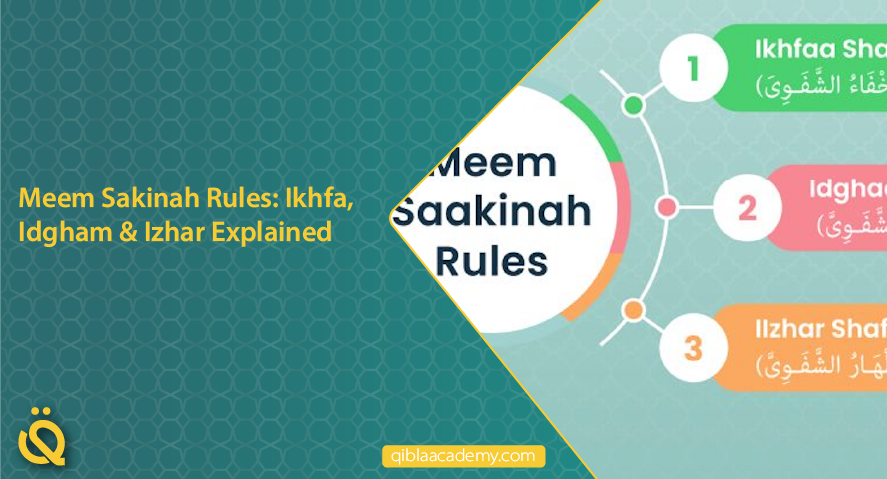
Meem Sakinah rules are easy to organize around one question:
What letter comes immediately after مْ?
The following letter determines the rule:
- ب → Ikhfa Shafawi
- م → Idgham Shafawi
- Any other letter → Izhar Shafawi
The goal is not only to memorize the three names.
A beginner should be able to recognize مْ, check the next letter, and apply the correct sound during Quran recitation.
For the wider Tajweed system, continue with Learn Quran Tajweed Online: How the Core Tajweed Rules Fit Together.
To compare this system with Noon Sakinah and Tanween, review Noon Sakinah and Tanween Rules: A Practical Beginner Guide.
What Is Meem Sakinah in Tajweed?
Meem Sakinah is the letter Meem carrying Sukoon:
مْ
Because Meem is produced with the lips, these rules are described as Shafawi, meaning related to the lips.
The basic reading process is:
Find مْ → check the next pronounced letter → apply Ikhfa, Idgham, or Izhar
Unlike Noon Sakinah and Tanween, Meem Sakinah has only three main outcomes.
That makes the system relatively simple to organize.
What Are the Three Meem Sakinah Rules?
| What Comes After مْ? | Rule | Main Reading Cue |
|---|---|---|
| ب | Ikhfa Shafawi | Conceal the Meem with nasal quality |
| م | Idgham Shafawi | Merge the first Meem into the second |
| Any other letter | Izhar Shafawi | Pronounce the Meem clearly |
Remember:
مْ + ب → Ikhfa
مْ + م → Idgham
مْ + anything else → Izhar
This table is the main decision tool for Meem Sakinah rules.
Ikhfa Shafawi in Meem Sakinah Rules

Ikhfa Shafawi occurs when Meem Sakinah is followed by:
ب
The Meem is concealed rather than pronounced with complete separation.
A controlled nasal quality remains as the lips prepare for Ba.
The pattern is:
مْ → ب → concealed Meem transition
In practice, avoid two extremes:
- Pronouncing the Meem too clearly, like Izhar
- Pressing the lips too strongly and creating an exaggerated extra Meem
The target is a smooth concealed transition into Ba.
For detailed Ghunnah control, continue with Ghunnah in Tajweed: When and How the Nasal Sound Applies.
Idgham Shafawi in Meem Sakinah Rules
Idgham Shafawi occurs when Meem Sakinah is followed by another:
م
The first Meem merges into the second.
The pattern is:
مْ + م → merged Meem
The sound should remain connected rather than becoming two separate Meems with a pause between them.
Nasal quality accompanies the merged sound.
A simple beginner principle is:
Do not release the first Meem as a completely separate sound.
Once this distinction becomes familiar, the merged pattern should begin to sound more natural inside the Quranic phrase.
Izhar Shafawi in Meem Sakinah Rules
Izhar Shafawi applies when Meem Sakinah is followed by any Arabic letter other than:
ب or م
The Meem remains clear before moving to the following letter.
The pattern is:
مْ + any letter except ب or م → clear Meem
Most letters therefore produce Izhar Shafawi.
What matters here is keeping the Meem distinct without adding unnecessary concealment or merging.
Why Are Fa and Waw Important in Izhar Shafawi?
Beginners sometimes need extra attention when Meem Sakinah is followed by:
ف or و
These letters also involve the lips, so the learner may accidentally hide the Meem instead of keeping it clear.
The rule does not change.
It remains Izhar Shafawi.
Use:
مْ + ف → clear Meem
مْ + و → clear Meem
Do not turn these into Ikhfa patterns.
Remember the full system in one line:
Ba means Ikhfa, Meem means Idgham, and every other following letter means Izhar.
How to Identify Meem Sakinah Rules Quickly
Use three steps:
- Find مْ.
- Check the next pronounced letter.
- Apply:
- ب → Ikhfa Shafawi
- م → Idgham Shafawi
- Anything else → Izhar Shafawi
Then read the complete word or phrase.
The purpose is not to stop and name the rule every time.
What matters is recognizing and applying it while Quran recitation continues.
How Is Meem Sakinah Different From Noon Sakinah?
Both rule families depend on the following letter, but they are different systems.
Noon Sakinah and Tanween have four main outcomes:
- Izhar
- Idgham
- Iqlab
- Ikhfa
Meem Sakinah has three:
- Izhar Shafawi
- Idgham Shafawi
- Ikhfa Shafawi
The easiest distinction is:
Noon Sakinah has several trigger groups.
Meem Sakinah has only two special trigger letters: ب and م.
For the full Noon system, continue with Noon Sakinah and Tanween Rules: A Practical Beginner Guide.
How Does Ghunnah Connect With Meem Sakinah Rules?
Ghunnah appears in Meem-related Tajweed contexts, especially in Ikhfa Shafawi and Idgham Shafawi.
However, Ghunnah is not the same as the Meem Sakinah rule.
The rule tells you which interaction is taking place.
Ghunnah describes the nasal quality required in that recitation pattern.
For detailed Ghunnah timing and sound control, continue with Ghunnah in Tajweed: When and How the Nasal Sound Applies.
How to Practise Meem Sakinah Rules
Because there are only three outcomes, Meem Sakinah can be practised in a simple sequence.
Start with:
3 Ikhfa examples → 3 Idgham examples → 3 Izhar examples
Then mix the patterns.
A useful progression is:
- Find مْ.
- Identify the next letter.
- Apply the rule.
- Read the complete Quranic phrase.
- Test the same rule in another example.
- Mix all three patterns later.
Once recognition becomes easier, stop naming the rule before every example.
The sound should gradually become part of normal recitation.
If you know the three rules but still miss them during longer recitation, slow down and train the visual trigger: find مْ, check the next letter, and read the full phrase.
Common Meem Sakinah Mistakes
1. Treating Every Meem Sakinah the Same
The following letter determines the rule.
2. Pronouncing Ikhfa Shafawi Like Izhar
Before ب, the Meem should not remain fully clear.
3. Separating Two Meems During Idgham
When مْ is followed by م, the first Meem merges into the second.
4. Hiding the Meem Before Fa or Waw
The rule remains Izhar Shafawi, so the Meem should stay clear.
5. Adding Too Much Nasal Sound
Ghunnah should remain controlled rather than exaggerated.
When Should a Teacher Correct Meem Sakinah?
Teacher feedback becomes useful when:
- Ikhfa Shafawi sounds fully clear
- Idgham still sounds like two separate Meems
- Izhar becomes hidden before Fa or Waw
- Ghunnah is exaggerated
- The learner knows the rule but loses it in longer recitation
- Accuracy drops when reading faster
The teacher should identify the specific sound problem, model the correction, and ask the learner to apply it again in Quranic context.
For the wider correction process, continue with Tajweed Quran Online: How Live Correction Improves Recitation.
Frequently Asked Questions
1. What Are the Three Rules of Meem Sakinah?
The three rules are Ikhfa Shafawi, Idgham Shafawi, and Izhar Shafawi.
Ikhfa applies before ب, Idgham before م, and Izhar before every other following letter.
2. What Letter Causes Ikhfa Shafawi?
Ikhfa Shafawi occurs when Meem Sakinah is followed by:
ب
3. What Letter Causes Idgham Shafawi?
Idgham Shafawi occurs when Meem Sakinah is followed by another:
م
The first Meem merges into the second.
4. When Does Izhar Shafawi Apply?
Izhar Shafawi applies when Meem Sakinah is followed by any letter other than ب or م.
The Meem should remain clear.
5. Why Do Fa and Waw Need Extra Attention?
Fa and Waw involve nearby lip articulation, which can make some learners accidentally conceal the Meem.
The rule remains Izhar Shafawi, so the Meem should stay clear.
Conclusion: Check the Letter After Meem Sakinah
Meem Sakinah rules are easiest to apply when you organize them around the following letter.
Use:
مْ + ب → Ikhfa Shafawi
مْ + م → Idgham Shafawi
مْ + any other letter → Izhar Shafawi
Do not stop at memorizing those three patterns.
Find the Meem Sakinah, check the following letter, and apply the rule inside the complete Quranic phrase.
At first, recognition may be deliberate.
With practice, the correct sound should appear more quickly without interrupting the flow of recitation.
The goal is not to name the rule.
It is to keep the correct Meem sound while reading Quran.
Continue Your Tajweed Learning
1. Want to Compare Meem Sakinah With Noon Sakinah?
Continue with Noon Sakinah and Tanween Rules: A Practical Beginner Guide.
Use this guide when you want to understand the four Noon/Tanween outcomes and how their trigger letters differ from Meem Sakinah.
2. Need to Understand Ghunnah More Deeply?
Continue with Ghunnah in Tajweed: When and How the Nasal Sound Applies.
This is the better next step when nasal quality, timing, or sound control remains unclear.
3. Want the Wider Tajweed Rule System?
Continue with Learn Quran Tajweed Online: How the Core Tajweed Rules Fit Together.
Use this guide to see where Meem Sakinah fits alongside Noon Sakinah, Madd, Qalqalah, Waqf, and other applied Tajweed rules.
Prefer to Test Meem Sakinah in Your Recitation?
Read a short unfamiliar Quranic passage and see whether you can recognize Ikhfa Shafawi, Idgham Shafawi, and Izhar Shafawi independently.