
Noon Sakinah and Tanween Rules: A Practical Beginner Guide

Noon Sakinah and Tanween rules become easier when you stop treating them as four definitions to memorize and use one practical question instead:
What letter comes immediately after the Noon Sakinah or Tanween?
That following letter determines the rule.
The four outcomes are:
- Izhar — keep the Noon sound clear
- Idgham — merge it into the following letter
- Iqlab — change it toward a concealed Meem-like sound before ب
- Ikhfa — conceal the Noon sound before one of the fifteen Ikhfa letters
The goal is to recognize the pattern while reading Quran and produce the correct sound without stopping to analyse every word.
For the wider rule system, continue with Learn Quran Tajweed Online: How the Core Tajweed Rules Fit Together.
If Arabic letter pronunciation itself is unstable, review Learn Quran Online With Tajweed: Makharij and Pronunciation Correction first.
What Are Noon Sakinah and Tanween in Tajweed?
Noon Sakinah is نْ — Noon carrying Sukoon.
Tanween is the doubled vowel ending that produces an additional “n” sound:
- ـً Fathatain
- ـٍ Kasratain
- ـٌ Dammatain
They appear differently in writing, but the rule is usually identified in the same practical way:
Find the Noon sound → look at the next pronounced letter → apply the correct Tajweed rule
This is why Noon Sakinah and Tanween are normally studied together.
What Are the Four Noon Sakinah and Tanween Rules?
| Rule | What Happens? | Main Trigger |
|---|---|---|
| Izhar | Noon sound remains clear | 6 throat letters |
| Idgham | Noon/Tanween merges into the next letter | 6 Idgham letters |
| Iqlab | Noon sound changes toward a concealed Meem-like sound | ب |
| Ikhfa | Noon sound is concealed | 15 Ikhfa letters |
Use the written pattern first:
Find Noon Sakinah or Tanween → check the next letter → identify the rule → recite it
This table gives the overview. The following sections explain the four patterns.
Izhar in Noon Sakinah and Tanween Rules
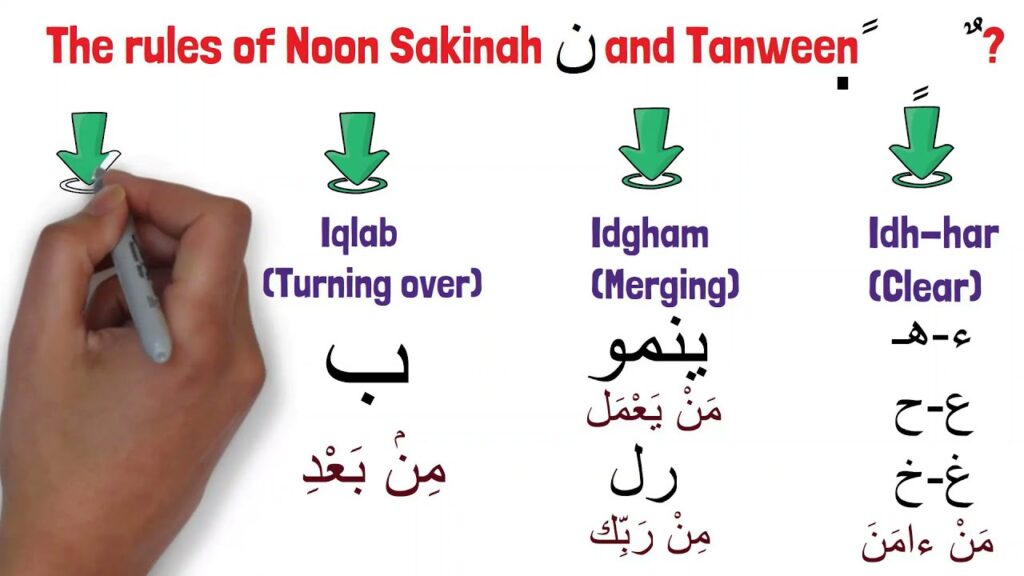
Izhar means clarity.
It applies when Noon Sakinah or Tanween is followed by one of these six throat letters:
ء ه ع ح غ خ
The pattern is:
Noon Sakinah / Tanween → throat letter → clear Noon sound
The Noon should remain distinct before moving to the following letter.
Do not exaggerate it or add unnecessary nasal quality.
Common Izhar Mistake
A beginner may conceal the Noon because they are used to Ikhfa examples.
Finish the Noon clearly, then move to the throat letter.
Do not merge the two sounds.
Idgham in Noon Sakinah and Tanween Rules
Idgham means merging.
It occurs when Noon Sakinah or Tanween is followed by one of six letters:
ي ر م ل و ن
They are commonly remembered through:
يرملون
Idgham has two practical forms.
Idgham With Ghunnah
The letters are:
ي ن م و
The Noon or Tanween merges into the following letter while nasal quality remains.
Do not pronounce a complete separate Noon before beginning the next letter.
For detailed Ghunnah application, continue with Ghunnah in Tajweed: When and How the Nasal Sound Applies.
Idgham Without Ghunnah
The letters are:
ل ر
The sound merges without the same Ghunnah treatment used with ي ن م و.
Avoid preserving a strong separate Noon before Lam or Ra.
Important Idgham Exception
The standard Idgham pattern normally occurs between two words.
In several Quranic words, Noon Sakinah is followed by ي or و inside the same word, including:
- الدُّنْيَا
- بُنْيَان
- صِنْوَان
- قِنْوَان
The Noon is not merged in the normal Idgham manner.
This is commonly called Izhar Mutlaq.
For beginners, remember:
Do not merge every نْ followed by ي or و without checking whether the letters occur inside the same word.
Iqlab: The Noon Sakinah Rule Before Ba
Iqlab occurs when Noon Sakinah or Tanween is followed by:
ب
It is the only following letter that triggers Iqlab.
The Noon sound changes toward a concealed Meem-like sound with nasal quality before Ba.
Use:
Noon Sakinah / Tanween → ب → concealed Meem-like transition
Do not pronounce a fully separate Noon.
Do not add a heavy extra Meem before Ba.
How to Recognize Iqlab in the Mushaf
Some printed Mushafs show a small م near Noon Sakinah or Tanween as a visual indication.
Use the symbol as a recognition aid, but remember the actual reason for the rule:
The following letter is ب.
Ikhfa in Noon Sakinah and Tanween Rules
Ikhfa means concealment.
It occurs when Noon Sakinah or Tanween is followed by one of fifteen letters:
ت ث ج د ذ ز س ش ص ض ط ظ ف ق ك
Ikhfa sits between clear pronunciation and full merging.
The Noon is not pronounced as clearly as Izhar, but it is not merged in the same way as Idgham.
A practical beginner description is:
Preserve the nasal quality while concealing the full Noon articulation before moving to the following letter.
Do not turn this section into a complete Ghunnah explanation.
That belongs to the dedicated Ghunnah article.
How Is Ikhfa Different From Idgham?
The difference is easiest to understand as a spectrum:
Izhar: clear Noon
Ikhfa: concealed Noon
Idgham: merged Noon
Iqlab is different because the Noon changes toward a concealed Meem-like sound before ب.
This contrast is enough for the current article.
Detailed Ghunnah control belongs in the dedicated Ghunnah guide.
How to Identify the Correct Noon Sakinah or Tanween Rule
Use three steps:
- Find نْ or Tanween.
- Identify the next pronounced letter.
- Match that letter to Izhar, Idgham, Iqlab, or Ikhfa.
Then recite the complete word or phrase.
Do not stop at naming the rule.
The real skill is applying it during Quran recitation.
Noon Sakinah and Tanween Rule Decision Table
| What Comes Next? | Rule | Reading Cue |
|---|---|---|
| ء ه ع ح غ خ | Izhar | Keep the Noon clear |
| ي ن م و | Idgham with Ghunnah | Merge with nasal quality |
| ل ر | Idgham without Ghunnah | Merge without the same Ghunnah treatment |
| ب | Iqlab | Change toward a concealed Meem-like sound |
| ت ث ج د ذ ز س ش ص ض ط ظ ف ق ك | Ikhfa | Conceal the Noon sound |
Use the table as a recognition aid.
The long-term goal is to recognize the pattern during Quran reading without mentally reciting the complete letter list every time.
How to Practise Noon Sakinah and Tanween Rules
Practise one rule family at a time before mixing all four.
A simple progression is:
- Recognize the trigger letters.
- Hear several correct examples.
- Read prepared words.
- Apply the rule in a short Quranic phrase.
- Test the same rule in an unfamiliar example.
- Mix the rule families after recognition becomes stable.
For example:
3 Izhar examples → 3 Idgham examples → one short phrase → mixed review
The aim is to move from knowing which rule is being practised to identifying it independently during Quran reading.
If you know the rule names but still choose the wrong one during recitation, practise the visual trigger: identify the Tanween or Noon Sakinah, check the next letter, and then read the complete phrase.
During natural recitation, the learner should gradually move from consciously naming the rule to recognizing and applying the pattern without interrupting the Quranic flow.
Accuracy should become stable before speed increases.
Common Noon Sakinah and Tanween Mistakes
1. Looking Only at the Noon
The following letter determines the rule.
2. Treating Every Rule as Ghunnah
The four rule families do not use nasal quality in exactly the same way.
3. Pronouncing Ikhfa Like Izhar
A completely clear Noon removes the concealment.
4. Turning Iqlab Into a Full Extra Meem
The Meem-like quality remains part of the transition into Ba.
5. Memorizing Trigger Letters Without Quran Recitation
Letter lists support recognition, but the rule must work inside real Quranic phrases.
How Do Noon Sakinah and Tanween Rules Connect With Ghunnah?
Ghunnah appears in several situations involving Noon and Meem, but Ghunnah and the four Noon Sakinah and Tanween rules are not the same topic.
The rule tells you what interaction is taking place.
Ghunnah describes the nasal quality required in particular recitation situations.
For detailed Ghunnah application, timing, and correction, continue with Ghunnah in Tajweed: When and How the Nasal Sound Applies.
When Should a Teacher Correct Noon Sakinah and Tanween?
Teacher feedback becomes useful when:
- You recognize the rule but produce it inaccurately
- Izhar and Ikhfa sound too similar
- Idgham still contains a strong separate Noon
- Iqlab becomes an exaggerated Meem
- Ghunnah is inconsistent
- The rule disappears during longer passages
The teacher should identify the specific sound problem, model the correction, and ask you to apply it again in context.
For the wider correction process, continue with Tajweed Quran Online: How Live Correction Improves Recitation.
Frequently Asked Questions
1. What Are the Four Rules of Noon Sakinah and Tanween?
The four main rules are Izhar, Idgham, Iqlab, and Ikhfa. The following letter determines which rule applies.
2. What Are the Izhar Letters?
The six Izhar letters are:
ء ه ع ح غ خ
When one follows Noon Sakinah or Tanween, the Noon sound is pronounced clearly.
3. What Are the Idgham Letters?
The six Idgham letters are:
ي ر م ل و ن
They are often remembered through the word:
يرملون
4. What Letter Causes Iqlab?
Iqlab occurs when Noon Sakinah or Tanween is followed by:
ب
The Noon sound changes toward a concealed Meem-like pronunciation before Ba.
5. What Are the Ikhfa Letters?
The fifteen Ikhfa letters are:
ت ث ج د ذ ز س ش ص ض ط ظ ف ق ك
When one follows Noon Sakinah or Tanween, the Noon sound is concealed rather than pronounced fully clearly or completely merged.
Conclusion: Apply Noon Sakinah and Tanween Rules by Checking the Next Letter
Noon Sakinah and Tanween rules become easier when you organize them around one decision:
What letter comes next?
Use Izhar before the six throat letters.
Use Idgham before ي ر م ل و ن, with the correct Ghunnah distinction.
Use Iqlab before ب.
Use Ikhfa before the fifteen concealment letters.
Do not stop at memorizing the groups.
Find the Noon Sakinah or Tanween, check the following letter, identify the rule, and apply it inside the complete Quranic phrase.
At first, this process may be deliberate.
With repeated Quran reading and focused practice, recognition should gradually become quicker and more natural.
The final goal is not to pause and name every rule.
It is to recognize the pattern and apply it accurately while continuing the recitation.
Continue Your Tajweed Learning
Need to Understand How These Rules Fit Into the Wider Tajweed System?
Continue with Learn Quran Tajweed Online: How the Core Tajweed Rules Fit Together.
Want to Understand Ghunnah More Deeply?
Continue with Ghunnah in Tajweed: When and How the Nasal Sound Applies.
Need Help Applying the Rules During Live Recitation?
Continue with Tajweed Quran Online: How Live Correction Improves Recitation.
Prefer to Test the Four Rules in Your Own Recitation?
Read a short unfamiliar Quranic passage and see which Noon Sakinah or Tanween patterns you recognize independently.