Tafkheem and Tarqeeq in Tajweed: Heavy and Light Sounds Explained
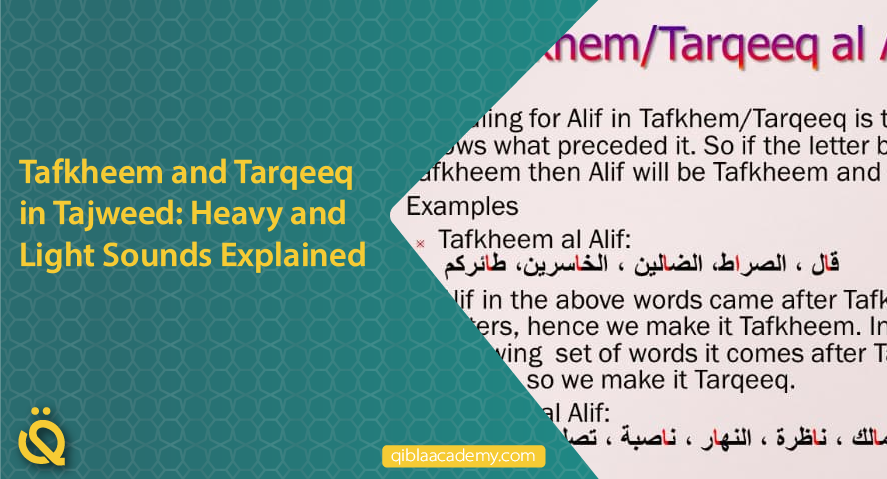
Tafkheem and Tarqeeq in Tajweed control whether a Quranic sound should be pronounced with a heavy or light quality.
A learner may pronounce the correct Arabic letter but still give it the wrong sound quality.
A heavy letter may become too light, while a light sound may become unnecessarily heavy.
The practical goal is:
Identify the letter → recognize whether heaviness or lightness applies → hear the contrast → preserve it in Quran recitation
For the wider Tajweed system, continue with Learn Quran Tajweed Online: How the Core Tajweed Rules Fit Together.
If the letter itself is difficult to articulate accurately, review Learn Quran Online With Tajweed: Makharij and Pronunciation Correction first.
What Are Tafkheem and Tarqeeq in Tajweed?
Tafkheem refers to heaviness or fullness in the sound quality of particular Arabic letters.
Tarqeeq refers to lightness or thinness.
This distinction is not about volume.
A heavy letter does not need to be louder.
Tafkheem → heavy sound quality
Tarqeeq → light sound quality
The first step is learning which letters are consistently heavy and which cases depend on context.
What Are the Tafkheem Letters in Tajweed?
| Letter | Arabic | Beginner Focus |
|---|---|---|
| Kha | خ | Preserve heaviness without exaggeration |
| Sad | ص | Keep it distinct from س |
| Dad | ض | Maintain its heavy quality |
| Ghayn | غ | Avoid making the sound too light |
| Ta | ط | Keep it distinct from ت |
| Qaf | ق | Preserve its heavy quality |
| Za | ظ | Keep it distinct from lighter alternatives |
The seven consistently heavy letters are:
خ ص ض غ ط ق ظ
They are commonly remembered through:
خص ضغط قظ
Memorizing the letters helps.
The more important skill is hearing when one of them becomes too light during real Quran recitation.
What Are the Tarqeeq Letters in Tajweed?
Most Arabic letters are generally pronounced with Tarqeeq rather than the permanent heaviness of the seven Tafkheem letters.
However, beginners should not assume that every non-heavy letter is always light in every context.
Two important context-dependent cases are:
- Ra (ر)
- The Lam in Allah (ل in الله)
A practical beginner framework is:
- Consistently heavy letters
- Generally light letters
- Context-dependent letters
This is enough for the current guide.
Why Does Tafkheem Not Mean “Pronounce the Letter Louder”?
Tafkheem changes the quality of the sound, not its volume.
If a learner tries to create heaviness by speaking louder, the recitation can become forced.
Compare heavy and light pairs such as:
ص / س
ط / ت
ق / ك
The purpose is not to teach their full Makharij.
It is to hear that the heavy letter has a different sound quality even when both are recited at the same volume.
When Is Ra Heavy or Light in Tajweed?
Ra (ر) can receive Tafkheem in some contexts and Tarqeeq in others.
A simple beginner distinction is:
- Ra with Fathah or Dammah is commonly heavy
- Ra with Kasrah is commonly light
Additional cases and exceptions exist.
Do not try to memorize every Ra exception at this stage.
Use the written context and a reliable teacher model before moving into more advanced Ra rules.
When Is the Lam in Allah Heavy or Light?
The Lam in:
الله
changes according to the vowel immediately before the name of Allah.
A practical beginner rule is:
- After Fathah or Dammah → Tafkheem
- After Kasrah → Tarqeeq
This applies specifically to the Lam in the name of Allah.
Do not generalize the rule to every Arabic Lam.
Heavy and Light Sounds at a Glance
| Situation | Sound Quality | Beginner Cue |
|---|---|---|
| خ ص ض غ ط ق ظ | Heavy | Preserve Tafkheem |
| Most other letters | Generally light | Avoid unnecessary heaviness |
| ر | Context-dependent | Check the vowel and context |
| Lam in الله | Context-dependent | Check the preceding vowel |
This is a beginner recognition tool, not a complete list of every advanced exception.
How to Practise Tafkheem and Tarqeeq in Tajweed Correctly
Comparison is especially useful because Tafkheem and Tarqeeq are sound qualities.
Start with a contrasting pair, such as:
ص / س
Then use this progression:
- Hear the heavy letter.
- Hear the lighter comparison.
- Repeat both slowly.
- Place the target letter inside a Quranic word.
- Read the complete phrase.
- Check whether the heavy or light quality remains.
- Test another unfamiliar example.
The same process can be used with:
ط / ت
ق / ك
Once the contrast becomes clear, avoid exaggerating it.
The final sound should remain natural in Quran recitation.
Common Tafkheem and Tarqeeq Mistakes
1. Making Heavy Letters Too Light
A heavy letter may begin sounding too close to its lighter counterpart.
2. Making Light Letters Heavy
Nearby heavy sounds can sometimes affect light letters unnecessarily.
3. Using Volume to Create Tafkheem
Heaviness is not loudness.
4. Treating Every Ra the Same
Ra can be heavy or light depending on context.
5. Treating Every Lam Like the Lam in Allah
The special heavy/light treatment here applies specifically to the Lam in الله.
Tafkheem vs. Makharij: What Is the Difference?
These concepts are related but not identical.
Makharij concerns how and where the Arabic letter itself is articulated.
Tafkheem and Tarqeeq concern the heavy or light quality of pronunciation.
A learner may articulate ص but still make it sound too close to س because its heavy quality is weak.
Makharij: Is the letter itself accurate?
Tafkheem/Tarqeeq: Does it have the correct sound quality?
For detailed articulation correction, continue with Learn Quran Online With Tajweed: Makharij and Pronunciation Correction.

How Do You Know Heavy and Light Pronunciation Is Improving?
Look for four signs:
- Heavy letters remain distinct
- Light letters are not unnecessarily darkened
- Ra and Lam change more accurately according to context
- Less teacher prompting is needed
Do not judge progress by how dramatic the heavy sound becomes.
Better control usually sounds more natural, not more exaggerated.
When Should a Teacher Correct Tafkheem and Tarqeeq?
Teacher feedback becomes useful when:
- ص repeatedly sounds close to س
- ط loses its heavy quality
- ق becomes too close to ك
- Light letters become unnecessarily heavy
- Ra is treated the same in every context
- The Lam in Allah is applied inconsistently
The teacher should identify whether the problem comes from the letter itself or its heavy/light quality.
For the wider correction process, continue with Tajweed Quran Online: How Live Correction Improves Recitation.
Frequently Asked Questions
1. What Is Tafkheem in Tajweed?
Tafkheem is the heavy or full sound quality used with particular Arabic letters and in specific recitation contexts.
2. What Is Tarqeeq in Tajweed?
Tarqeeq is the light or thin sound quality used with letters that do not require Tafkheem in the relevant context.
3. What Are the Seven Heavy Letters in Tajweed?
The seven consistently heavy letters are:
خ ص ض غ ط ق ظ
They are commonly remembered through:
خص ضغط قظ
4. Is Ra Always Heavy in Tajweed?
No.
Ra can be heavy or light depending on its vowel and surrounding context.
5. Is the Lam in Allah Always Heavy?
No.
The Lam in الله is generally heavy after Fathah or Dammah and light after Kasrah.
5. Is the Lam in Allah Always Heavy?
No.
The Lam in الله is generally heavy after Fathah or Dammah and light after Kasrah.
Conclusion: Keep Tafkheem and Tarqeeq Controlled
Tafkheem and Tarqeeq in Tajweed help preserve the correct heavy or light sound quality of Quranic letters.
Begin with the seven consistently heavy letters:
خ ص ض غ ط ق ظ
Then learn the main context-dependent cases, especially Ra and the Lam in Allah.
Remember:
Heavy does not mean louder.
Light does not mean weak.
The aim is accurate sound quality.
Listen to the contrast, practise it inside Quranic words, and preserve it during normal recitation without exaggeration.
Continue Your Tajweed Learning
1. Want to See Where Heavy and Light Sounds Fit Into the Wider Tajweed System?
Continue with Learn Quran Tajweed Online: How the Core Tajweed Rules Fit Together.
Use this guide to see how Tafkheem and Tarqeeq fit alongside Madd, Ghunnah, Qalqalah, Noon Sakinah, and Waqf.
2. Is the Underlying Letter Difficult to Pronounce?
Continue with Learn Quran Online With Tajweed: Makharij and Pronunciation Correction.
This is the better next step when the letter itself is inaccurate before heaviness or lightness is considered.
3. Need Help Applying Heavy and Light Sounds During Recitation?
Continue with Tajweed Quran Online: How Live Correction Improves Recitation.
Use this guide when you know the rule but the sound still changes during real Quran reading.
Prefer to Check Your Heavy and Light Sounds?
Read a short unfamiliar Quranic passage and ask the teacher to check whether your Tafkheem and Tarqeeq remain clear, controlled, and natural.